

Why Foam Filled Fenders Are Ideal for Ports & Dock Protection
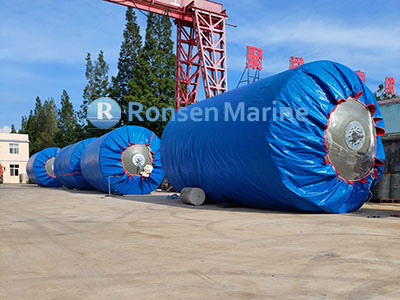
Foam Filled Fenders
If your port handles bulk carriers, tankers, container feeders, OSVs, or cruise vessels, the question is no longer “Do we need fenders?”—it’s “Which fender protects the quay, the hull, and the maintenance budget at the same time?”
For many commercial berths, the answer is foam filled fenders.
A foam filled fender uses a closed-cell EVA or PE foam core inside a polyurethane / polyurea elastomer skin, often with nylon reinforcement and an optional rope/chain/net system. There is no air chamber, so there is no sudden deflation, no pressure check, and no “flat fender” emergency during berthing.
That single design difference is why ports increasingly specify foam filled fenders for dock protection, pile dolphins, floating berths, and high-traffic terminals.
1. The Core Reason: Energy Absorption Without Surprise Failure
When a vessel berths, its kinetic energy must be absorbed safely:
Berthing energy ≈ ½ × displacement × approach velocity² × eccentricity / added-mass / berth coefficients
(PIANC WG 211 method)
Two numbers matter:
- Energy absorption (EA) — kJ or kNm the fender can absorb
- Reaction force (R) — kN pushed back into hull and quay
Foam filled fenders give a high EA/R ratio because the closed-cell foam compresses progressively. The fender absorbs impact energy through foam deformation instead of relying on sealed air pressure.
Practical result for ports:
- Large vessels are cushioned during approach
- Quay walls see lower peak reaction force
- Hull plating is less likely to dent or buckle
Performance does not collapse after a minor surface cut
As one supplier comparison puts it: foam fenders offer “near-zero maintenance” and “no puncture loss,” while pneumatic fenders need pressure checks and repair after breaches.
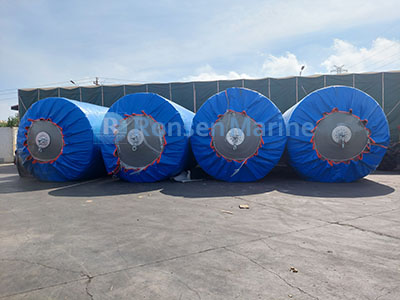
Foam Fenders
2. Unsinkable = Less Downtime for the Terminal
Pneumatic fenders can puncture. Rubber fenders can crack. Foam filled fenders can be abraded—but they usually keep working.
Because the core is closed-cell:
- Water does not flood the core
- Buoyancy remains after skin damage
- The fender stays in service until scheduled repair
- No vessel berthing is stopped because “the fender went flat”
For a busy terminal, downtime is often more expensive than the fender itself. Foam filled fenders reduce one of the most common failure modes in floating berthing: sudden loss of cushioning.
In port economics, “still berthing” beats “cheaper to buy.”
3. High Energy Absorption for Large Vessels
Modern ports are not docking 500-ton coasters only. They handle:
- 10,000–100,000 DWT bulk carriers
- Product and crude tankers
- Container feeders
- Cruise vessels
- Offshore support vessels
- Ro-Ro and ferry streams with tidal movement
A 2.0 m × 3.5 m class foam fender can absorb in the range of 100–500 kNm, depending on foam density, length, and skin/system design. Larger units go much higher.
Foam filled fenders are especially strong where:
- Vessel size varies widely
- Approach energy is high
- Berth face is long and exposed
- Crew cannot inspect fenders every shift
- Debris, tyres, barges, or construction equipment abuse the berth
4. Lower Reaction Force Protects Old Quay Walls
Many ports are not building new concrete. They are protecting existing wharf structures that were never designed for today’s vessel sizes.
Foam filled fenders help because they:
- Compress progressively
- Avoid sharp reaction-force spikes
- Spread load over a larger contact zone
- Reduce shock transfer to bolts, brackets, and pile caps
For older jetties, timber-faced wharves, sheet-pile walls, and marginal quays, this matters. You are not just protecting the ship—you are extending the life of the dock.
High-performance floating fenders often achieve EA/R ratios around 35–45 kJ/kN, while basic fixed rubber fenders may sit nearer 15–25 kJ/kN.
5. Tidal Berths: Foam Fenders Float With the Water
Fixed rubber fenders stay where you bolt them. Foam filled fenders can be:
- Chain-suspended from the dock face
- Rope/tether floated
- Mounted on dolphins
- Used as free-floating buffers for temporary or offshore berthing
So when tide rises and falls, the fender does not “miss” the hull.
This makes foam filled fenders ideal for:
- Open-pile jetties
- Ferry terminals
- Fishing harbors
- River ports with large tidal range
- Offshore wind SOV berthing
- Navy/OSV boat landings
6. Maintenance: The Hidden Port Cost Saver
Pneumatic fender ownership includes:
- Pressure checks
- Valve inspections
- Spare units
- Patch/repair labor
- Removal if deflated
Foam filled fender ownership includes:
- Visual inspection
- Skin repair if cut
- Chain/rope/net check
- Re-coating in severe cases
Over 8–10 years, foam fenders often win on total cost of ownership not because they are cheapest to buy, but because they are hardest to disable.
Typical service life in normal port conditions: 10–15 years with basic inspection.
7. Foam Filled Fender vs Pneumatic Fender vs Rubber Fender
| Factor | Foam Filled | Pneumatic | Solid Rubber |
| Deflation risk | None | Yes | N/A |
| Maintenance | Very low | Medium-high | Low |
| Energy absorption | High | High | Medium |
| Reaction force | Low-moderate | Very low | Higher |
| Best for | Fixed/harsh/dirty/berths | STS, temporary, low hull pressure | Quay-face fixed systems |
| Upfront cost | Higher | Medium | Lower-medium |
| Cyclic swell use | Use with care | Better | Good if designed |
Source synthesis from supplier/engineering comparisons.
Rule of thumb:
Pneumatic = portable and low reaction. Foam = abuse-tolerant and maintenance-light. Rubber = fixed quay workhorse.
8. Where Foam Filled Fenders Are the Best Dock-Protection Choice
Specify foam filled fenders when you have:
- High berthing frequency
- Mixed vessel sizes
- Debris, tyres, barges, or workboats
- Unmanned or low-staff terminals
- Tidal range that defeats fixed fenders
- Old quay structure with low allowable reaction force
- Offshore/pile/dolphin protection
- Cruise/ferry pontoon contact points
Do not treat foam fenders as automatic for permanently moored vessels in constant swell—under continuous cyclic load, foam can creep and recover slower than air. Trelleborg notes foam fenders are not recommended for permanently moored/cyclic conditions without proper analysis.
Good engineering still wins over marketing.
9. How to Size Foam Filled Fenders Correctly
Do not size by diameter alone. Size by:
- Vessel displacement / DWT
- Approach velocity
- Berth type
- Tidal range
- Allowable hull pressure
- Quay reaction limit
- Angle of impact
- Current/wind/added mass
Use the PIANC berthing energy model:
E = ½ × M × V² × Ce × Cm × Cs × Cc
Then match the fender’s EA at rated deflection and check reaction force against both hull panel strength and wharf structure.
A 2.0 m diameter foam fender commonly covers 100–500 kNm, but the curve—not the photo—is what matters.
10. Buying Checklist for Port Procurement
Ask suppliers:
- Closed-cell EVA or PE? Density?
- PU or polyurea skin? Shore hardness?
- Nylon filament reinforcement?
- Net type: netless / rope net / chain + tyre?
- Compression test report at 60% deflection?
- PIANC-based energy/reaction curve?
- ISO 9001 / CCS / BV / ABS documentation?
- Repair method for skin cut?
- Buoyancy after skin damage?
- Expected service life in your environment?
If a supplier only sends a price list and a diameter table, that is a red flag.
FAQ
Are foam filled fenders better than pneumatic fenders?
Not universally. Foam wins for maintenance-light, debris-heavy, fixed/floating dock use. Pneumatic wins for ship-to-ship transfer and very low reaction force.
Do foam fenders sink if damaged?
No. Closed-cell foam stays buoyant even if the skin is cut.
What is the lifespan of a foam filled fender?
Usually 10–15 years in typical port service with inspection and minor repair.
Can foam fenders handle large tankers?
Yes, if sized by berthing energy—not by “2 meter looks big enough.”
Are they good for old ports?
Often yes. Lower peak reaction force helps protect aging quay walls.
Final Verdict
Foam filled fenders are ideal for ports and dock protection because they combine three things procurement teams care about:
- Engineering safety — high energy absorption, manageable reaction force
- Operational reliability — no deflation, no daily pressure checks
- Lifecycle economy — fewer failures, fewer spares, longer service life
They are not the cheapest fender on the quote sheet. But for many commercial berths, they are the lowest-risk fender over 10 years.
