

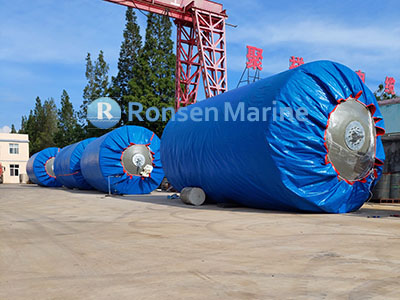
Foam Filled Fenders
Foam Filled Fenders for Port & Dock Protection
Foam filled fenders are high-performance marine fenders and floating fenders designed for ships mooring, berthing, dock protection and ship-to-ship operations. They utilize pure polyurea technology combined with a robust closed-cell EVA/PE foam core. This unique construction ensures they remain buoyant and stable on water without requiring inflation, making them ideal for ports, terminals, offshore projects, lightweight vessels and sensitive marine environments.
Advanced Construction & Materials
The superior performance of foam filled fenders comes from their advanced multi-layer construction:
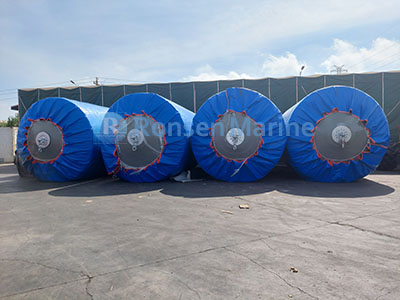
Foam Filled Fenders
- Core: High density closed-cell EVA/PE foam provides permanent buoyancy and high energy absorption.
- Skin: Sprayed pure polyurea polyurethane elastomer (PU) offers exceptional resistance to abrasion, UV rays, Oil and seawater.
- Reinforcement: Embedded tough nylon layers add structural integrity and prevent deformation under heavy loads
- Finish: Available in netless or sling types, often featuring customized colorful polyurea skins for high visibility.
“Tired of punctured pneumatic fenders that require constant maintenance? Foam filled fenders offer zero-inflation, zero-puncture, always-ready protection for your vessels and docks.”
Key Advantages of Foam Filled Fenders
Zero maintenance: No need for inflation, pressure checks, or puncture repairs.
Low Hull Pressure: Gentle on vessel hulls, perfect for yachts, barges, and lightweight ships.
High Durability: Resistant to harsh weather, chemicals, and mechanical damage.
Versatile Use: Widely applied in shipyards, offshore platforms, construction sites, and marine salvage operations.
“Unlike pneumatic fenders that risk punctures, our closed-cell fenders EVA foam fenders offer maintenance-free protection, making them ideal for high-traffic docks and sensitive environments.”
Foam Filled Fenders Classification
Netless(Guard) Foam Fender – sling type, polyurea skin, lighest, STS/yacht/cruise
They offer significantly reduced weight compared to netted cushion foam fenders. Foam fenders are used for STS docking, STQ berthing in ships and marine industry as a protection warning foam fender system.
Netted (Cushion) Foam Fender – tyre-net, heavy berths/container terminals
Netted polyurethane skin can protect foam fender bodies from external sharp scratches like steel constructions. It has a higher energy absorption performed in a better solutions among the buoyancy floats.
Floating Foam Fenders
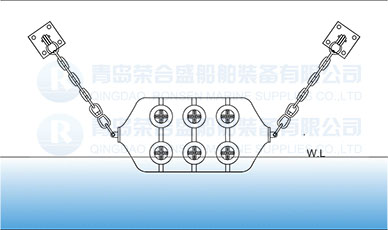
Donut/Pile Foam Fender – rides tide, turning dolphin
Donut foam fenders are more ideal for large tidal wings area. It is designed to protect corners while vessels are ready to dock or playing as a turning dolphin. Foam donut fenders perform as good as guard foam fenders but different design.
Shipboard Portable Foam Fender – 0.3-1.5m, fibre rope sling, navy/quick response
Their range from 0.3 m in diameter to 1.5 m etc. Normally, Portable foam fenders are installed by fibre ropes at two sides of ships. Shipboard fenders can be equipped with fibres nets outside also.
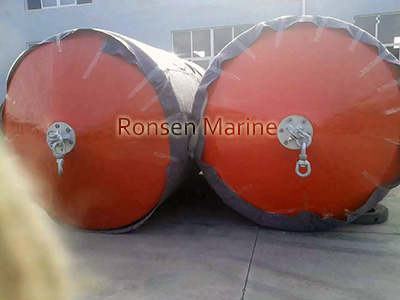
Foam Filled Fender Netless Type
Rubber-Coated Foam Fender – Vulcanized rubber outer, hardest construction sites
It has same appearance, shapes as guard foam filled fenders and cushion netted foam fender. The difference is it’s coated with rubber outer skin. Floating foam rubber fenders are the best proven choice of fendering systems for heavy construction marine field especially in hardest conditions.
Technical Specification & Performance Table
We manufacture foam fenders as per PIANC standard and industry standard. Foam filled fenders can be tested by BV, ABS, SGS, Lioyds and CCS.
| Vessel DWT | Size D x L (m) | Energy@60% (KJ) | Reaction (kN) | Type |
| ≤5,000 | 1.0 x 1.5 | 80 | 420 | Netless |
| 5,000-20,000 | 1.5 x 3.0 | 210 | 680 | Netted |
| 20,000-80,000 | 2.5 x 4.0 | 580 | 980 | Netted |
| STS/Offshore | 3.3 x 6.5 | 1,250 | 1,650 | Netless |
| Diameter x Length | Standard Capacity Foam Filled Fenders | ||||
| Metric | English | Energy Absorption at 60% Compression | Reaction Force at 60% Compression | ||
| (mm) | (ft) | (ft-kips) | (ton-m) | (kip) | (ton) |
| 700 x 1500 | 2.3 x 4.9 | 19 | 3 | 30 | 13 |
| 1000 x 1500 | 3.3 x 4.9 | 35 | 5 | 39 | 17 |
| 1000 x 2000 | 3.3 x 6.5 | 50 | 7 | 57 | 26 |
| 1200 x 2000 | 3.9 x 6.5 | 67 | 10 | 63 | 28 |
| 1350 x 2500 | 4.4 x 8.2 | 112 | 16 | 94 | 42 |
| 1500 x 3000 | 4.9 x 9.8 | 171 | 24 | 130 | 59 |
| 1700 x 3000 | 5.6 x 9.8 | 208 | 29 | 139 | 63 |
| 2000 x 3500 | 6.5 x 11.5 | 335 | 47 | 190 | 86 |
| 2000 x 4000 | 6.5 x 13.1 | 398 | 56 | 226 | 102 |
| 2000 x 4500 | 6.5 x 14.7 | 460 | 64 | 261 | 118 |
| 2500 x 4000 | 8.2 x 13.1 | 591 | 82 | 269 | 122 |
| 2500 x 5500 | 8.2 x 18.0 | 885 | 123 | 402 | 182 |
| 3000 x 6000 | 9.8 x 19.7 | 1365 | 189 | 516 | 234 |
| 3300 x 4500 | 10.8 x 14.7 | 1105 | 153 | 380 | 172 |
| 3300 x 6500 | 10.8 x 21.4 | 1786 | 248 | 614 | 279 |
Foam Filled Fenders vs. Pneumatic Fenders
Buyers often compare these two floating fender types. Here is how they stack up:
| Feature | Foam Filled Fender | Pneumatic (Yokohama) Fender |
|---|---|---|
| Buoyancy | Unsinkable(Watertight core) | Floats(Risk of sinking if ruptured) |
| Maintenance | Zero (Maintenance-cree) | Requires regular pressure checks |
| Damage Response | Puncture does not effect performance | Requires immediate repair |
| Weight | 60%-70% lighter than steel alternatives | Moderate weight |
“Unlike pneumatic fenders that risk deflation and need constant pressure checks, Ronsen foam filled fenders use a closed-cell EVA core-even if the polyurea skin is punctured, buoyancy stays at 100%. Ideal for high-traffic docks, scrap terminals, and LNG berths.”
Quality Inspection & Certifications
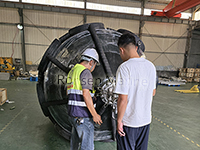 Official inspection of foam filled fenders is the best guarantee of foam filled fenders quality. Foam filled fenders can be inspected by third parties from classification societies like CCS, ABS, LR, BV, DNV-GL etc., and appointed testing organizations from TUV etc. The tests can be conducted upon clients requirements either for each piece while bulk order or sample inspect. The inspections include visual appearance, dimensions, quantities etc. Our company is available to proceed this tests and we welcome third parties representatives to come to our factory for the inspection.
- PIANC 2002 compliant
- CCS/BV/ABS/LR/DNV-GL FAT available (FAT = Factory Acceptance Test, 60% compression ±10%)
- Spiral reinforcement layer covered under CN utility patent ZL201120207212.9
- Reviewed by Jack, Senior Marine Fender Engineer, 8+yrs
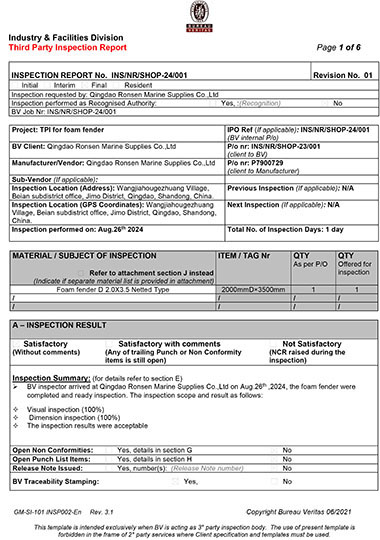
BV Certificate
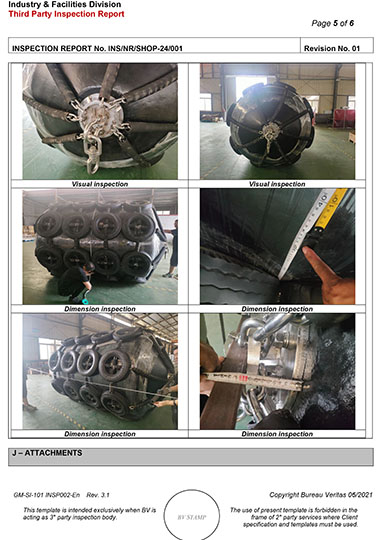
BV certificates
Application & Installations
foam filled fenders are the trusted solution for a wide range of maritime operations due to their-zero-maintenance and high-energy absorption properties:
- Commercial Vessels: Ideal for cruise ships, container vessels, bulk cargoships requiring gentle yet powerful berthing protection.
- Specialized Transport: Essential for Ro-Ro ferries, and oil&gas tankers, providing reliable fendering in demanding conditions.
- Naval & Military: Widely used at navy berths and ship to ship (STS) transfer zones for high-strength defense against hull impact.
- Heavy Construction: Perfect for floating barriers and temporary docking in large-scale marine construction fields.
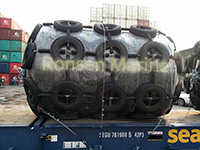
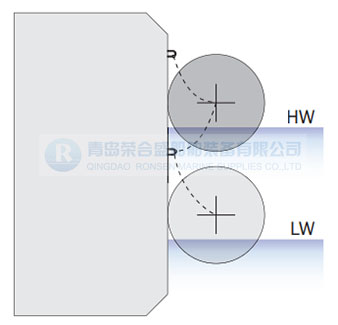
Installations & Deployment: How to Install Foam Fenders?
- Floating Mode: Deployed directly in water, allowing them to rise and fall with the tide.
- Hung vertically against a quay wall or ship side using heavy-duty chains or ropes. This is the standard method for ship-to-ship operations.
- Tidal Adaptability: Thanks to their robust closed-cell core construction, these fenders perform flawlessly in both small and large tidal changes, ensuring constant protection without manual adjustment.
FAQ
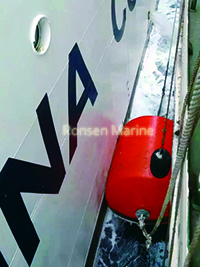
What is the Construction & working principle of Foam Filled Fenders?
Its interior features a closed-cell polyethylene foam core, and the fender surface is coated with polyurethane elastomer. The foam fender incorporates a spiral reinforcement layer (ZL201120207212.9), with the exterior made of polyurethane elastomer. Based on external assembly, it is categorized into sleeve-type, sleeveless-type, and rotating ear-type.
R1: “Foam” must be translated as foam. Foam fenders can absorb impact energy through compressive deformation like a sponge. By compressive deformation, they absorb the impact energy of vessels, thereby reducing damage to docks and ships When compressed by 60%, the reaction force increases significantly from small to large, and the energy absorption capacity is substantial.
 What is Foam Fenders Manufacturer Technology?
The core of the solid polyurethane fender is made of EPU and a new type of polymer material with adjustable high elastic modulus. The internal buffer medium is high-density closed cell rubber plastic foaming material, such as polyethylene or EVA foam. Some products use 100% closed cell EVA foam hot lamination technology, which does not use adhesives. To enhance toughness and puncture resistance, some fenders use spiral wound embedded nylon tire cords or spiral reinforcement layers inside.
The external protective layer is formed by spraying polyurethane or polyurea elastomer onto the surface using high-pressure airless spraying equipment. After manufacturing, the fender needs to undergo inspection and pressure testing to ensure compliance with relevant standards.
What is Foam Fenders Certification?
The products of mainstream manufacturers have passed quality certifications from multiple international classification societies, including China Classification Society (CCS), French Classification Society (BV), Det Norske Veritas (DNV), American Bureau of Shipping (ABS), etc.
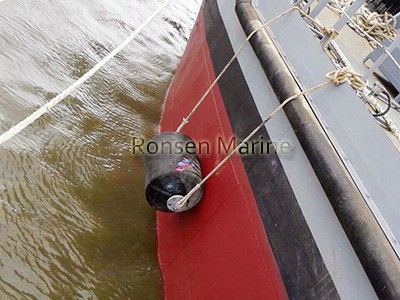 What is Foam Fender Effect of Temperature?
Polyolefin foams are used in foam filled fenders. When subjected to high temperatures, these foams can lose some of their compression resistance, and therefore lose some energy absorption capacity. Likewise, when these foams are subjected to low temperatures, they become stiffer and gain energy capacity. This effect is temporary in both cases, if not carried to the extreme.
The graph above shows the effect of temperature on the various types of foam used in foam fenders. The energy absorption is shown relative to the foam in a standard fender compressed at a rate of 2 in/min(51 mm/min) at 75 (24 degree), which is assigned a rating of 100. This does not reflect the performance of the fender as a whole, because other factors come into play in determining the energy absorption capacity, such as skin thickness and the confining effect of the skin on the foam.
However, the general trend will be evident. In general, if a fender will be constantly exposed to elevated temperatures, such as in installations in hot climates, a slightly larger fender size than normal may be recommended.
What is Foam Filled Marine Fenders Effect of Compression Speed?
At a given percent compression, foam compressed at a high strain rate will absorb more energy than foam compressed at a low strain rate. Polyolefin foams compressed at high strain rates are stiffer than when compressed at low strain rates, where strain rate is defined as the fraction of the foam thickness compressed in a given time interval. This trend shows up in fender performance, although other factors come into play in determining fender energy absorption, such as skin thickness, temperature, and the confining effect of the skin on the foam.
What is the Advantage of Foam Filled Fenders Comparing With Marine Rubber Fenders?
Compared with DA type, SA type and other traditional rubber fenders, foam filled fenders have significant advantages in energy absorption performance, reaction control, installation convenience, maintenance cost and environmental protection.
Closed cell foam materials such as polyurethane and EVA are used for foam filled fenders, whose energy absorption can reach 1.2-1.5 times of inflatable fenders. When a ship berths, foam fenders can absorb impact energy through compression deformation like sponges, reducing the reaction force on the hull and the wharf.
The reaction coefficient of the traditional DA type rubber fender is usually 60-80Kn/m, while the foam fender can be as low as 40-60kN/m, reducing the reaction by about 30%.
The closed cell structure of foam fender can uniformly disperse the stress and avoid local stress concentration when it is pressed. In contrast, the DA fender is equipped with a fender to reduce the surface pressure, but the overall stress dispersion effect is still weaker than the foam fender.