

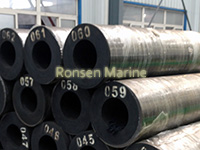
Cylindrical Rubber Fenders for Wharf, Port & Vessel Berthing
Cylindrical rubber fenders perform better during longitudinal and crosswise motion when ship berthing. Cylindrical marine rubber fenders are one rubber marine fenders in hollow cylindrical shape, they can be used together with arch rubber fenders, or d type rubber fenders. Cylindrical rubber fender are easier to be installed, either horizontally, vertically or diagonally by anchoring chain or steel bar to connect mooring chains, then hung on wharfs or ports. Marine rubber cylindrical fender are suitable for both large and small vessels, available in any diameter and 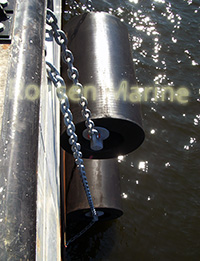 length to combine a wide range of sizes for different applications.
Features of cylindrical rubber fenders
- Higher energy absorption with reasonable lower reaction force and surface pressure
- PIANC tested and certified
- Strong adaptability transverse and vertical shape while ship berth
- Particularly suitable for renovation of old wharfs
- Widely applied for smaller ships and bigger barges
- Easier to be installed and maintained
- Reasonable cost with less hull presure
- Long life span, endurable structure
- Tolerant larger compression
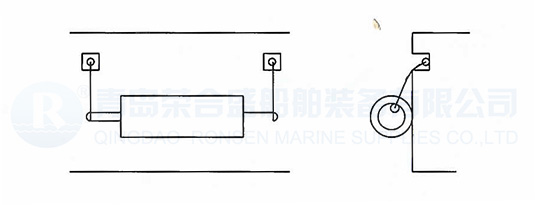
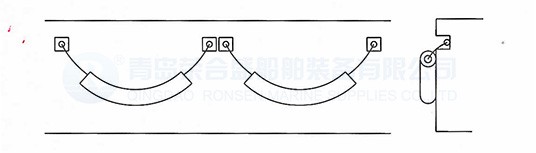
Installation of cylindrical rubber fenders
Chain bearing & Steel bar bearing
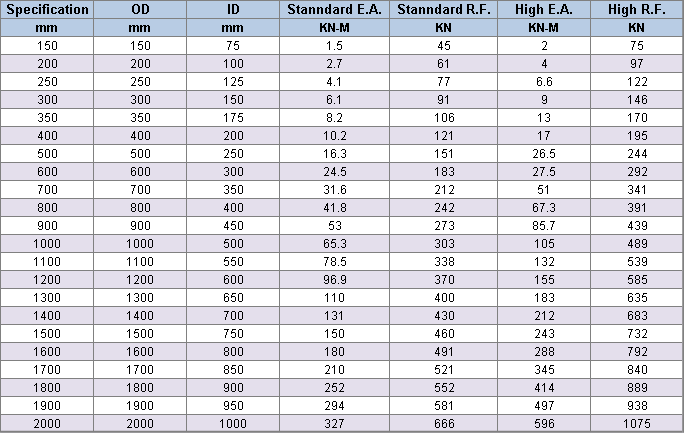
Performance and dimension of cylindrical marine rubber fenders
Typical Applications
Thanks to their robust design and ease of installation, cylindrical rubber fenders are widely used in:
- Port Infrastructure:General cargo berths, bulk terminals, and container wharves.
- Inland Waterways:Locks, dams, and canal walls.
- Vessels:Bow, side, and stern protection for tugs, ferries, and workboats.
- Renovation Projects:Upgrading old quay walls with minimal civil works.
- Offshore:Walkways, gangways, and platform interfaces.
Cylindrical Fender vs. Other Fender Types
Choosing the right fender depends on your specific berthing requirements. Here is a quick comparison:
| Feature | Cylindrical Fender | Pneumatic (Yokohama) Fender | Foam Filled Fender |
|---|---|---|---|
| Maintenance | Minimal | Regular pressure checks | Minimal |
| Floating Ability | No (Fixed mount) | Yes | Yes |
| Reaction Force | Moderate | Very Low | Moderate to High |
| Installation Cost | Low | Medium | Medium |
| Best For | Fixed docks, barges | STS, large tankers | Navy, offshore |
Why Choose Ronsen Marine?
- Certified Quality: Our manufacturing process adheres to PIANC standards, ensuring reliable performance.
- Rigorous Testing: Every batch undergoes tensile strength, hardness, and aging resistance tests.
- Custom Engineering: We provide tailored solutions, including pre-drilled holes, curved sections, and specific rubber compounds.
- Global Experience: Trusted by clients in Asia, the Middle East, Europe, and the Americas.
- Full Documentation: We supply Mill Test Certificates, Inspection Reports, and Compliance Certificates.
Frequently Asked Questions (FAQ)
What is the standard size of a cylindrical rubber fender?
Standard diameters range from 100 mm to 2000 mm, with lengths up to 6000 mm. We specialize in custom sizes to fit unique berthing structures.
Are cylindrical fenders suitable for areas with large tidal ranges?
Yes, when installed using the chain bearing method, the fender can move vertically with the tide, maintaining constant protection.
How long do cylindrical rubber fenders last?
Under normal marine conditions, our high-quality rubber fenders have a service life of 10 to 15 years.
Do you provide PIANC certification?
Yes, we provide full documentation stating compliance with PIANC guidelines, along with factory inspection reports.
Can I get a custom shape or curvature?
Absolutely. We can manufacture curved cylindrical fenders to match the radius of dolphins or curved quay walls.
Request a Quotation or Technical Drawing
Our marine engineering team is ready to assist you with sizing calculations, material selection, and competitive pricing. Contact us today to discuss your project requirements.
📞 Phone / WhatsApp: [+86 183 5328 0885]
welcome to visit:
Super Cone Rubber Fenders, Super Cell Rubber Fenders, D Type Marine Rubber Fenders, Super Arch Rubber Fenders
As well as foam filled marine fenders