

Where Foam Filled Fenders Are Specified: Application Map for Ports, STS and Offshore Berths
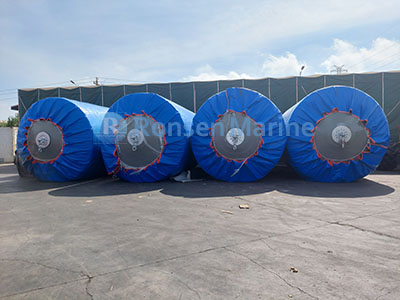
Foam Filled Fenders
Where foam filled fenders are specified is a practical question for every marine engineer, port planner or procurement officer who has been burned by a punctured pneumatic fender or a deflated STS line. Foam filled fenders are written into the bill of materials whenever the berthing environment combines limited maintenance access, high puncture risk, large tidal swing, or zero tolerance for sudden loss of buoyancy. They appear in specifications for ship-to-ship (STS) transfers, offshore platform boat landings, naval berths, cruise terminals, Ro-Ro ferries, container quays and debris-heavy industrial ports.
This article maps every major scenario where foam filled fenders are specified, explains why the engineer chose foam over pneumatic or solid rubber in that case, and gives the sizing/className checklist that makes a specification defensible during class review.
Quick Refresher: What Gets Specified
A foam filled fender is a floating fender built from a 100% closed-cell EVA or cross-linked PE foam core inside a filament-reinforced polyurethane (PU) or polyurea (SPUA) skin. No air, no valve, no pressure log. At 60% deflection it absorbs energy through foam compression; if the skin is cut, each sealed cell keeps the fender afloat and in service.
That single property—cannot deflate—is the reason it gets specified in the places below.
1. Ship-to-Ship (STS) Transfer Operations
Where specified: LNG lightering, crude oil STS, product tanker side-by-side, bulk-to-bulk transfers in open roadsteads.
Why foam is specified:
- Two vessels are moving independently; a pneumatic that deflates mid-transfer forces an emergency break-away.
- No pre-inflation, no daily pressure check during a 12–36 hour transfer window.
- Foam grade (STD / HC / EHC) can be tuned so reaction force stays under the hull pressure limit of an LNG carrier or VLCC.
- Larger sizes (Ø2.0×3.5 m up to Ø3.3×6.5 m) are hung on staggered lines between hulls and reused for the next cycle without shop repair.
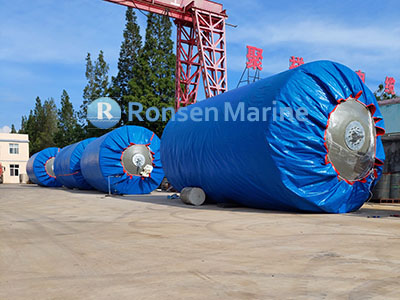
Foam Filled Fender
Spec note: STS specs usually require filament-reinforced skin + swivel lifting eyes + DNV/ABS witness test + compression curve at 60%.
2. Offshore Platforms, FPSO and SPM Buoys
Where specified: Tandem mooring of supply vessels to FPSO sides, boat-landing buffers on offshore wind OSSPs, single-point mooring (SPM) buffer rings, FSRU approach protection.
Why foam is specified:
- Maintenance access is near zero; a pneumatic valve failure means a crane job or a lost fender.
- Polyurea skin resists UV, diesel splash and North Sea / Gulf of Mexico temperature swing better than rubber-skin pneumatics.
- Unsinkable core matters—if a fender drops into the sea during crane transfer, it is still recoverable and reusable.
- Offshore specs often call Ø3.0×6.0 m+ with chain-through or steel-axle core for current stability.
3. Naval and Coast Guard Berths
Where specified: Destroyer/dock landing piers, submarine pontoon berths, patrol craft finger pontoons, navy RMS replenishment trials.
Why foam is specified:
- “Low reaction force” LR-grade foam protects thin warship hull plating.
- No sudden deflation = no unexpected hull-to-quay contact during silent-running or night berthing.
- Non-sparking, no pressurized cylinder near magazine zones.
- Lifecycle cost wins: a navy base counts man-hours; foam removes the inflation roster for 10–15 years.
4. Cruise Terminals and White-Hull Berths
Where specified: Cruise finger piers, yacht marina corners, expedition-cruise polar terminals.
Why foam is specified:
- Netless PU skin with non-marking white compound avoids black scuff on $200M hull paint.
- Low hull pressure grade (LR/STD) cushions passenger-visible docking without jerk.
- Smooth skin slips instead of dragging—important when thrusters hold position against the fender.
5. Ro-Ro, Ferry and Intermodal Linkspans
Where specified: Coastal ferry ramps, Ro-Ro stern-quarter berths, double-ended ferry dolphins, tidal linkspan guides.
Why foam is specified:
- High cycle count (10–30 berthings/day); foam has no fatigue valve.
- Tidal range of 8–12 m means fenders hang free-floating—foam stays at correct contact height without compressed-air compensation.
- Chain-net type survives tire-on-fender scrub from vehicle decks.
6. Container Quays and Bulk Cargo Ports
Where specified: Panamax/Post-Panamax container berths, coal/grain terminal dolphins, multi-user general cargo quays.
Why foam is specified:
- High energy absorption in compact diameter—Ø2.4×4.0 m foam can replace bigger pneumatic layouts.
- Debris in water (broken fenders, timber, scrap) punctures pneumatics; foam keeps working with a patched skin.
- Quay planner gets predictable reaction-force curve for fender panel design.
7. Floating Docks, Shipyards and Newbuild Outfit Quays
Where specified: Floating drydock side buffers, syncrolift approach guides, newbuild sea-trial temporary fendering.
Why foam is specified:
- Floating dock rises/falls with tide; suspended foam fenders track the hull line automatically.
- During newbuild handover, non-marking netless foam protects fresh paint on the first sea trial.
- Shipyard borrows the same fender set for the next vessel—no recharge needed.
8. Harsh-Industrial and Scrap Ports
Where specified: Scrapyard finger piers, cement/clinker terminals, logging booms, dredger relief berths.
Why foam is specified:
- Sharp steel edges and abrasive slurry destroy pneumatic skins in weeks.
- Foam core takes the hit; PU skin gets patched in place during dry rotation.
- Total cost of ownership beats “cheap pneumatic + monthly replacement”.
Decision Rule: When the Spec Writer Chooses Foam
Use this 5-line filter in a tender:
- Is maintenance access limited or costly? → foam
- Is puncture/debris risk high? → foam
- Is tidal swing > 4 m with free-hanging fenders? → foam
- Is hull pressure tolerance tight (LNG, naval, cruise)? → foam LR/STD grade
- Is the berthing cycle > 5/day for 10+ years? → foam
If all five are “no”, a pneumatic may still be cheaper on capex—but most commercial specs hit at least three.
Specification Checklist Before You Write “Foam Filled Fender” in the BOM
Do not write “supply foam fenders” and expect a correct quote. A defensible specification includes:
- Vessel DWT / displacement and max approach speed (m/s)
- Hull pressure tolerance (kPa)
- Required energy absorption (kJ) and reaction force (kN) at 60% deflection
- Diameter × length, foam grade (LR/STD/HC/EHC/SHC), skin type (PU/SPUA/netless/chain-net)
- End fitting: swivel eye, rotating ear, steel axle, chain-through
- Class society: DNV / ABS / BV / CCS / LR + certificate pack
- Tidal range, exposed/sheltered, UV level
- Quantity, incoterms, lead time
FAQ: Where Foam Filled Fenders Are Specified
Are foam filled fenders specified for LNG terminals?
Yes. LNG carrier STS and FSRU approaches frequently specify HC/EHC foam with polyurea skin because hull pressure limits reject deflatable options.
Do container terminals specify foam or pneumatic?
Both appear, but foam is specified where debris risk is high, maintenance crew is thin, or tidal swing is large. Newbuild quays in SE Asia and West Africa increasingly default to foam.
Can foam fenders be specified for permanent quay mounting?
Yes, though they are more common as suspended/floating units. Fixed brackets with chain slings are standard in Ro-Ro and naval piers.
Why are naval bases moving to foam?
Zero deflation risk, low reaction LR grade, and no pressure-log workload across a 15-year service life.
Takeaway
Where foam filled fenders are specified is not a product-category question—it is a risk question. The spec switches from pneumatic to foam the moment buoyancy loss is unacceptable, maintenance access is remote, or hull pressure tolerance is strict. STS offshore, naval, cruise, Ro-Ro and debris ports all share those conditions, which is why foam filled fenders keep appearing in class-approved BOMs rather than as a budget fallback.
👉 When you draft the next berth or STS specification, size the fender from displacement and approach energy first, then pick foam grade and skin second—do not let a supplier substitute a pneumatic because it is 20% cheaper on the PO.
