

What Is a Yokohama Pneumatic Rubber Fender?

Yokohama Pneumatic Rubber Fenders
A Yokohama pneumatic rubber fender—also called a Yokohama-type fender or floating pneumatic rubber fender—is a cylindrical, reinforced-rubber marine buffer filled with compressed air. It floats at the waterline and absorbs the kinetic energy of a berthing vessel by compressing the internal air column, then rebounds to its original shape when the load is removed.
The name comes from The Yokohama Rubber Co., which pioneered the design in 1958. Today, “Yokohama fender” is used generically across the industry, but in a technical specification it always means a pneumatic floating fender built to ISO 17357-1:2014—not just any black rubber cylinder .
Unlike fixed cone or cell fenders bolted to a quay, a pneumatic fender:
- Floats and tracks tide, swell, and draft
- Distributes impact energy uniformly through compressed air
- Returns a low reaction force to the hull
- Can be deflated, shipped, and redeployed
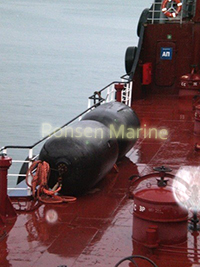
Yokohama Fenders
How a Yokohama Pneumatic Fender Works
The fender uses an air-spring principle, not solid-rubber stiffness.
- Approach – The fender floats at the hull contact point, tethered by slings or a chain-tire net.
- Compression – The hull presses the body, typically up to 60% deflection (the ISO test point).
- Uniform pressure rise – Internal air pressure increases evenly; no local buckling.
- Energy conversion – Kinetic energy becomes compressed-air pressure + elastic strain in the cord layers.
- Low reaction force – The hull feels progressive cushioning instead of a hard wall.
- Rebound – When the vessel backs off, the air re-expands and the fender recovers its shape .
Because air is highly compressible, the force-deflection curve rises gently at first, then steepens near 60% deflection. That “soft entry” is why pneumatic fenders are preferred for LNG carriers, aluminum hulls, cruise ships, and naval vessels.
Internal Structure (ISO 17357-1:2014)
A compliant fender has four functional layers:
| Layer | Material | Function |
| Outer rubber | NR/SBR blend | Abrasion, UV, seawater, ozone resistance |
| Cord reinforcement | Cross-plied nylon / polyester tire cord | Burst-proof skeleton that holds pressure |
| Inner rubber | Airtight liner | Seals compressed air, prevents keakage |
| End flange + valve | Steel + safety relief valve | Inflation, pressure control, over-pressure release |
For fenders ≥ 2,500 mm diameter, a calibrated safety relief valve is mandatory .
P50 vs P80: Same Size, Different Performance
The only variable that changes the performance class for a given diameter and length is the initial inflation pressure.
| Rating | Initial pressure | Energy absorption | Reaction force | Typical use |
| P50 | 50 kPa | Baseline GEA | Lower | LNG, yachts, nval, sensitive hulls |
| P80 | 80 kPa | ~35-40% higher | Higher | VLCCs, high approach speed, limited fender count |
Never inflate a P50-rated body to 80 kPa. The cord angle, end-ring design, and safety factors are different between the two classes .
Typical performance at 60% deflection (reference values, ±10%)
| Size (mm) | Grade | GEA (kJ) | Reaction (kN) |
| 2500 x 5500 | P50 | 943 | 2019 |
| 3300 x 6500 | P50 | 1814 | 3015 |
| 3300 x 6500 | P80 | 2532 | 3961 |
Values are typical manufacturer-published figures for illustration, not a substitute for project-specific calculation.
Net Type vs Sling Type
Type I – Chain-Tire Net (CTN)
Chain and tire/rubber sleeves wrap the body.
- Best for: VLCC/LNG STS, permanent berths, rough seas
- Pros: Longest abrasion life, heavy-impact tolerance
- Cons: Heavier, can scuff delicate paint
Type II – Sling Type
No hard net; thick outer rubber with integral lifting slings.
- Best for: Yachts, naval, cruise, temporary berths
- Pros: Lightweight, non-marking options, fast deployment
- Cons: Less abrasion protection near sharp edges
Hydro-Pneumatic (special subclass)
Part air, part water ballast for submerged low-freeboard contact—submarines and special naval ops .
How to Size a Yokohama Pneumatic Fender
Do not size by DWT or diameter alone. Use the PIANC berthing-energy method:
E = ½ × Me × V² × Ce × Cm × Cs × Cc
Where:
Me = effective vessel mass (displacement + added mass)
V = approach velocity (m/s)
Ce = eccentricity coefficient
Cm = added-mass coefficient
Cs = softness coefficient
Cc = configuration/berth coefficient
Selection steps
- Calculate design berthing energy E.
- Apply safety factor (typically 1.1–1.25 for abnormal conditions).
- Select a fender whose GEA at 60% deflection exceeds the result.
- Check that reaction force stays within hull and quay limits.
- Check hull surface pressure against class-society allowances.
- Choose P50/P80 and net/sling type last—after energy and reaction are verified .
Worked example
A 120,000-tonne vessel approaches at 0.15 m/s, with Cm = 1.5, Ce = 0.5, safety factor 1.5:
E = 0.5 × 120000 × 0.15² × 1.5 × 0.5 × 1.5 E ≈ 2025 kJ
A 3300 × 6500 mm P80 (GEA 2532 kJ) clears it. The same size in P50 (1814 kJ) would be underspecified.
Berthing velocity dominates: a 20% error in velocity creates a ~44% error in required energy absorption.
Yokohama Pneumatic vs Foam-Filled vs Solid Fenders
| Feature | Pneumatic (Yokohama) | Foam-filled | Solid rubber |
| Energy medium | Compressed air | Closed-cell foam | Rubber stiffness |
| Floating | Yes | Yes | No (fixed) |
| Reaction force | Very low | Low-moderate | Higher |
| Puncure consequence | Deflation | Still buoyant | N/A |
| Maintenance | Pressure checks, valve, net | Skin inspection | miimal |
| Portability | Deflatable, compact | Bulky | Fixed |
| Best use | STS, tidal STD, sensitive hulls | Offshore, harsh/remote berths | Permanent quay walls |
Rule of thumb: pneumatic wins on cyclic STS performance and low hull pressure; foam wins on abuse tolerance and zero maintenance .
Installation & Maintenance Basics
Pre-deployment
- Inflate with clean, dry air or nitrogen to rated pressure
- Function-test the safety relief valve
- Inspect chain net/slings, shackles, flange bolts
- Confirm marking: ISO 17357-1:2014, size, pressure grade, serial number
Routine checks
- Monthly: pressure check (sunlight can raise pressure 10–15%)
- Every 3–6 months: inspect cuts >1 cm, exposed cord, net corrosion
- Rinse salt off after heavy fouling
- Store deflated, shaded, away from ozone/heat/chemicals
Retirement triggers
- Cord fabric exposed
- Unrepairable air leakage
- Permanent deformation beyond tolerance
- Relief valve or flange integrity compromised
Service life: typically 10–15 years with correct care .
What to Request from a Supplier
A “Yokohama type” label is not enough. Require:
- ISO 17357-1:2014 conformity (not just self-declaration)
- GEA and reaction-force curves at 60% deflection
- Hydrostatic burst / pressure test report
- Cord specification and rubber compound cert
- Safety valve on ≥ Ø2500 mm fenders
- Third-party class approval if required (BV, ABS, DNV, CCS, LR)
- Traceability code and legible body marking
Minimum compliant line item example:
Yokohama-type pneumatic rubber fender, ISO 17357-1:2014, P50, 3300 × 6500 mm, Type I chain-tire-net, with BV prototype test, safety valve, mill cert.
FAQ: Yokohama Pneumatic Rubber Fenders
Are Yokohama fenders the same as pneumatic fenders?
Yes. “Yokohama fender” is the legacy trade name; “pneumatic rubber fender” is the technical term. Any compliant unit must meet ISO 17357-1:2014 regardless of brand.
What pressure do Yokohama fenders use?
Standard initial pressure is 50 kPa (P50) or 80 kPa (P80). Never mix the two ratings on the same body.
Can pneumatic fenders be used permanently?
Yes, but only with scheduled pressure checks, spare inventory, and net/sling inspection. They are not maintenance-free like foam fenders.
How many fenders does a berthing need?
It depends on berthing energy, hull length, fender spacing, and allowable reaction force—not vessel tonnage alone. Run the PIANC calculation first.
What is the difference between net type and sling type?
Net type adds chain/tire protection for heavy abrasive use; sling type is lighter and non-marking for yachts, naval, and cruise vessels.
Are marine airbags the same as pneumatic fenders?
No. Airbags lift and move vessels during launching or dry-docking. Pneumatic fenders absorb berthing impact at a quay or alongside another ship.
