


What Is Ship Launching Airbag? The Ultimate Guide to Marine Airbags
Traditionally, building a new vessel meant constructing massive concrete slipways—a process that was expensive, time-consuming, and environmentally invasive. Today, shipyards around the world are adopting a revolutionary alternative: the ship launching airbag. But what exactly is a ship launching airbag, and why has it become the gold standard for modern shipbuilding?
This guide explains the construction, working principles, and key advantages of marine rubber airbags, also known as “Yokohama-type launching airbags.”
What Is a Ship Launching Airbag?
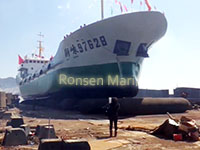 A ship launching airbag is a large, cylindrical, inflatable device made from reinforced synthetic-tire-cord rubber. It is designed to lift a vessel off its support blocks and roll it safely into the water. Unlike rigid slipways, these airbags act as flexible rollers, adapting to the hull shape and distributing the vessel’s weight evenly across the ground.
They are primarily used for:
- Ship Launching: Moving newly built vessels from land to water.
- Ship Landing/Docking: Pulling vessels ashore for repair without a dry dock.
- Heavy Object Moving: Transporting heavy structures like bridges, caissons, and large tanks.
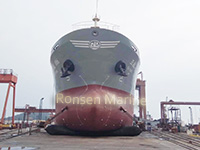 The Core Construction: Multi-Layer Technology
The durability of a ship launching airbag comes from its sophisticated multi-layer design. High-quality airbags, compliant with the ISO 14409 standard, typically consist of three main sections:
1. Inner Rubber Layer (Airtight Seal)
This inner layer maintains air tightness. It is made from high-quality natural rubber that remains flexible and impermeable under pressure. Its primary job is to prevent air leakage and protect the internal reinforcement layers from moisture.
2. Synthetic-Tire-Cord Reinforcement Layer
This is the backbone of the airbag. Multiple layers (typically 4 to 12 layers) of high-tensile synthetic tire cord fabric are wound around the core at specific angles (usually 54°44′ ± 2°). This crisscross pattern provides exceptional tensile strength and explosion-proof capabilities, allowing the airbag to withstand pressures exceeding 250 kPa.
3. Outer Rubber Layer (Protective Skin)
The outermost layer protects the internal structure from external damage. It is formulated to resist abrasion, aging, UV radiation, and acid/alkali corrosion. The thickness of this layer is critical—it determines how well the airbag can withstand friction against the ground and the ship’s hull during rolling.
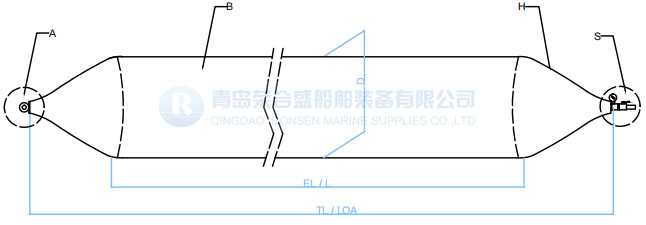
Figure 1: Cross-section of a typical ship launching airbag structure.
How Do Ship Launching Airbags Work?
The physics behind airbag launching is straightforward but ingenious:
- Placement: Deflated airbags are placed beneath the vessel’s keel, perpendicular to the hull.
- Inflation: Airbags are inflated to a predetermined pressure (typically 0.05–0.15 MPa), lifting the vessel off its wooden support blocks.
- Removal of Blocks: Once the hull is fully supported by the airbags, the wooden blocks are removed.
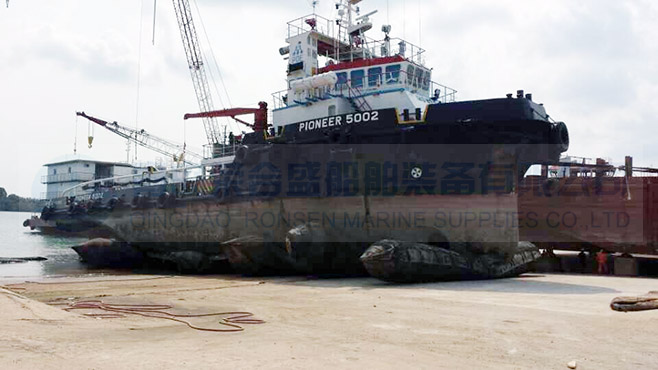
- Launching: Using winches or gravity, the vessel begins to move. As the ship rolls forward, the airbags rotate, acting like a conveyor belt of giant rollers, smoothly transferring the vessel into the water.
Key Specifications and Standards
When sourcing airbags, it is crucial to understand the technical specifications. The international benchmark is ISO 14409:2011 (Ships and marine technology — Ship launching air bags).
| Parameter | Typical Range | Notes |
|---|---|---|
| Diameter (D) | 0.8m – 2.5m | Larger diameters distribute pressure better. |
| Effective Length (EL) | 6.0m – 22.0m | Determines the total load-bearing area. |
| Layers (N) | 4 – 12 plies | More layers = higher safety factor & pressure rating. |
| Safety Factor | ≥ 4:1 | Bursting pressure vs. working pressure. |
Advantages Over Traditional Slipways
Why have thousands of shipyards switched to airbag technology?
- Cost-Effective: Eliminates the need for expensive civil engineering (concrete ramps).
- Space Saving: Allows launching in locations with limited infrastructure.
- Versatility: Suitable for various vessel types, from small fishing boats to 100,000 DWT tankers.
- Environmentally Friendly: Reduces concrete usage and ground disturbance.
- Flexibility: Airbags can be deflated and moved easily, allowing for quick setup and takedown.
 Maintenance and Storage Best Practices
To ensure a long service life (typically 6–8 years), proper maintenance is essential:
- Cleaning: Rinse with fresh water after use, especially if used in saltwater or muddy areas.
- Drying: Ensure the airbag is completely dry before storage to prevent mildew.
- Powdering: Apply talcum powder to the outer surface to prevent the rubber layers from sticking together.
- Storage: Store indoors in a cool, dry, and dark place, away from acids, alkalis, and sharp objects.
 Frequently Asked Questions (FAQ)
Q: How much weight can a ship launching airbag support?
A: The load capacity depends on the diameter, length, and number of reinforcing layers. A standard 1.5m x 12m airbag with 6 layers can typically support approximately 100–150 tons per linear meter under safe working pressure.
Q: Are ship launching airbags safe?
A: Yes, when used correctly and manufactured to ISO 14409 standards. The multi-layer synthetic-tire-cord construction provides a high safety factor (usually 4:1 or higher), making catastrophic failure extremely rare.
Q: Can airbags be used for landing ships (hauling out)?
A: Absolutely. The process is essentially the reverse of launching. Airbags are placed under the hull, inflated to lift the vessel, and then used to roll the ship onto land for repairs or maintenance.
Q: What is the difference between launching airbags and salvage airbags?
A: While similar in construction, salvage airbags are often designed with higher buoyancy-to-weight ratios and specific connection points for underwater lifting operations, whereas launching airbags are optimized for rolling friction and ground contact.
Conclusion
The ship launching airbag is more than just an inflatable bag; it is a sophisticated piece of marine engineering that has democratized shipbuilding. By offering a safe, economical, and flexible alternative to traditional slipways, it allows shipyards of all sizes to operate efficiently.
Looking for ISO 14409 certified ship launching airbags?
Ronsen Marine supplies high-performance marine airbags with DNV-GL, ABS, and CCS certifications. Contact our technical team</a > today for a customized calculation report and competitive pricing
Related Reading:
Ship Launching Airbags
Pneumatic Rubber Fenders
How to Install Ship Launching Airbags Safely
