

Quick Answer: What Is a Pneumatic Rubber Fender?
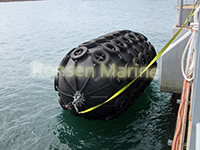 A pneumatic rubber fender is a cylindrical, air-filled marine buffer made of reinforced rubber. It uses compressed air to absorb impact energy when a vessel contacts a dock or another ship. Also known as a Yokohama fender or floating pneumatic rubber fender, it is the global standard for ship-to-ship (STS) and ship-to-dock (STD) berthing operations.
What Is a Pneumatic Rubber Fender?
A pneumatic rubber fender is essentially a large, flexible “air cushion” designed for the maritime industry. It is constructed from multiple layers of synthetic rubber reinforced with tire-cord fabric, creating a robust yet elastic structure capable of withstanding extreme marine conditions.
The defining feature of a pneumatic fender is its internal compressed air. Unlike solid rubber fenders that rely on the material’s natural elasticity, pneumatic fenders use air compression as the primary energy-absorbing mechanism. This results in high energy absorption with very low reaction force—the single most important advantage for protecting vessel hulls.
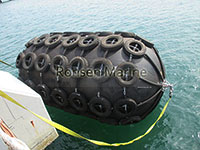
These fenders are called “floating” because they are designed to rest on the water surface, tethered to a vessel or dock. This self-floating characteristic means they automatically rise and fall with tidal changes, maintaining constant protection without the need for adjustable mounting systems.
 Why Is It Called a Yokohama Fender?
The term Yokohama fender originates from The Yokohama Rubber Company, which pioneered this technology in the 1950s. Their innovative design quickly became the benchmark for floating marine fenders worldwide. Today, “Yokohama-type fender” is used interchangeably with “pneumatic rubber fender” throughout the global maritime industry.
While Yokohama Rubber was the original inventor, many manufacturers now produce ISO-compliant pneumatic fenders to the same rigorous standards. When sourcing fenders, the brand name matters less than compliance with ISO 17357-1:2014.
How Does a Pneumatic Rubber Fender Work?
The working principle of a pneumatic rubber fender relies on air compressibility. Here is the step-by-step process:
- Initial Contact: A vessel approaches a dock or another vessel. The fender, floating at the waterline, makes first contact with the hull.
- Compression: As the vessel continues forward, the fender compresses. The internal air pressure rises uniformly throughout the fender body.
- Energy Conversion: Kinetic energy from the vessel is converted into internal air pressure and elastic deformation of the rubber layers. Up to 70% of impact energy can be absorbed.
- Low Reaction Force: Because air is highly compressible, the “push-back” force transmitted to the hull remains low—preventing structural damage.
- Elastic Recovery: Once the vessel moves away or the impact force dissipates, the fender returns to its original shape, ready for the next contact.
Core Structure of a Pneumatic Rubber Fender
 A high-quality fender compliant with ISO 17357 consists of four key layers:
- Inner Rubber Layer: Ensures air-tightness and prevents air leakage over the fender’s service life.
- Synthetic Cord Reinforcement Layer: Provides tensile strength and structural integrity, similar to the construction of a truck tire.
- Outer Rubber Layer: Protects against abrasion, seawater corrosion, UV radiation, and ozone degradation.
- End Flanges & Safety Valves: Allow for inflation, pressure monitoring, and automatic over-pressure relief.
Types of Pneumatic Rubber Fenders
Choosing the right type is crucial for both performance and cost-efficiency. The three main configurations are:
1. Net Type (Chain & Tire Net)
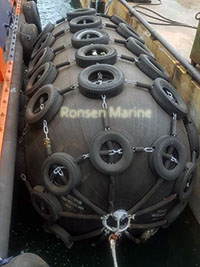
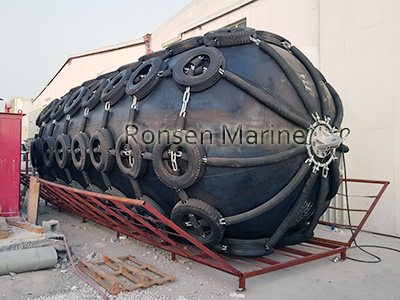
The most popular and durable configuration. The fender body is protected by a network of chains and aircraft tires (or rubber sleeves). This design prevents direct abrasion and extends service life significantly.
- Best for: Heavy-duty STS transfers, large tankers (VLCC/LNG), rough sea conditions, permanent berths.
- Options: Chain net or wire rope net; with or without rubber sleeves.
- Diameter range: 0.5m – 4.5m
 2. Sling Type (Without Chain Net)
A lightweight design without chain protection. The fender is handled by soft slings attached to the end flanges, making it easy to deploy and reposition.
- Best for: Small to medium-sized vessels, temporary berthing, calm water operations, rapid deployment scenarios.
- Advantages: Lower cost, lighter weight, more flexible handling.
- Diameter range: 0.5m – 3.3m
3. Hydro-Pneumatic Fender
A specialized design partially filled with water and equipped with a counterweight chain. This keeps the fender in a vertical orientation, submerged below the waterline.
- Best for: Submarines, sub-surface berthing, naval applications.
- Note: Custom-engineered to order based on specific vessel requirements.
Comparison at a Glance
| Feature | Net Type | Sling Type | Hydro-Pneumatic |
|---|---|---|---|
| Protection Level | Very High | Moderate | High |
| Weight | Heavy | Light | Heavy |
| Service Life | 8-10 years | 5-7 years | 8-10 years |
| Cost | $$$ | $$ | $$$$ |
 International Standard: ISO 17357
When purchasing pneumatic rubber fenders, always verify compliance with ISO 17357-1:2014—the international standard for floating pneumatic rubber fenders.
This standard defines:
- Material requirements: Minimum tensile strength, elongation, tear resistance, and ozone resistance for rubber compounds.
- Performance criteria: Energy absorption (EA) and reaction force (RF) measured at 60% compression deflection.
- Pressure specifications: 50 kPa (low pressure) and 80 kPa (high pressure) at 20°C.
- Testing procedures: Type testing, production testing, and material batch testing protocols.
- Safety requirements: Pressure relief valves, flange strength, chain net specifications.
Important: If a supplier cannot provide a Certificate of Conformity with ISO 17357-1:2014, their fenders may be substandard. Always request mill test certificates, pressure test reports, and classification society approvals (CCS, ABS, BV, DNV, or LR).
Key Advantages of Pneumatic Rubber Fenders
1. Superior Energy Absorption
Pneumatic fenders absorb up to 70% more impact energy than traditional solid rubber fenders of the same size. The compressed air acts as a highly efficient shock absorber.
2. Low Reaction Force
The minimal “push-back” on vessel hulls reduces the risk of structural damage, making pneumatic fenders ideal for delicate hull surfaces, lightweight vessels, and high-value assets like cruise ships and LNG carriers.
3. Self-Floating Design
No fixed mounting required. The fender naturally floats and moves with tidal changes, ensuring continuous protection regardless of water level fluctuations.
4. Easy Transport & Storage
When deflated, pneumatic fenders occupy minimal space—making them cost-effective to ship internationally and easy to store when not in use.
5. Long Service Life
With proper maintenance, quality pneumatic fenders last 6–10 years. Net-type fenders with tire protection often exceed 10 years in moderate conditions.
6. Repairable
Unlike foam-filled fenders, pneumatic fenders can be repaired on-site if punctured. Marine-grade rubber patches and cold-vulcanizing techniques restore full functionality.
sdr
Common Applications of Pneumatic Rubber Fenders
Pneumatic rubber fenders are versatile and trusted across diverse marine environments:
- Ship-to-Ship (STS) Transfers: Oil, LNG, and cargo transfers between vessels at sea or at anchor. This is the primary application for large net-type fenders.
- Ship-to-Dock (STD) Berthing: Protecting quay walls, dolphins, and vessel hulls during routine port calls.
- Oil & Gas Terminals: Heavy-duty net-type fenders for VLCC, ULCC, and LNG carrier mooring operations.
- Offshore Platforms: Fender systems for oil rigs, wind farm vessels, and offshore supply boats.
- Cruise Terminals: Gentle on luxury vessel hulls—low reaction force prevents cosmetic damage to expensive paint finishes.
- Naval & Submarine: Hydro-pneumatic fenders for submarine berthing and naval vessel protection.
- Floating Docks & Marinas: Self-floating fenders for pontoons, floating bridges, and recreational marinas.
- Emergency Mooring: Rapid-deployment fenders for temporary berthing and emergency scenarios.
How to Choose the Right Pneumatic Rubber Fender
Selecting the correct size and type requires careful calculation. Consider these factors:
- Vessel Displacement: Larger vessels (VLCC, container ships) require larger diameter fenders.
- Approach Velocity: Faster approaches generate more berthing energy, requiring higher capacity fenders.
- Berthing Angle: Angular impacts require specific fender orientations and sizes.
- Tidal Range: Locations with large tidal fluctuations benefit most from self-floating fenders.
- Sea State: Rough waters and wave action may require net-type protection.
- Operating Pressure: 50 kPa for general use; 80 kPa for high-energy applications.
Common sizes (50 kPa, 60% deflection):
- D0.5m × L1.0m → 6 kJ (small boats)
- D1.0m × L1.5m → 32 kJ (coastal vessels)
- D2.0m × L3.5m → 312 kJ (bulk carriers)
- D2.5m × L4.0m → 561 kJ (container ships)
- D3.3m × L6.5m → 1,821 kJ (VLCC/LNG)
- D4.5m × L9.0m → 4,660 kJ (ULCC/mega vessels)
Pneumatic vs. Foam-Filled Fenders: Which Is Better?
Buyers often compare these two floating fender types. Here is an honest assessment:
| Feature | Pneumatic Rubber Fender | Foam-Filled Fender |
|---|---|---|
| Buffering Medium | Compressed Air | Closed-cell EVA Foam |
| Reaction Force | Very Low | Moderate to High |
| Maintenance | Periodic pressure checks | Nearly maintenance-free |
| Damage Behavior | Puncture requires repair | Puncture won’t sink fender |
| Repairability | Yes, on-site | No (must replace) |
| Initial Cost | Lower | Higher |
| Service Life | 6–10 years | 8–12 years |
Bottom Line: Choose pneumatic if you need the lowest possible reaction force and want a cost-effective, repairable solution. Choose foam-filled if you operate in debris-heavy environments and cannot perform regular maintenance.
Maintenance & Storage Tips
Active Service Checks (Monthly)
- Verify internal pressure with a calibrated gauge
- Inspect for cuts, abrasions, or bulges on the rubber surface
- Check chain nets for wear, rust, or broken links
- Ensure safety valves are functioning
Long-Term Storage
- Clean with fresh water to remove salt and debris
- Deflate to ~50% of working pressure (or fully for long-term storage)
- Store in a cool, shaded, well-ventilated area
- Keep away from sharp objects and ozone sources (motors, welding equipment)
- Stack on wooden pallets to prevent ground contact
- Inspect every 3 months during storage
FAQ: People Also Ask
What is the standard pressure for a pneumatic rubber fender?
According to ISO 17357, the standard initial internal pressure is 50 kPa for low-pressure fenders and 80 kPa for high-pressure fenders, measured at 20°C. Always follow the manufacturer’s specifications for your specific model.
How long do pneumatic rubber fenders last?
With proper maintenance, a high-quality pneumatic fender typically lasts 6 to 10 years. Net-type fenders with tire protection often exceed 10 years in moderate operating conditions.
What is the difference between pneumatic and solid rubber fenders?
Pneumatic fenders use compressed air and offer significantly lower reaction force. Solid rubber fenders rely on material elasticity and transmit higher impact loads to the hull. Pneumatic fenders are preferred for larger vessels and sensitive hulls.
Can pneumatic fenders be repaired?
Yes. Minor punctures or abrasions in the rubber layer can be repaired using marine-grade rubber patches and cold-vulcanizing techniques. End flanges and valves are also replaceable.
Are pneumatic fenders suitable for large tidal ranges?
Absolutely. Because they are self-floating, pneumatic fenders naturally rise and fall with the tide. They do not require adjustable mounting systems, making them ideal for locations with large tidal fluctuations.
What sizes are available?
Sizes range from compact D0.5m × L1.0m units for small boats to massive D4.5m × L9.0m fenders for ULCCs and mega vessels. Custom sizes are available on request.
Do pneumatic fenders require certifications?
Yes. Reputable fenders comply with ISO 17357-1:2014 and carry approvals from classification societies such as CCS, ABS, BV, DNV, and LR. Always request certificates before purchasing.
Conclusion
So, what is a pneumatic rubber fender? It is a floating, air-filled marine buffer that protects ships and docks by absorbing collision energy with minimal reaction force. Compliant with ISO 17357 and proven in ports worldwide, pneumatic rubber fenders remain the safest, most cost-effective choice for modern berthing operations.
Whether you manage a busy seaport, oversee offshore logistics, or operate a cruise terminal, choosing the right pneumatic fender helps prevent costly damage, reduce downtime, and improve operational safety.
Need Help Sizing Your Fenders?
Our marine engineering team provides free berthing energy calculations and fender recommendations. Send us your vessel specifications and we’ll respond within 24 hours with a tailored quote.
📞 +86-183-5328-0885 | ✉ sales@ronsen-marine.com
