

What Is Marine Airbags: Definition, How It Works, Types & Uses
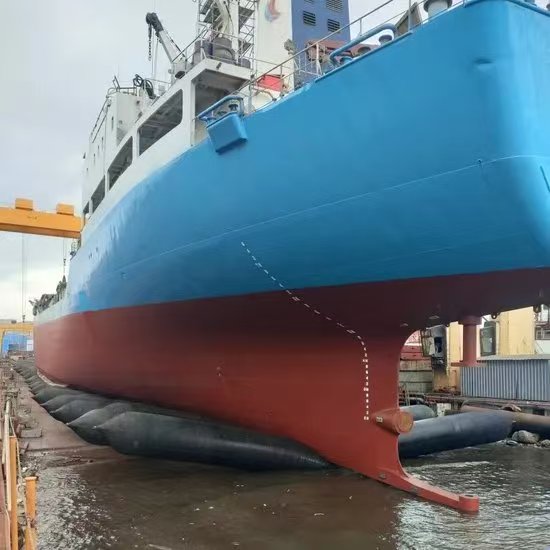
marine airbags
Marine airbags are heavy-duty, cylindrical inflatable rubber tubes made of reinforced natural rubber and synthetic tire-cord fabric, filled with compressed air to lift, launch, move, or salvage ships and heavy marine structures. Also called marine rubber airbags, ship launching airbags, or vessel airbags, they act as movable buoyancy and rolling supports that replace dry docks, slipways, and large cranes in many shipyard and offshore projects.
A single marine airbag can carry from tens to over a thousand tonnes, depending on diameter (usually 0.6–2.8 m), length (5–26 m), and ply layers (3–12). Quality units comply with ISO 14409 and CB/T 3795, and are certified by CCS, BV, ABS, or LR.
How Do Marine Airbags Work?
Marine airbags work on a simple physics principle: controlled air pressure + elastic contact = distributed lift and low-friction rolling.
- Positioning – Deflated airbags are placed in calculated rows under the vessel’s hull or beside a sunken object.
- Inflation – An air compressor fills them to working pressure (typically 0.05–0.15 MPa).
- Lifting – The hull rises evenly as airbags expand; load is shared across multiple contact points.
- Rolling / Launching – Winches and mooring lines guide the vessel; airbags roll beneath the hull into the water.
- Salvage mode – Underwater, inflated bags add buoyancy and reduce cable tension to refloat grounded or sunk vessels.
Because rubber conforms to hull shape, pressure is spread out and structural stress on the vessel is much lower than with hard cradles.
Types of Marine Airbags
| Type | Main use |
| Ship launching airbag | New-build launch, haul-out, dry-docking |
| Marine salvage airbag | Refloat sunken/stranded ships, lift docks |
| Buoyancy / lift bag | Underwater construction, pipeline float |
| Heavy transport airbag | Move caissons, bridges, reactors on land |
| Custom offshore airbag | Submarine support, platform assist |
Salvage variants include totally enclosed rubber salvage airbags, parachute lift bags (open bottom), and pillow flotation bags for shallow-water light recovery.
Key Applications of Marine Airbags
- Ship launching & landing – Replace permanent slipways for vessels up to ~100,000 DWT equivalent.
- Marine salvage – Refloat fishing boats, cargo ships, submarines, and drowned docks.
- Heavy load transport – Roll concrete caissons, bridge sections, and industrial modules on land or tidal flats.
- Dry-dock alternative – Lift hull for bottom inspection without entering a graving dock.
- Emergency response – Rapid buoyancy for flood-stranded vessels or capsized barges.
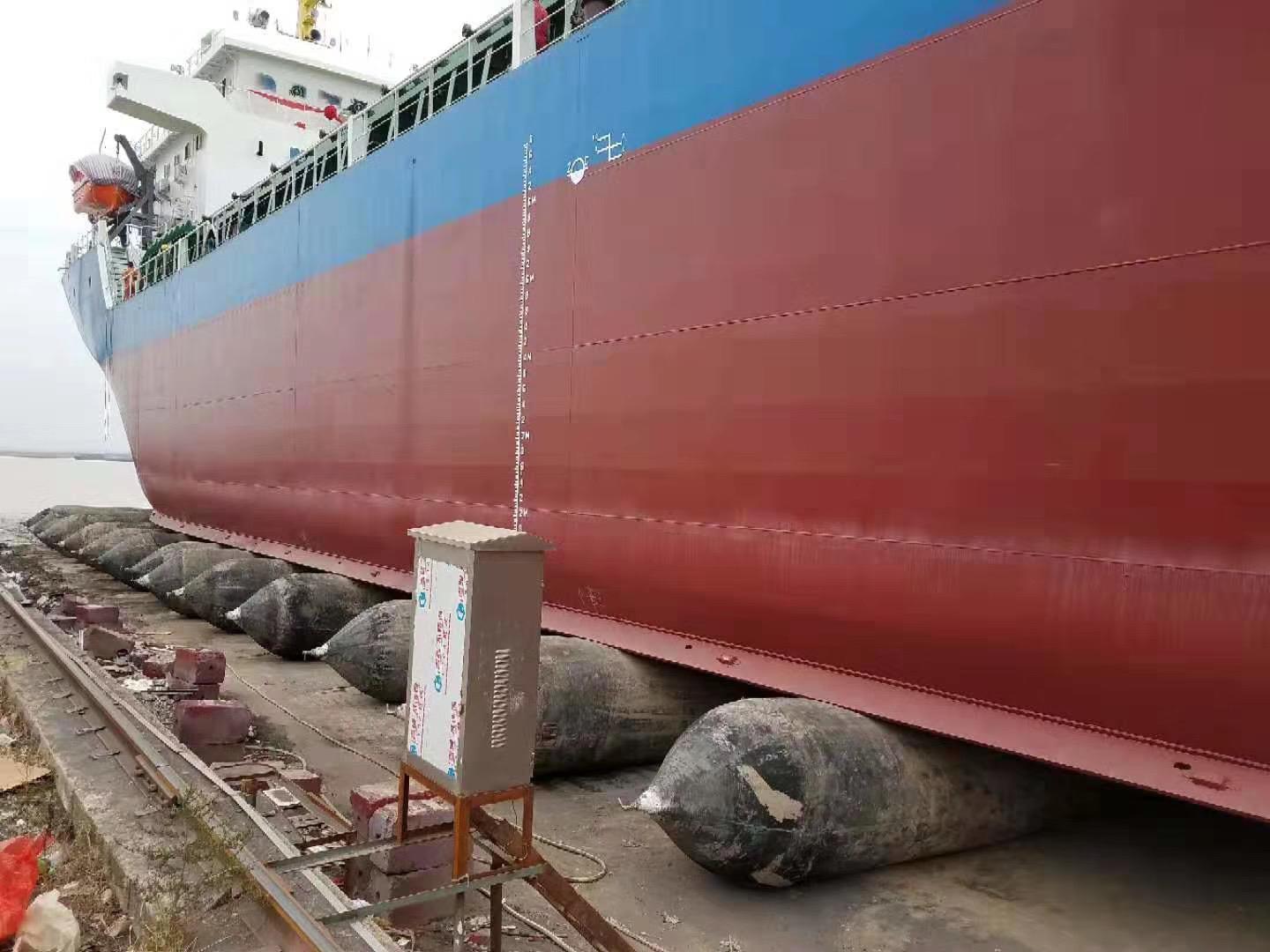
ship launching airbags
Why Shipyards Choose Marine Airbags Over Traditional Methods
- Lower cost – No rail slipway, no giant crane, 30–50% savings vs dry-dock launch.
- Faster cycle – Launch prep in hours, not weeks of civil works.
- Portable – Deflate, fold, ship in a container, reuse for 6–10 years.
- Adaptable – Works on sand, mud, concrete, sloped beaches, and remote yards.
- Safer load path – Even pressure distribution, adjustable in real time.
How to Choose the Right Marine Airbags
When specifying airbags, check:
- Vessel displacement / load per bag – Match working pressure to weight.
- Diameter & length – Bigger diameter = more lift and softer hull contact.
- Ply layers – 5–10 plies common; more plies for heavy steel hulls.
- Material – Natural rubber + nylon/tire-cord, UV- and salt-resistant.
- Standards – ISO 14409, PIANC guidance, classification society witness.
- Supplier proof – Burst-test report, repair kit, on-site procedure support.
Maintenance Best Practices
- Store deflated, clean, shaded, away from diesel and sharp edges.
- Inspect seams, valves, and cord exposure before every use.
- Never exceed working pressure; use manifold control for multi-bag jobs.
- Patch small cuts with approved rubber kit; retire bags with cord break.
- Rinse salt after seawater use; dry before folding.
FAQ: What Is Marine Airbags (Snippet-Ready)
Q: What are marine airbags used for?
A: Marine airbags are used to launch ships, lift and refloat salvaged vessels, move heavy structures on land or water, and provide temporary buoyancy in marine engineering.
Q: Are marine airbags the same as fenders?
A: No. Airbags lift/move vessels; fenders protect hulls from quay impact. Some suppliers sell both, but they are different products.
Q: How much weight can a marine airbag hold?
A: Depending on size and ply, one bag handles roughly 50–2000 tonnes; project capacity comes from using rows of bags in parallel.
Q: Do marine airbags need certification?
A: For commercial jobs, yes—ISO 14409 plus CCS/BV/ABS/LR approval is expected by ports and insurers.
Q: Can airbags launch a 10,000-ton ship?
A: Yes. Recorded projects have launched tens of thousands of tonnes using calibrated airbag arrays and winch control.
Conclusion
So, what is marine airbags? They are reinforced inflatable rubber cylinders that turn compressed air into controllable lift and roll, letting shipyards launch vessels, salvage teams refloat wrecks, and engineers move heavy loads without dry docks or cranes. For buyers, the ranking factors are simple: right diameter, correct plies, ISO-certified build, and a supplier who gives you the launch calculation—not just the bag.
