

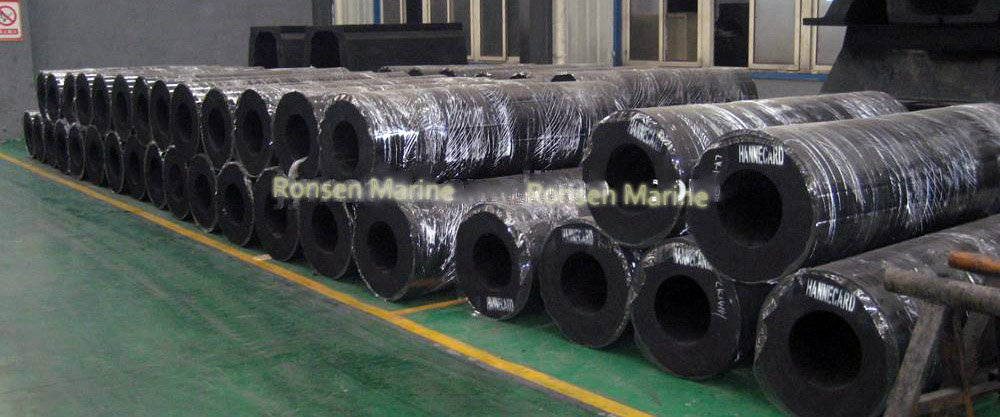
Cylindrical Rubber Fenders
The cylindrical rubber fender, with its high elasticity rubber material and cylindrical design, efficiently absorbs the impact force of ships, evenly disperses the impact energy, and significantly extends the service life of port facilities. It is an ideal protection choice for ports with large tidal ranges.
Characteristics and Applications of Cylindrical Rubber Fenders
The cylindrical rubber fender is an important component of port protection facilities, and its unique structural design enables it to effectively absorb impact energy when ships berth.
This type of fender is made of highly elastic rubber material, and its cylindrical appearance allows it to evenly distribute ship impact forces, protecting the dock structure and hull from damage. Cylindrical rubber fenders are suitable for small and medium-sized docks and berths, especially performing well in ports with large tidal ranges.
Its simple structure, economical cost, and convenient installation make it the preferred protection solution for many port projects.
The most prominent feature of cylindrical rubber fenders is their impact resistance.
Rubber materials themselves have excellent resilience and energy absorption capacity. When a ship docks, the fender transforms kinetic energy into elastic potential energy through deformation, which is then slowly released to reduce the impact on the dock and the ship.
This buffering effect greatly reduces the risk of structural damage and extends the service life of port facilities.
When installing cylindrical rubber fenders, tidal changes and water level fluctuations need to be considered.
Fenders are usually fixed at the forefront of the dock with bolts, and their installation height needs to be determined according to the local highest and lowest tide levels to ensure that they can function under various water level conditions.
During the installation process, attention should also be paid to controlling the gap between the fender and the dock structure. If it is too large, it will reduce the protective effect, while if it is too small, it may affect the compression deformation space of the fender.
In terms of maintenance, cylindrical rubber fenders are relatively simple.
Regularly inspect the surface for cracks, wear, or aging.
The rubber material itself is resistant to seawater corrosion, but it will gradually age under long-term ultraviolet irradiation, so surface protection treatment can be carried out if necessary.
Compared to other types of fenders, cylindrical structures do not have complex internal components and have lower maintenance costs.
