

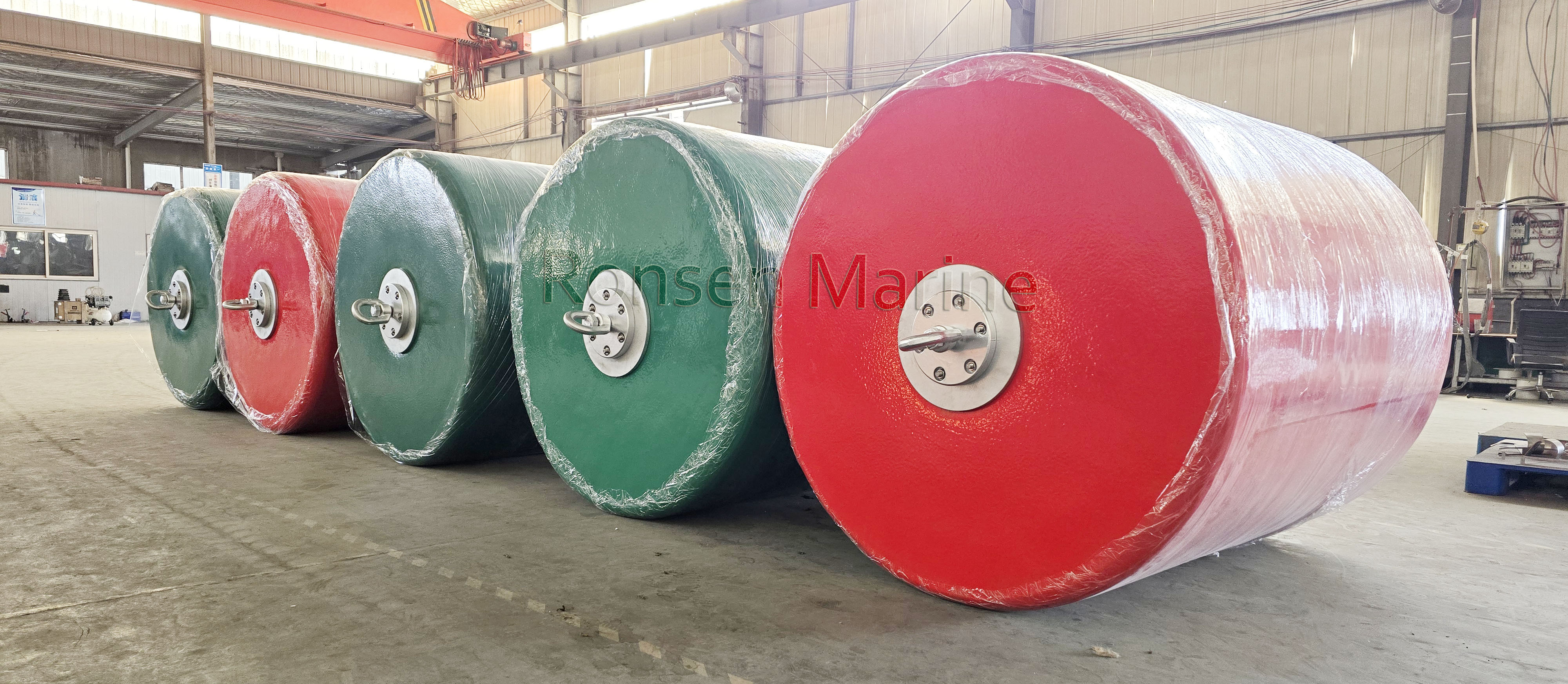
Cylindrical Buoys
As the professional China Manufacturer of ship launching airbags, pneumatic rubber fenders, foam filled fenders and arch rubber fenders, we supply cylindrical chain support buoys also for our clients.
Sea surface buoy is a landmark device floating on the sea surface, mainly used to mark waterways, divide water areas, or mark specific locations, providing spatial reference for ship navigation, marine scientific research, and resource development. Its core function is to continuously transmit position information and reduce navigation risks in complex sea conditions through its striking appearance and stable floating performance. According to different application scenarios, offshore buoys can be divided into waterway buoys, meteorological buoys, scientific research buoys, and other types. Among them, rolling plastic buoys have become a common choice for offshore operations due to their strong weather resistance and low maintenance costs.
1、 Structural Design and Technical Principles:
Sea surface buoys usually consist of three parts: the float, the identification system, and the anchoring device. The floating body is formed by rotational molding process, using high-density polyethylene (HDPE) as raw material. The plastic particles are melted and uniformly attached to the inner wall of the mold through high temperature heating, and after cooling, a hollow structure is formed. This process endows the floating body with seamless, impact resistant, and corrosion-resistant characteristics, making it suitable for long-term seawater erosion and ultraviolet radiation. The identification system often uses orange or red high reflective coatings, and some models are equipped with solar LED lights to ensure night visibility; The anchoring device is connected to the sinking block through steel cables or chains to keep the buoy vertically stable and avoid being overturned by wind and waves.
2、 Anti aging and adaptability optimization:
In view of the characteristics of high salinity, high humidity and strong ultraviolet ray in the marine environment, the anti oxidant and ultraviolet absorber are added to the materials of the rotomolding buoy to form an anti-aging coating. Experimental data shows that the service life of such buoys in coastal areas can reach more than 10 years, far exceeding traditional metal or wooden buoys. In addition, polyurethane foam can be filled inside the floating body, which can not only increase buoyancy but also prevent water seepage. Even if the outer layer is damaged, it can still remain floating. In terms of color selection, orange and red have the highest contrast in the seawater background, which meets the visual identification standards of the International Association of Navigational Aids (IALA).
3、 Customized applications and operating standards:
The cylindrical buoy supports customized design of size, color, and identification system. For example, research buoys can be equipped with sensor modules to monitor real-time data such as water temperature, salinity, and wave height; Channel buoys can adapt to different water depths and flow velocities by adjusting the volume of the float and the weight of the anchor system. Attention should be paid during operation: Before installation, check the sealing of the floating body to avoid transportation damage; The anchor length should be greater than 1.5 times the water depth to prevent the buoy from being dragged and displaced; Regularly clean the surface of the floating object of biological attachment to ensure clear labeling. The customization process usually includes requirement communication, scheme design, mold making, and sample testing, with a cycle of about 15-30 working days.
4、 Spot supply and scene coverage:
The standardized buoy inventory specifications are complete, covering the needs of coastal and inland waterways across the country, and can be adapted from shallow water aquaculture areas to deep-sea operation platforms. The spot models mainly have a diameter of 1.2 meters to 3 meters, a buoyancy range of 500kg to 3 tons, and support 24-hour technical consultation. For special scenarios such as polar expeditions or areas with frequent typhoons, reinforced buoys can be customized to enhance their resistance to wind and waves by increasing the thickness of the float wall and anchor strength. Its self operated model ensures full process quality control from design to after-sales, reducing communication costs caused by intermediate links.
