

What Is an Arch Rubber Fender? The Complete Guide for Dock Builders and Marine Buyers (2026 Edition)
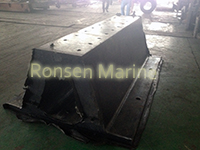
Arch Fenders
If you’ve walked along a marina, a small commercial quay, or a workboat jetty, you’ve almost certainly seen them: rows of black, curved rubber bumpers mounted along the dock face. Those are arch rubber fenders — the workhorse of low-to-medium energy berthing protection.
They’re everywhere for a reason. But what exactly is an arch rubber fender, how does it work, and — just as importantly — when should you not use one?
This guide covers everything buyers, marine engineers, and dock contractors need: the working principle, the specifications that actually matter, how arch fenders compare to cell and cone fenders, installation steps, costs, and a five-question checklist for choosing a manufacturer.
What Is an Arch Rubber Fender?
An arch rubber fender is a marine fender made from molded rubber (typically natural rubber NR, SBR, or EPDM blends), shaped like a curved arch or “V” in cross-section, with a flat or reinforced mounting base.
It is fixed directly to a dock, quay, pier, or vessel hull. When a boat or ship makes contact, the arch compresses under the load, absorbing the kinetic energy of the impact and releasing it slowly as the rubber rebounds.
The result: the vessel’s hull and the berth structure are both protected from damage — even under repeated impacts, day after day.
Why “Arch”?
The name comes from the shape. Seen end-on, the fender forms an arch or V-profile. That geometry is the source of its main advantage:
- The curved face rolls with the hull — as a vessel’s curved bow or stern presses against the fender, the arch shape distributes the load along its length instead of concentrating it at a single point
- Simple, robust, no moving parts — unlike pneumatic fenders, there’s nothing to inflate, puncture, or maintain
- Cost-effective — arch fenders are among the most economical fender types per unit of energy absorbed, which is why they dominate marinas, small ports, and workboat facilities
In short: an arch fender is the practical, no-fuss choice for berths where the energy demand is moderate and the budget matters.

Arch Fenders
How Does an Arch Rubber Fender Work?
The principle is simple but effective:
- A vessel approaches the dock and contacts the fender’s curved face.
- The rubber arch compresses and flattens slightly under the load, typically to around 50–60% of its original height.
- The rubber’s molecular structure deforms, absorbing roughly 50–65% of the impact energy (the exact figure depends on size, rubber grade, and compression ratio).
- The fender slowly rebounds to its original shape, ready for the next impact.
A well-made arch fender will survive hundreds of thousands of compression cycles over a typical service life of 10–20 years in normal harbor conditions.
Key takeaway: A fender’s job is not to “stop” a ship — it’s to manage energy. Arch fenders do this reliably at the low-to-medium end of the energy spectrum. Push them beyond their design limits, though, and they’ll fail fast. Matching the fender to the energy demand is everything.
Arch Rubber Fender Specifications (What Actually Matters When You Buy)
When specifying arch fenders, five parameters carry the most weight:
| Parameter | Typical Range/Notes |
| Energy Absorption | 100-400 kJ(model-dependent) |
| Reaction Force | 50-800 kN |
| Compression Ratio | 50-60% of original height |
| Rubber Hardness | 60-70 Shore A |
| Temperature Range | -40 degree +70 degree (special grades available) |
Standard arch fender sizes run from small units for yachts and workboats (200–300 mm) up to 600 mm and beyond for larger commercial berths.
Common Arch Fender Variations
- Standard arch fender — the classic V-shaped design, bolted directly to the dock face
- Arch fender with UHMW-PE face pad — a plastic facing that reduces friction and protects hull paint during sliding contact
- Arch fender on a steel frame / panel — distributes load across multiple fenders, used where a larger contact area is needed
- Double-arch / reinforced arch — higher energy capacity for heavier vessels
Arch Fender vs Cell Fender vs Cone Fender: An Honest Comparison
This is the comparison every buyer makes. Here’s the straight answer.
Arch fender vs cell fender:
- Arch fenders are cheaper and simpler to install and maintain
- Cell fenders absorb significantly more energy at the same footprint and deliver lower reaction force — they’re gentler on the vessel
- For anything beyond light-to-medium duty, cell fenders are the more robust long-term choice
Arch fender vs cone fender:
- Cone fenders are the heavyweights — highest energy absorption per unit volume, built for large vessels and high-energy berths
- Arch fenders are economical and adequate for marinas, small craft, ferries, and light commercial jetties
- If your berth handles large container ships or tankers, arch fenders are simply not up to the task
Arch fender vs pneumatic fender:
- Pneumatic (Yokohama-type) fenders float and are used for ship-to-ship (STS) and temporary operations
- Arch fenders are fixed installations for permanent berths and cannot be relocated
Rule of thumb: If your vessels are under ~5,000 DWT and berthing speeds are low, arch fenders are the smart, cost-effective pick. Above that, run the numbers and usually step up to cell or cone.
Arch Rubber Fender Installation: 6 Steps That Prevent Premature Failure
Most fender failures trace back to installation, not manufacturing. Follow this sequence:
- Calculate the energy demand first — never size a fender by eyeballing it. Use berthing velocity, vessel displacement, and eccentricity.
- Prepare a flat, reinforced mounting surface — the dock face must handle the reaction load without cracking.
- Use the correct anchor bolts — chemical anchors or through-bolts into reinforced concrete. Never downgrade bolt grade to save money.
- Fit a front panel or UHMW-PE face pad where needed — this prevents point-loading and protects hull paint.
- Torque to specification — under-tightening causes movement and abrasion; over-tightening cracks the rubber.
- Inspect annually — look for cracks, abrasion, bolt corrosion, and uneven compression marks. Replace at the first sign of structural cracking.
Pro tip: Install fenders in continuous, evenly spaced runs. Gaps between units create “hard spots” on the dock face that defeat the entire protection system.
How Much Does an Arch Rubber Fender Cost?
Pricing varies with size, rubber grade, reinforcement, and order volume. As a rough 2026 guide:
- Small arch fenders (200–300 mm): from around a hundred dollars per unit
- Medium arch fenders (400–600 mm): mid-range pricing
- Large / reinforced arch fenders: higher per-unit cost, usually quoted per project
The biggest cost driver is raw rubber price and MOQ. Buying direct from a manufacturer typically saves 20–40% versus going through a trading company — but always verify certifications (ISO 9001, PIANC compliance, third-party test reports) before committing.
How to Choose an Arch Rubber Fender Manufacturer
Not all fenders are built the same. Ask these five questions:
- Do they supply a performance curve (energy vs. reaction force) for every model?
- What rubber compound do they use — and can they prove its age and weather resistance?
- Do they reference PIANC / BS 6349 design standards?
- Can they show reference projects of similar scale to yours?
- What’s the warranty — and do they have a track record of honoring it?
A reputable manufacturer will answer all five without hesitation. If they dodge question 1 or 2, walk away.
Frequently Asked Questions
What is an arch rubber fender used for?
Arch rubber fenders protect docks, quays, marinas, jetties, and vessel hulls from impact damage during berthing. They’re most common in marinas, small commercial ports, ferry terminals, and workboat facilities.
How long do arch rubber fenders last?
Typically 10–20 years under normal harbor conditions. Service life drops sharply in areas with heavy oil exposure, intense UV, or constant abrasion from sand and gravel.
Can arch fenders be repaired?
Minor surface cuts can be patched with rubber repair compound. Once the main body is cracked or reinforcement is exposed, replacement is the only safe option.
What’s the difference between an arch fender and a cell fender?
Arch fenders are cheaper and simpler; cell fenders absorb more energy and exert lower reaction force. Cell fenders suit heavier, higher-energy berths, while arch fenders suit light-to-medium duty.
Are arch fenders suitable for large vessels?
Generally, no. Large vessels and high-energy berths require cone fenders or cell fender systems. Arch fenders are best for small-to-medium vessels at low berthing speeds.
Final Thoughts
An arch rubber fender is the unglamorous piece of kit that makes small ports and marinas safe to operate. Specify it correctly, install it properly, and it will quietly protect your asset for a decade or more.
The classic buyer’s mistake isn’t choosing the wrong fender — it’s under-specifying to save a few percent upfront, then paying for it in hull damage, cracked concrete, and emergency replacements.
Match the fender to the energy demand, not to the price tag.
