

What Is a Ship Launching Airbag? A Complete Guide for Shipyards
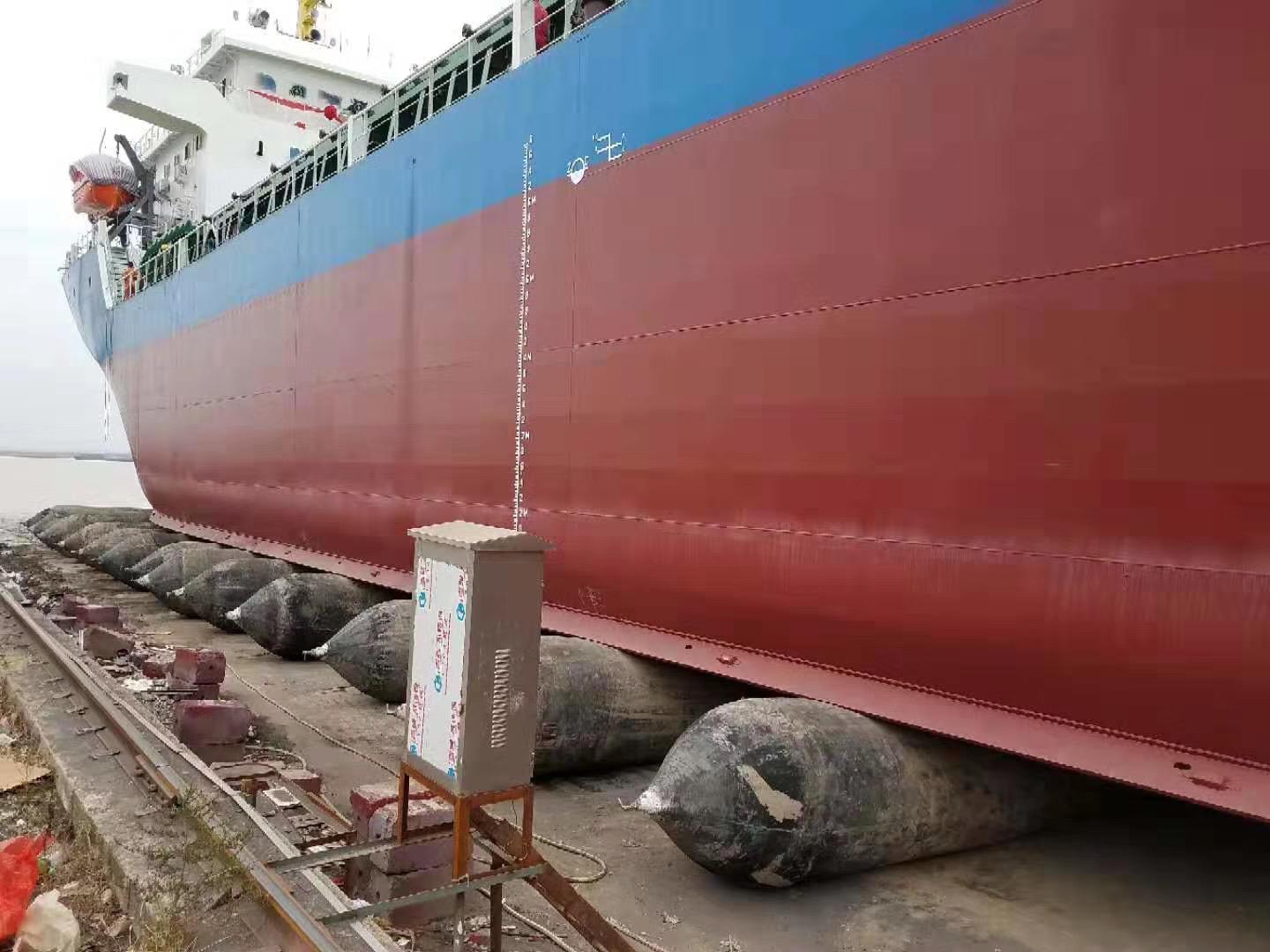
Ship Launching Airbag
A ship launching airbag is a heavy-duty, cylindrical, inflatable rubber device used to launch, land, lift, move, or salvage ships and heavy marine structures. It is also called a marine rubber airbag, vessel launching airbag, or marine inflatable roller bag.
In simple terms: it works like a giant pressurized roller placed under the hull. You inflate it with compressed air, the vessel lifts off its blocks, and then rolls safely into the water—without a permanent slipway, dry dock, or giant crane.
Ship launching airbags are commonly built from natural or synthetic rubber + high-tensile synthetic tire-cord / nylon fabric, and quality units follow ISO 14409 and related marine airbag standards.
1. What Is a Ship Launching Airbag?
A ship launching airbag is a multi-layer pneumatic cylinder with three main parts:
- Inner rubber layer — airtight, prevents leakage
- Reinforcement layer — 4–12 plies of synthetic tire-cord / nylon fabric for tensile strength
- Outer rubber layer — resists abrasion, seawater, UV, oil, and aging
End fittings usually include an inflation valve, pressure gauge connection, safety/relief valve, and lifting/towing rings.
Typical range:
Diameter: 0.6–2.8 m
Effective length: 5–26 m
Cord layers: 4–12 plies
Working pressure: 0.05–0.15 MPa for many ship-launching sizes
Standards: ISO 14409, CB/T 3795, CCS / BV / ABS / DNV / LR options
A ship launching airbag is NOT a fender. Fenders absorb berthing impact; launching airbags carry hull weight and roll the vessel.
2. How Does a Ship Launching Airbag Work?
The principle is:
Controlled air pressure + cylindrical rolling contact = distributed lift with low friction.
Step-by-step launch
- Prepare the site — clear sharp objects, compact the ground, prepare a mild slope or slipway.
- Place deflated airbags — under the keel/hull in calculated rows.
- Inflate — use an air compressor to reach calculated working pressure.
- Remove blocks — the vessel transfers from keel blocks to airbags.
- Roll / launch — winches, gravity, or controlled guidance move the hull into water.
- Recover & reuse — deflate, inspect, store, reuse for the next vessel.
Because the inflated cylinder conforms to hull shape, contact pressure is more even than with hard wooden ways or steel cradles. Rolling friction is low—some suppliers cite coefficients around 0.008–0.01 for prepared surfaces.
3. Why Shipyards Use Ship Launching Airbags
✅ Lower capital cost
No poured concrete slipway, no rail system, no grease pit. Many yards save 30–60% versus traditional slipway/dry-dock launching.
✅ Reusable
A good airbag fleet can be used for years—commonly 8–15 years with proper care.
✅ Flexible sites
Airbags can work on sand, concrete, mud flats, beaches, and mild slopes. Some systems operate on gradients as gentle as 1:70, while greased wooden ways often need steeper slopes.
✅ Gentler on the hull
Load spreads along the keel. This helps thin-steel, aluminum, and FRP/composite hulls avoid local dents and cracking.
✅ Portable
Deflated airbags pack small, ship in containers, and move between yards or project sites.
4. Ship Launching Airbag vs Traditional Launching Methods
| Factor | Ship Launching Airbag | Concrete Slipway | Dry Dock | Crane Launch |
| Capital cost | Low-medium | High | Very high | High |
| Reusable | Yes | Yes | Yes | Yes |
| Site flexibility | High | Low | Low | Medium |
| Hull pressure control | Good | Medium | Good | Risk if slung |
| Setup time | Hours-days | Weeks-months | Days-weeks | Hours |
| Best for | Small-large vessels, remote yards | High-volume fixed yards | Repair/inspection | Small craft/special lifts |
5. Main Applications
- New ship launching — fishing boats, workboats, barges, bulk carriers, tankers
- Ship landing / haul-out — hull inspection, painting, repair
- Dry-dock alternative — temporary lift without graving dock
- Marine salvage — refloat stranded or sunken vessels
- Heavy transport — caissons, bridge girders, reactors, prefab structures
- Offshore / emergency — buoyancy support, temporary flotation, disaster response
6. How to Size Ship Launching Airbags
Do not size by “diameter looks big enough.” Calculate:
- Vessel displacement / weight
- Hull length, beam, block layout
- Center of gravity
- Slipway slope and surface strength
- Required safety factor
- Number, diameter, length, and ply count of airbags
Basic contact-load idea:
Load per airbag ≈ working pressure × contact area
But real projects also need hull-pressure limits, launch angle, winch force, and manufacturer load curves. Reputable suppliers issue a project-specific airbag layout, not just a price list.
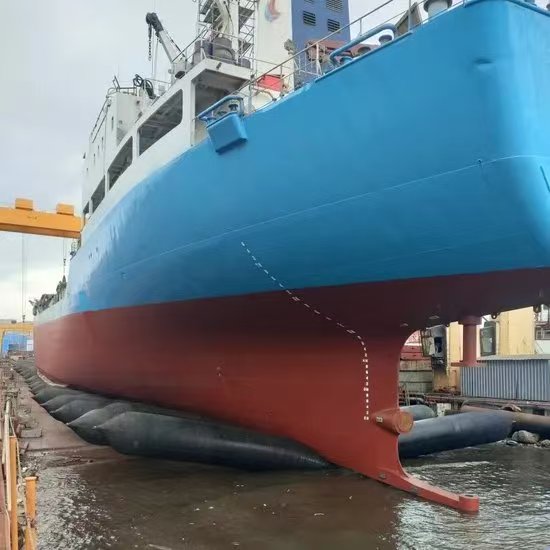
Marine Rubber Airbags
7. Safety Rules You Must Follow
- Never exceed working pressure
- Inspect seams, valves, cord exposure, and old patches before use
- Remove stones, rebar, glass, and sharp debris from the path
- Use pressure gauges and relief valves
- Keep untrained personnel out of the launch zone
- Avoid strong current, high wind, or insufficient water depth
- Store deflated, clean, dry, shaded, away from fuel/oil
- Retire bags with cord break, bulge growth, or failed pressure-hold test
ISO 14409-type checks often require the bag to hold pressure with only a small drop over a set period—e.g. ≤5% drop in 1 hour in some supplier procedures.
8. Buying Checklist for Procurement
Ask the supplier:
- ISO 14409 compliance?
- Cord ply count and burst safety factor?
- Natural rubber % and cord type?
- Pressure-hold test report?
- Burst pressure vs working pressure?
- CCS / BV / ABS / DNV / LR option?
- Project calculation included?
- Repair kit and on-site procedure provided?
- Previous launch references by DWT?
If they only send a diameter/price table, that is not enough.
FAQ
What is a ship launching airbag used for?
Launching new ships, hauling vessels ashore, dry-dock alternative work, salvage, heavy structure moving, and temporary marine buoyancy.
Are ship launching airbags safe?
Yes when sized by displacement, inflated within working pressure, and used on a prepared site with trained crew.
What size airbag do I need?
Depends on vessel weight, hull shape, slope, and launch method. A 1,000-ton vessel needs a different layout than a 50,000 DWT hull.
How long do marine airbags last?
Typically 8–15 years with proper use, rinsing, storage, and repair discipline.
Can airbags replace a dry dock?
For launching/landing and many repairs, yes. For full underwater overhaul of large ships, a dry dock may still be required.
Final Definition
A ship launching airbag is a reinforced, inflatable rubber cylinder that uses compressed air to lift and roll a vessel safely between land and water—replacing expensive slipways and dry docks with a portable, reusable, low-infrastructure system.
For modern shipyards, that means: lower capex, faster turnaround, safer hull contact, and one system that also does salvage and heavy transport.
