

Quick answer:
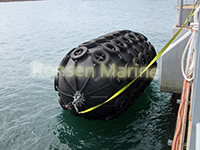
Pneumatic Fender
A pneumatic fender—also called a pneumatic rubber fender or Yokohama fender—is a floating marine fender filled with compressed air. It works as an air-spring shock absorber between ship and ship (STS) or ship and dock (STD), absorbing berthing energy while keeping reaction force and hull pressure low.
If you work in ports, shipping, offshore, naval, or marine procurement, this guide explains what a pneumatic fender is, how it works, why ISO 17357 matters, and how to choose the right one.
What Is a Pneumatic Fender?
A pneumatic fender is a cylindrical, reinforced-rubber marine buffer inflated with air. Because it contains compressed air, it floats on the water surface and compresses when a vessel pushes against it.
Instead of hard rubber crushing on impact, the air inside compresses gradually. This “air-spring” effect absorbs kinetic energy from the ship and returns to its original shape after the load is removed.
Pneumatic fenders are commonly used for:
- Ship-to-ship cargo transfer
- Tanker, LNG, and VLCC berthing
- Cruise ship and naval vessel protection
- Offshore platform and FPSO operations
- Ports with large tidal ranges
- Emergency or temporary berthing
They are often called Yokohama fenders because Yokohama developed the original compressed-air marine fender technology. Today, “Yokohama type fender” and “pneumatic rubber fender” are used interchangeably, but performance should always be checked against ISO 17357-1:2014.
How Does a Pneumatic Fender Work?
The working principle is simple but highly effective:
- A vessel approaches the berth or another ship.
- The pneumatic fender floats at the waterline, tethered by sling, chain, or net.
- The hull presses against the fender.
- The reinforced rubber body deforms and internal air pressure rises.
- Berthing energy is absorbed by air compression and elastic cord-layer strain.
- Reaction force stays relatively low and stable.
- When the vessel moves away, the air re-expands and the fender recovers its shape.
At the ISO 17357 test point of 60% deflection, manufacturers publish:
- GEA – Guaranteed Energy Absorption
- R – Reaction Force
- P – Hull Pressure
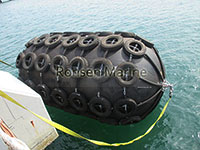
Pneumatic Fenders
This is why pneumatic fenders are preferred when hull paint, coatings, aluminum structures, or lightweight berths must be protected.
Pneumatic Fender Structure
A quality pneumatic rubber fender is not just a rubber balloon. It is a vulcanized, multi-layer marine product.
| Layer | Material |
| Outer rubber | Abrasion-resistant natural/synthetic rubber |
| Cord layer | Synthetic tire-cord fabric, nylon/polyester |
| Inner rubber | Airtight rubber lining |
| End flange & valves | Galvanized/stainless steel |
For fenders ≥ 2500 mm diameter, ISO 17357 requires a safety relief valve to release excess pressure if over-compressed.
Types of Pneumatic Fenders
1. Net Type Pneumatic Fender
Also called chain-tire-net or Type I.
- Protected by chain/wire net and tires or rubber sleeves
- Best for VLCC, LNG, tankers, rough seas
- Longest abrasion life
- Heavier and more robust
2. Sling Type Pneumatic Fender
Also called Type II.
- No hard protection net
- Thick outer rubber + integral lifting slings
- Lighter, faster to deploy
- Good for yachts, cruise ships, naval vessels, calm water
3. Hydro-Pneumatic Fender
- Part air, part water ballast
- Held vertically, often submerged
- Used for submarines, low-freeboard hulls, special naval operations
- Usually custom-engineered
P50 vs P80: What Pressure Rating Do You Need?
Pneumatic fenders are usually supplied at two initial pressures:
| Rating | Initial pressure | Energy absorption |
| P50 | 50 kPa | Lower |
| P80 | 80 kPa | Higher |
Rule: never inflate a P50 fender to P80 pressure. Cord angle, flange design, and safety factors are different.
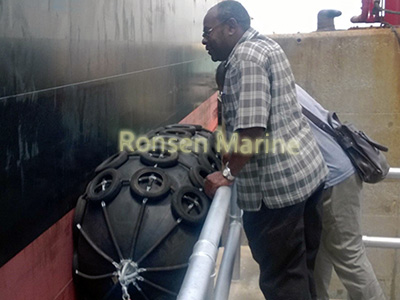
Yokohama Fenders
Why Pneumatic Fenders Beat Solid and Foam Fenders
| Feature | Pneumatic fender | Solid rubber fender | Foam-filled fender |
| Yes | Yes | No | Yes |
| Yes | Yes | No | Partial |
| High | High | Medium | High |
| Low | Low | High | Medium |
| Yes | Yes | No | No |
| Yes | Yes | Limited | Difficult |
| Excellent | Exellent | Poor | Good |
Pneumatic fenders win for ship-to-ship transfer, tidal berths, LNG/cruise/naval protection, and operations where low hull pressure matters.
ISO 17357-1:2014: Why It Matters
When buying pneumatic fenders, do not accept “Yokohama type” as a full specification. Always specify:
Pneumatic rubber fender, ISO 17357-1:2014, P50 / P80, Diameter × Length, Type I net type / Type II sling type, with safety valve, mill certificate, third-party class approval (ABS/BV/DNV/CCS/LR)
ISO 17357 defines:
- Rubber physical properties
- Cord layer strength
- Air tightness
- Energy absorption and reaction force at 60% deflection
- Pressure ratings: 50 kPa and 80 kPa at 20°C
- Safety valve and flange requirements
- Type testing and production testing
Common Pneumatic Fender Sizes
Typical range: Ø500 mm × 1000 mm to Ø4500 mm × 12000 mm.
Example performance:
- 2500 × 5500 mm, P50: ≈ 943 kJ GEA, ≈ 2019 kN reaction
- 3300 × 6500 mm, P50: ≈ 1814 kJ GEA, ≈ 3015 kN reaction
- 3300 × 6500 mm, P80: ≈ 2532 kJ GEA, ≈ 3961 kN reaction
Exact values vary by manufacturer and tolerance is usually ±10%.
How to Choose the Right Pneumatic Fender
Use this checklist:
1. Calculate berthing energy
Based on vessel displacement, approach velocity, and berthing coefficient.
2. Set allowable hull pressure
LNG, cruise, and naval hulls need low pressure.
3. Match GEA at 60% deflection
Fender energy absorption must exceed calculated berthing energy.
4. Choose P50 or P80
Sensitive hull → P50. Heavy tanker STS → P80.
5. Choose net or sling type
Rough duty → net type. Clean hulls → sling type.
6. Check certifications
ISO 17357-1:2014 + class society approval.
7. Plan maintenance
Monthly pressure check, surface inspection, chain/net inspection every 3–6 months.
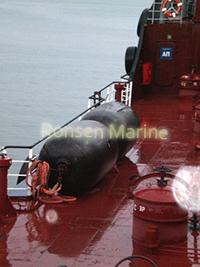
Pneumatic Yokohama Fender
Pneumatic Fender Maintenance Best Practices
- Inflate with dry air or nitrogen to rated pressure
- Check pressure monthly; sunlight/temperature can change readings
- Wash with fresh water after seawater exposure
- Inspect for cuts, abrasion, valve leaks, chain corrosion
- Store deflated/shaded, away from ozone and sharp objects
- Never overinflate
- Keep safety relief valve functional
With proper care, quality pneumatic fenders typically last 6–10 years; net-type fenders in moderate service can exceed 10 years.
Applications of Pneumatic Fenders
- Ship-to-ship oil and LNG transfer
- Ship-to-dock berthing
- Oil terminals and VLCC/ULCC berths
- FPSO and FSU offloading
- Offshore wind and supply vessels
- Cruise terminals
- Naval and submarine berthing
- Floating docks and marinas
- Emergency mooring and lay-by protection
FAQ: People Also Ask
What is a pneumatic fender used for?
A pneumatic fender protects ships and structures by absorbing impact energy during berthing or ship-to-ship transfer.
What is the difference between a pneumatic fender and a foam fender?
A pneumatic fender uses compressed air and can be deflated for shipping/repair. A foam fender uses closed-cell foam, floats, but cannot be pressure-tuned like a pneumatic fender.
Why is it called a Yokohama fender?
Because Yokohama developed the original air-filled marine fender. “Yokohama type” now describes ISO-style pneumatic rubber fenders from any qualified manufacturer.
What pressure should a pneumatic rubber fender be?
Usually 50 kPa (P50) or 80 kPa (P80) at 20°C. Never mix ratings.
How long does a pneumatic fender last?
Typically 6–10 years with proper maintenance; longer for net-type fenders in moderate conditions.
Is ISO 17357 important?
Yes. It ensures published energy absorption, reaction force, materials, and safety features are standardized and verifiable.
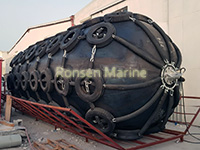
Pneumatic Rubber Fenders
Key Takeaways
- A pneumatic fender is an air-filled, floating marine shock absorber.
- It gives high energy absorption + low reaction force.
Best for STS, tidal docks, LNG, cruise, naval, and offshore use.
Always specify ISO 17357-1:2014, size, P50/P80, and net/sling type.
Maintenance is simple: pressure checks, surface inspection, clean storage.
Need Pneumatic Fenders?
If you want a quotable spec sheet, send us:
Vessel type: Vessel tonnage: Berthing velocity: Tidal range: Application: STS / STD / offshore Preferred type: net / sling / hydro-pneumatic Target size:
We’ll recommend P50/P80, quantity, and ISO 17357-compliant configuration.
