

What Is a Mooring Chain? The Complete Guide to Types, Grades, Selection & Maintenance
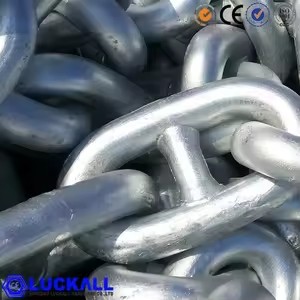
Mooring Chains
Quick Answer: What Is a Mooring Chain?
A mooring chain is a heavy-duty steel chain that connects a floating vessel, offshore platform, buoy, or other marine structure to an anchor or weight on the seabed. Unlike a ship’s temporary anchor rode, a mooring chain is built for permanent or long-term station-keeping — often staying submerged for years at a time.
Its job is twofold: hold the structure on station against wind, waves, current, and tide; and absorb dynamic shock loads through its own weight. A properly sized chain hangs in a catenary (downward-curving) shape, with a section resting on the seabed. When the moored structure moves, it lifts part of that chain, and the weight of the lifted segment pulls it back — a passive, reliable restoring force that doesn’t need power or thrusters.
How a Mooring Chain Works
Every mooring system is built around the same physics. The chain lies on the seabed and rises toward the floating structure, forming a catenary curve. That curve is the key to the whole system:
- Weight keeps the pull on the anchor horizontal, helping the anchor stay buried and hold.
- Shock absorption: as the vessel moves, chain gradually lifts off the seabed, soaking up energy before loads reach the anchor, swivel, or deck fittings.
- Abrasion resistance: chain tolerates contact with rocks, mud, sand, and marine growth in a way rope simply cannot.
- Predictable geometry: chain maintains a known angle of pull, which makes the whole system easier to engineer.
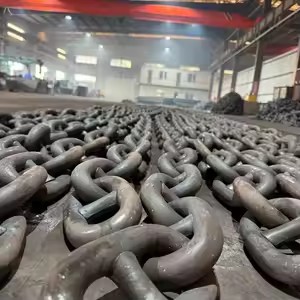
Marine Chains
This is what engineers mean by “station keeping” — holding a floating structure inside a defined operating area. A catenary mooring is a passive, long-term solution; dynamic positioning (DP) thrusters are the active alternative. Most permanent installations use chain or a chain-plus-rope hybrid because it works without constant power input.
Types of Mooring Chain
Stud-Link (Studlink) Chain
Each link has a steel stud welded across its inside width. That stud stops the link from bending sideways or twisting under extreme tension, so the link holds its shape.
Best for: deepwater, offshore oil rigs and platforms, FPSOs, floating wind turbines, and heavy commercial moorings where maximum strength and fatigue resistance matter.
Studless Chain
No internal stud. Lighter, more flexible, and easier to handle, deploy, and inspect. It’s increasingly favored for permanent moorings because of its simpler geometry and lower risk of stud loss.
Best for: shallow water, coastal facilities, navigation buoys, and many permanent mooring systems.
Open Link / Short Link Chain
Short link chain offers the best strength-to-size ratio of the common chain types and is very flexible, making it a strong choice for mooring and anchoring. Its compact links don’t accept standard shackles directly, so it’s usually built into a custom welded mooring assembly.
Mid Link & Long Link Chain
Mid link is a practical compromise — most of the benefits of short link with the advantage that it accepts matching shackles without special end links. Long link has the largest internal clearance, making it easy to fit a wide range of attachments, and offers a favorable weight-to-breaking-strength ratio, which matters when sizing a mooring buoy.
Material & Coating Variants
Hot-dip galvanized chain — the standard for permanent boat moorings, with proven corrosion protection for continuous immersion.
Stainless steel chain — highest corrosion resistance, ideal for long-term saltwater service, though more expensive; easier to inspect because it doesn’t hide damage under rust scale.
Grade 40 / solid-zinc chain — higher strength for demanding moorings.
Self-colour (untreated) chain — typically used as heavy ground chain that sits permanently on the seabed, where appearance doesn’t matter but mass and stability do.
Coated chain (epoxy, polyurethane, or polymer) — used in high-wear environments such as estuaries with shifting sands.
Mooring Chain Grades Explained
Chains are made in different strength grades by varying the steel alloy and heat treatment. For stud link anchor and mooring chain, Lloyd’s Register recognizes three common grades: U1 (mild steel), U2 (high tensile, no heat treatment), and U3 (heat-treated alloy steel — roughly 40% stronger than U2 at the same size).
Offshore mooring uses a separate R-grade scale. Higher grades let you use a smaller diameter for the same load, cutting system weight while keeping safety margins.
| Grade | Tensile Strength (min) | Typical Use |
| R3 | ~690 MPa | Continental shelf & standard offshore mooring |
| R3S | ~770 MPa | Improved toughness for harsh conditions |
| R4 | ~860 MPa | Deep-sea development facilities |
| R4S | ~960 MPa | High-purity steel, very high loads |
| R5 | ≥1000 MPa | Ultra-deepwater, ultra-high strength |
| R6 | ≥1100 MPa | Next-generation deepwater mooring |
Note: the strongest chain is not automatically the right chain. A higher grade may be unsuitable for galvanizing, may corrode faster in some environments, or may simply cost more than the application justifies. Weight matters as much as strength in a mooring — sometimes the lower, cheaper grade is the better all-round choice.
Sizing: Diameter, Proof Load & Breaking Load
Chain diameter is the single most important sizing parameter. Larger diameter means more weight per metre, more catenary restoring force, and a higher breaking load — but also more load on the buoy and more cost. A mooring study should calculate required chain length, diameter, unit mass, anchor load, and safety factors from the actual environmental loads (wind, wave, current), water depth, seabed conditions, and the motion envelope of the floating asset.
As a representative sample of stud link chain data, the table below shows how proof and breaking loads rise with diameter:
| Diameter (mm) | Proof Load (kN) | Breaking Load (kN) | Weight (kg / 27.5 m) |
| 30 | 514 | 735 | 564 |
| 40 | 896 | 1,280 | 1,032 |
| 50 | 1,370 | 1,960 | 1,546 |
| 60 | 1,940 | 2,770 | 2,249 |
| 70 | 2,580 | 3,690 | 3,010 |
| 100 | 4,940 | 7,060 | 6,143 |
Always confirm final sizing against the relevant classification society rules and the manufacturer’s certified data sheet for the exact grade and diameter you plan to use.
Where Mooring Chains Are Used
Ship mooring — securing vessels alongside quays, dolphins, or buoys in ports and terminals, both temporary and permanent.
Offshore oil & gas — semi-submersibles, FPSOs, and drilling rigs held on station through extreme environmental loads.
Single Point Mooring (SPM) — the critical link between a tanker and an offshore loading system.
Offshore wind — anchoring floating wind turbines in deeper water.
Navigation buoys, research stations, and floating docks — long-term stability in all conditions.
Aquaculture — securing fish-farming cages and equipment.
Recreational moorings — permanent ground chain plus a lighter riding chain connected with a shackle or swivel.
How to Choose the Right Mooring Chain
- Start with the environment. Shallow coastal water may only need a corrosion-resistant galvanized chain; deepwater or offshore demands high-strength stud link or R-grade chain.
- Match the load. The chain’s tensile and fatigue capacity must meet or exceed the worst-case environmental loads with the required safety factor.
- Account for the seabed. Sand grinds chain and causes accelerated wear; mud and clay are softer but can create oxygen-depleted, corrosive conditions; rock causes high-impact abrasion and calls for heavier grades or protective coatings.
- Balance weight and strength. A heavier chain gives more catenary restoring force but puts more load on the buoy and costs more to install.
- Check the whole assembly. Every component — shackles, swivels, end links, and connectors — must be of equivalent strength to the chain itself.
- Verify certification. Offshore projects typically require classification society approval (ABS, DNV, LR, BV, CCS, NK, and others) and a full Mill Test Certificate (MTC).
Standards, Certification & Inspection
Mooring chains must comply with strict international standards. Key references include API Spec 2F and API RP 2SK for offshore mooring, DNV-OS-E301, and classification society rules from ABS, DNV, Lloyd’s Register, BV, CCS, and others. Third-party inspection and class certification are often mandatory on offshore projects.
A disciplined inspection program is the difference between a 25-year service life and a sudden failure. Pay special attention to the “chafe section” — the part of the chain that rests on the seabed and suffers motion-induced abrasion.
| Check | Method | Acceptance / Action |
| Elongation | Calipers / chain gauge on 10-link segments | 3% elongation = significant wear; >12% is critical fatigue |
| Section loss | Diameter measurement at contact points | Replace at >10–15% reduction from original |
| Corrosion & pitting | Visual check + pit gauge | Pitting >1 mm or >10% of diameter = retire link |
| Cracks & deformation | Magnetic particle (MPI) or ultrasonic | Any crack = immediate replacement |
| Proof test | Hydraulic load cell | Every 5 years: 100% proof load, no permanent set |
| Shackles & swivel | Visual + pin check | Mouse pins with seizing wire; fit a swivel between ground and riding chain |
A practical rule for permanent moorings: inspect annually, haul the entire system out of the water at least every two to three years, and replace any chain showing pitting, elongation, or section loss beyond the thresholds above. Underwater visual checks alone miss damage at and below the mud line.
Maintenance & Service Life
Rinse with fresh water after every saltwater exposure to remove chlorides that accelerate galvanic corrosion.
Dry thoroughly before storage — trapped moisture causes “white rust” that breaks down zinc coatings.
Use soft brushes and pH-neutral cleaners on coated chains; abrasives and solvents damage the protective layer.
Lubricate interlink contact points with a marine-grade lubricant — but avoid over-application, which attracts grit.
Rotate end-for-end periodically so wear doesn’t concentrate in one zone; flip the full chain on a schedule and keep digital records of every link’s diameter and inspection date.
Store on non-conductive racks, never tightly coiled, in a ventilated, temperature-stable space — and keep desiccant in place.
When repair costs exceed roughly 60% of a new chain’s price within two years, replacement is normally the more economical choice. For Grade R4/R4S offshore chain under proper care, a service life of 20–25 years is achievable; quality protective coatings can remain effective for 20–30 years.
Common Questions
Mooring chain vs. anchor chain — what’s the difference?
An anchor chain is the temporary rode used to drop and retrieve an anchor; it must run smoothly through a windlass, bow roller, and chain locker. A mooring chain is sized for permanent or long-term station-keeping and stays in place for years. They share the same basic physics, but their duty cycles and certification requirements differ.
How long should a mooring chain be?
A common permanent-mooring rule of thumb is a ground chain 1.5 times the maximum water depth, with a lighter riding chain equal to the water depth, joined by a galvanized shackle or swivel. Final length must come from a site-specific catenary calculation — too short gives shock loads, too long reduces restoring stiffness and can let the chain go slack.
Can you weld a mooring chain to repair it?
Welding is strongly discouraged outside a certified facility with approved preheat and post-weld heat treatment procedures. In practice, the safe route is to replace the damaged section with a pre-tested repair link of matching grade and heat treatment, complete with certification.
How much does a mooring chain cost?
Cost is driven by diameter, grade, coating, and certified length. A 10 mm galvanized leisure mooring chain can be had for well under £10 per metre, while large-diameter R4/R5 offshore chain runs into hundreds of dollars per metre. The upfront price is high, but the low maintenance and reliability of chain make it a sound lifecycle investment — and offshore floating wind projects accept the chain cost as a major but justified share of the system.
Key Takeaways
A mooring chain is the load-bearing link between a floating asset and the seabed — engineered for long-term, passive station keeping.
Stud-link chains lead on strength and stability; studless chains win on handling, weight, and flexibility.
Grade, diameter, coating, and certification must all be matched to the site — there is no one-size-fits-all chain.
Sizing is a catenary calculation, not a guess: depth, environment, seabed, and load case all feed in.
Inspection and maintenance decide service life. Track diameter, elongation, corrosion, and fatigue — and never skip the out-of-water haul-out.
Need a specific specification? Send us your water depth, vessel or structure details, environmental loads, and preferred chain grade — and we’ll help you size the right mooring chain for the job.
