

What Is a Marine Fender? (The Only Guide You Need)
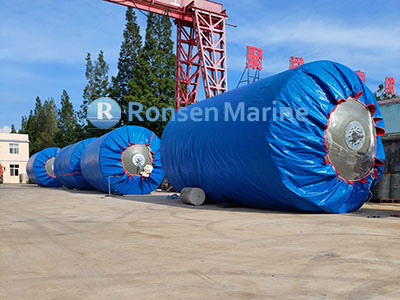
Foam Filled Fenders
A marine fender is a bumper-like energy-absorbing device mounted on a ship’s hull, dock, wharf, or offshore structure to prevent direct metal-to-metal (or concrete) contact during berthing. It absorbs the kinetic energy of a moving vessel and dissipates it as controlled deformation, protecting both the vessel and the berth structure from costly damage.
In plain terms: the fender is the “shock absorber” of any dock. Without it, a 50,000-ton ship brushing a concrete quay would transfer enormous point loads into the wall — cracks, spalling, and hull plating deformation follow within months.
Why “Fender” and Not “Bumper”?
The term marine fender is the international standard in technical and commercial contexts (ISO 17357, PIANC guidelines). “Bumper” is acceptable in casual or small-craft usage, but engineering specs, tender documents, and classification society rules almost always say fender system.
Key takeaway: a fender is not just a piece of rubber — it is a engineered energy-absorption system comprising the fender body, front panel (if any), chains, swivels, and the supporting structure behind it.
1. How a Marine Fender Works
When a vessel makes contact, the fender deflects. That deflection does three things at once:
- Absresses energy — the area under the force-deflection curve equals the energy absorbed (in kN·m or kJ).
- Limits reaction force — keeps the hull pressure and dock reaction within safe design values.
- Returns to shape — a good fender rebounds with minimal permanent set, ready for the next berthing.
The two numbers every spec sheet lives and dies by:
| Metr | What it tells you |
| Energy absorption (E) | Total berthing energy the fender can take at rated deflection, usually expressed at 60% or 70% deflection |
| Reaction force(R) | The peak push-back force transmitted to hull and dock at that deflection |
A common beginner mistake is buying on “hardness” alone. A very hard fender may absorb plenty of energy but hit the hull with a reaction force that bends steel. The curve — force vs. deflection — is the product.
2. Types of Marine Fenders
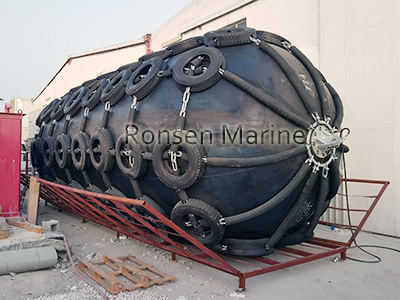
Pneumatic Rubber Fenders
2.1 Rubber Fenders
The workhorse of commercial ports. Made from high-grade rubber (typically SBR, NR, or EPDM blends) with internal steel reinforcement.
- Cone fenders — highest energy-to-reaction ratio; the modern default for large terminals.
- Cell fenders — cylindrical, very stable, popular in Asia and the Middle East.
- Arch (V-type) fenders — compact, high-performance, good where space is tight.
- D-type / GD-type fenders — economical, for smaller berths and tugboats.
- Cylindrical (roller) fenders — allow the vessel to slide along the face, common on lock walls and corners.
- Pneumatic (Yokohama-type) fenders — inflatable, filled with air, the classic choice for ship-to-ship (STS) transfer and temporary operations.
2.2 Foam-Filled Fenders
An EVA or polyurethane foam core sealed inside a polyurea skin. Will not deflate or sink — a decisive advantage over pneumatic types.
Best for: offshore platforms, floating docks, tugboats, yacht marinas, and any application where a puncture is a real risk.
2.3 Pneumatic Fenders (H3)
Air-filled, originally developed in Yokohama — hence the trade name. They deliver a very low hull pressure, which is why they dominate STS operations. The trade-off: they need pressure checks, valves, and protection from sharp contact.
2.4 Timber and Composite Fenders
Still found on older or low-budget jetties. Cheap and easy to replace, but they rot, splinter, and offer poor energy absorption. Generally being phased out in favor of rubber or foam.
2.5 Dock and Boat Fenders
Small-format vinyl or PVC fenders for yachts and workboats — fender bars, round fenders, flat fenders. They solve the same physics at a much smaller scale.
Comparison table (a strong ranking signal when formatted as a real HTML table):
| Type | Energy absorption | Maintenance | Best use |
| Cone rubber | Very high | Low | Large container/bulk terminals |
| Cell rubber | High | Low | General cargo, RO-RO |
| Arch rubber | High | Low | Space-constrained berths |
| Pneumatic | High | Medium | STS transfer, temporary berthing |
| Foam-filled | Medium-high | Very low | Offshore, floating structures |
| Timber | Low | High | Legacy/low-load jetties |
3. Key Selection Criteria
A fender that works perfectly at one berth can fail dangerously at another. Evaluate these six variables before specifying:
- Vessel size and displacement — the single biggest driver of energy.
- Berthing velocity — approach speed normal to the dock face.
- Dock geometry — straight quay, corner, dolphin, or mono-pile.
- Tidal range and water level variation — determines fender height and freeboard.
- Hull pressure allowance — larger, softer vessels (e.g., LNG carriers, ferries) need lower reaction force.
- Environmental conditions — saltwater, UV, temperature extremes, ice, and debris.
Pro tip: If a supplier quotes you a fender without asking for at least the vessel size, approach speed, and water level range — keep looking. That quote is a guess, not an engineering recommendation.
4. The Berthing Energy Formula
The theoretical berthing energy is:
E = ½ × M × V² × C × Cs × Ce
Where:
- M = effective mass of the vessel (tonnes)
- V = approach velocity (m/s)
- C = berthing configuration coefficient
- Cs = softness coefficient
- Ce = eccentricity coefficient
In practice, the effective mass is rarely the full displacement — a large ship berthing stern-first engages only part of its mass. This is where most DIY calculations go wrong, and why terminals rely on naval architects or the fender manufacturer’s calculation software.
5. Installation and Inspection
Installation
- Align the fender so its deflection axis is perpendicular to the expected contact line.
- Use hot-dip galvanized or stainless steel chains, shackles, and swivels — corrosion here is the #1 cause of system failure.
- Front panels (UHMW-PE) reduce friction and protect the fender; size them for the expected contact area.
- Verify the supporting concrete or steel structure can take the reaction force. The fender is only as strong as what’s behind it.
Inspection checklist (every 6–12 months)
- Cracks, cuts, or abrasion on the fender body
- Permanent deformation or compression set
- Chain elongation, rust, and swivel seizure
- Loose or missing bolts and anchor points
- Pressure and valve condition on pneumatic units
- UHMW-PE panel wear and scoring
6. Common Mistakes to Avoid
- Undersizing — the most expensive error, usually discovered after the first damaged quay.
- Buying on price per piece — compare cost per kJ of absorbed energy instead.
- Ignoring the reaction force — a “stronger” fender can damage a fragile hull.
- Skipping the structure check — anchor bolts and concrete capacity are part of the system.
- Mixing old and new in a line — uneven deflection leads to point loading on the new unit.
7. Frequently Asked Questions
What is a marine fender used for?
It absorbs the impact energy when a vessel berths, protecting both the ship’s hull and the dock structure from damage.
What is the difference between a rubber fender and a foam fender?
Rubber fenders are solid, reinforced, and generally used in permanent fixed installations. Foam fenders have a closed-cell foam core and will not deflate or sink, making them ideal for offshore and floating applications.
How long do marine fenders last?
Typically 10–15 years for rubber units and 15+ years for foam-filled types, assuming correct specification and regular inspection.
How do I choose the right size?
You need vessel displacement, approach speed, berth geometry, water level range, and allowable hull pressure. Use the energy formula above or request a calculation from the manufacturer.
Are marine fenders the same as dock bumpers?
Functionally yes. “Marine fender” is the technical term; “dock bumper” is the generic description.
