

What Are Support Buoys? A Complete Guide to Support Buoys in Marine & Offshore Operations
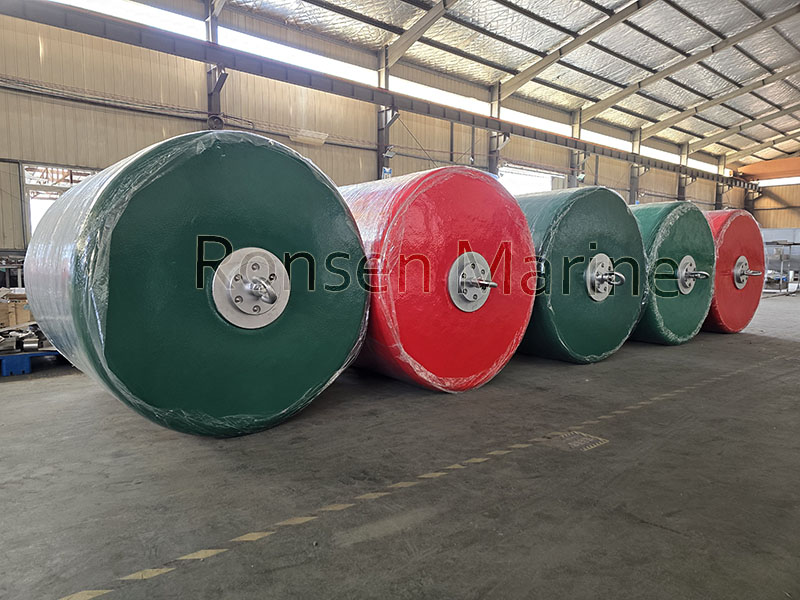
Support Buoys
Support buoys are heavy-duty floating devices used in marine and offshore systems to provide buoyancy, lift mooring chains, hoses, cables, and ropes off the seabed, and reduce tension, abrasion, and fatigue in subsea equipment.
Unlike navigation buoys, which exist mainly to guide ships, support buoys are operational marine infrastructure. Their job is not to mark a channel—it is to keep critical offshore assets safely suspended, loaded, and protected.
What Are Support Buoys Used For?
Support buoys are used wherever underwater lines need controlled buoyancy.
Common uses include:
- Supporting mooring chains in Single Point Mooring (SPM) systems
- Keeping loading hoses and flexible jumpers off the seabed
- Supporting subsea power cables, umbilicals, and fiber-optic cables
- Reducing chain seabed abrasion
- Controlling catenary shape in mooring lines
- Marking and retrieving submerged mooring ends
- Supporting aquaculture nets, scientific instruments, and dredging hoses
In short: support buoys lift, protect, and stabilize marine lines.
Support Buoy vs Navigation Buoy vs Mooring Buoy
This is one of the most searched comparisons, so Google rewards a clear answer.
| Buoy Type | Main Purpose |
| Navigation buoy | Mark channesl, hazards, safe water |
| Mooring buoy | Provide a tie-up point for vessels |
| Support buoy | Lift/support chains, hoses, cables |
A mooring buoy is where a ship ties up.
A support buoy is what keeps the mooring system itself from failing.
Types of Support Buoys
1. Cylindrical Support Buoy
Large foam-bodied buoy used for pipeline floatation, dredging hoses, and SPM hose support. High buoyancy, low roll.
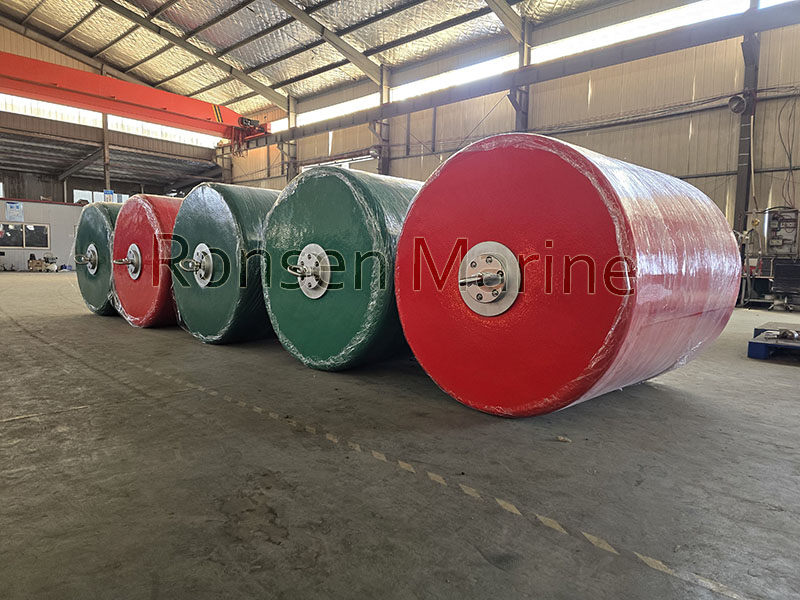
Cylindrical Chain Support Buoys
2. Chain-Through Support Buoy
The mooring chain passes through a central steel tube. The buoy shares axial load and keeps the chain in a controlled profile. Common in SPM and offshore tanker terminals.
3. Pick-Up Buoy
Small support buoy attached to a messenger rope or chain end. Used to locate and retrieve submerged mooring equipment.
4. Anchor Pendant Buoy
Keeps heavy pendant lines, auxiliary ropes, or clump-weight assemblies at the correct depth or surface profile.
5. Foam-Filled Surface Support Buoy
Made with closed-cell PE/EVA foam and polyurethane skin. Even if punctured, the core does not flood—so the buoy remains unsinkable.
How a Support Buoy Works
A typical support buoy load path looks like this:
- Seabed anchor or clump weight resists uplift
- Mooring chain / tension member transfers load
- Foam core provides net positive buoyancy
- Central steel tube + flanges carries tensile load
- End fittings connect to chain, hose, cable, or pendant
Engineers use this rule:
Net buoyancy ≥ submerged weight of hose/cable/chain + freeboard reserve
That formula is why support buoys prevent sagging, seabed drag, and premature equipment failure.
Support Buoy Construction: Why Foam-Filled Designs Win
Modern offshore support buoys usually have three layers:
1. Closed-Cell Foam Core
- PE or EVA foam
- Low density
- Water-resistant
- Remains buoyant even after damage
2. Reinforcement Layer
- Nylon or polyester cord
- Distributes tensile stress
- Improves impact resistance
3. Polyurethane (PU) Skin
- UV-resistant
- Abrasion-resistant
- Marine-grade durability
- Optional nylon-reinforced PU for harsh duty
Steel parts are typically hot-dip galvanized or epoxy coated to resist corrosion.
Where Support Buoys Are Used
Support buoys appear in nearly every heavy marine sector:
- SPM terminals – tanker loading/unloading hose support
- Offshore oil & gas – riser, chafe chain, and umbilical support
- Offshore wind – export cable handling and marker support
- Subsea cable laying – keeping cables neutral or positively buoyant during lay
- Ports & dredging – discharge hose flotation
- Aquaculture – net pen and mooring line support
- Salvage & temporary moorings – rapid-deployment flotation
Benefits of Support Buoys
Why do offshore engineers specify them?
✅ Prevent seabed wear on chains and hoses
✅ Reduce fatigue and tension in mooring systems
✅ Enable ship-to-shore transfer without fixed jetties
✅ Foam-filled units do not burst like steel air tanks
✅ Lower maintenance than inflatable buoys
✅ Customizable buoyancy, diameter, color, and fittings
✅ Perform in tropical, North Sea, and Arctic-modified projects
How to Choose the Right Support Buoy
When requesting a quote, include:
- Required net buoyancy (kg or kN)
- Chain diameter and grade
- Hose/cable outer diameter and wet weight
- Water depth and tidal range
- Current, wave height, and environmental class
- Central tube or end-fitting type
- Steel coating: HDG / epoxy
- Foam type: PE / EVA
- Skin: PU / nylon-reinforced PU
- Certs: ISO / BV / ABS / LR / CCS / OCIMF alignment
FAQ: What Are Support Buoys?
What is a support buoy used for?
A support buoy provides buoyancy to mooring chains, hoses, cables, and ropes so they do not drag on the seabed or overload the mooring system.
Are support buoys unsinkable?
Most modern foam-filled support buoys are virtually unsinkable. Closed-cell PE/EVA foam keeps them floating even if the outer skin is punctured.
What is the difference between a support buoy and a mooring buoy?
A mooring buoy is a tie-up point for vessels. A support buoy lifts and protects the chains, hoses, and cables inside the mooring system.
What is a chain-through support buoy?
It is a support buoy with a central steel tube that lets the mooring chain pass through the buoy body while sharing tension along the line.
Where are support buoys used?
SPM terminals, offshore oil and gas, subsea cable laying, offshore wind farms, dredging, aquaculture, ports, and salvage operations.
Key Takeaway
Support buoys are unsinkable offshore floats that hold hoses, cables, and chains in the correct position, protect subsea assets from abrasion, and reduce fatigue in mooring systems.
If you are specifying marine equipment, do not confuse them with navigation buoys. A navigation buoy tells a ship where to go. A support buoy keeps the entire offshore system from breaking.

