

What Are Pneumatic Rubber Fenders? The Complete Guide for Marine Operators and Procurement Teams (2026 Edition)
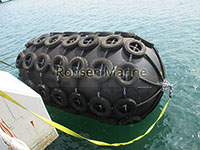
Pneumatic Rubber Fenders
If you’ve ever watched a large ship pull alongside another at sea — a tanker transferring cargo to a smaller vessel, or a cruise ship docking beside a quay — you’ve probably seen them: massive, black, tire-like rubber tubes floating in the water between the two hulls. Those are pneumatic rubber fenders.
They’re the only type of marine fender that floats, and that single fact makes them irreplaceable for an entire category of marine operations.
But what exactly are pneumatic rubber fenders, how do they work, and when should you choose them over foam-filled or fixed fender systems?
This guide gives you everything buyers, marine superintendents, and port contractors need: the working principle, the anatomy of the fender, the specifications that actually matter, a head-to-head comparison with foam fenders, safety and inflation procedures, costs, and a five-question checklist for choosing a manufacturer.
What Are Pneumatic Rubber Fenders?
Pneumatic rubber fenders (also known as Yokohama fenders, pneumatic fenders, floating fenders, or inflatable rubber fenders) are marine fenders made from reinforced rubber, shaped like a large elongated cylinder or barrel, and inflated with compressed air to a working pressure typically between 50 and 80 kPa.
Unlike cone, cell, arch, or D fenders — which are solid rubber and bolted permanently to a dock — pneumatic fenders are hollow and filled with air. This lets them float on the water surface, which is why they’re the default choice for any operation where a fixed fender cannot be installed.
They were invented in 1958 by Yokohama Rubber Company in Japan, which is why the generic term “Yokohama fender” is still used worldwide today.
Why “Pneumatic”?
The word comes from the Greek pneuma, meaning “air” or “breath.” The fender’s entire working principle depends on compressed air:
- The air inside acts as the energy-absorbing medium — when a vessel presses against the fender, the air compresses and the rubber distorts, absorbing the impact energy
- The air also makes the fender buoyant — it floats, so it can be positioned between two moving vessels or along a quay face without any fixed mounting
- The pressure is adjustable — inflate it more for a stiffer response, less for a softer one
In short: a pneumatic fender is the only floating, movable, high-capacity fender in the marine world. If your operation involves moving vessels, ship-to-ship transfer, or temporary berthing, it’s the only game in town.
How Do Pneumatic Rubber Fenders Work?
The principle is different from solid rubber fenders — and understanding it is key to using them safely:
- The fender is inflated to its specified working pressure (usually 50–80 kPa, depending on size and type).
- When a vessel makes contact, the fender’s curved surface meets the hull and the internal air compresses.
- The rubber carcass distorts while the air pressure absorbs the kinetic energy of the impact — typically 70–80% energy absorption.
- The fender slowly rebounds as the air re-expands, ready for the next impact.
Because the working medium is air rather than solid rubber, pneumatic fenders deliver a uniquely soft, gradual reaction force — gentler on both hull and structure than any other fender type.
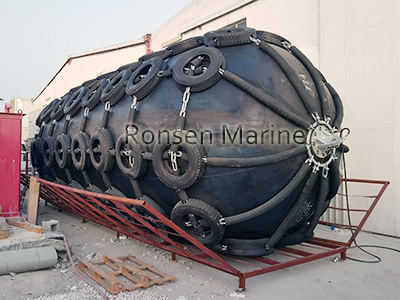
Pneumatic Rubber Fender
Key takeaway: A pneumatic fender absorbs energy by compressing air, not by deforming rubber. That’s why it feels softer than a solid fender of the same size — and why pressure management is everything.
Anatomy of a Pneumatic Rubber Fender
A typical pneumatic fender has five main components:
| Component | Function |
| Rubber carcass | The main body - inner rubber layer (airtight) + outer rubber layer (abrasion/weather resistant) |
| Synthetic tire cord reinforcement | Cross-plied nylon or polyester cords that give the fender its strength and shape |
| End flanges | Steel or rubber rings at each end, with bolt holes for attaching the chain net |
| Chain net (chain and tire net) | Galvaized steel chain with old tires or rubber sleeves, protecting the fender body from abrasion |
| Shackles and mooring lines | Connect the fender to the vessel or dock |
Common Pneumatic Fender Types
- Type I (Sling type) — no chain net, attached by slings. Light duty, lower cost
- Type II (Chain net type) — full chain and tire net covering the body. The industry standard for heavy-duty work
- Type III (Rope net type) — rope net instead of chain. Lighter but less durable
- Extra high pressure (EHP) type — higher working pressure for greater energy capacity in the same footprint
Pneumatic Fender Specifications (What Actually Matters When You Buy)
When specifying pneumatic fenders, these are the parameters that carry the most weight:
| Parameter | Typical Range / Notes |
| Size | 500x1000 mm up to 3300x6500 mm (DxL) |
| Energy Absorption | 10-6,000+ kJ (Size and pressure dependent) |
| Working Pressure | 50-80 kPa (higher = stiffer, more energy) |
| Reaction Force | 60-1,500+ kN |
| Number of Ply | 4-10 cord layers (more = stronger) |
Standard Sizes
Pneumatic fenders are designated by diameter × length. Common sizes range from small 500×1000 mm units for tugs and workboats up to 3300×6500 mm for the largest STS operations involving VLCCs and ULCCs.
Pneumatic Fender vs Foam Fender: An Honest Comparison
This is the comparison every marine operator makes. Here’s the straight answer.
Pneumatic fender vs foam-filled fender:
- Pneumatic fenders are lighter, cheaper, and easier to handle — but they can deflate or burst if damaged
- Foam-filled fenders (EVA foam inside a polyurethane skin) cannot deflate — they’re safer for operations where a sudden failure would be catastrophic
- Foam fenders are maintenance-free and don’t require pressure checks; pneumatic fenders need regular inflation monitoring
- For STS oil transfer, foam fenders are increasingly mandated by oil majors due to the zero-deflation safety advantage
Pneumatic fender vs fixed rubber fenders (cone/cell/arch):
- Pneumatic fenders float and can be moved — they’re used for STS and temporary operations
- Fixed fenders are bolted to a permanent berth and cannot be relocated
- If you have a fixed dock, fixed fenders are more economical; if you have moving vessels, pneumatic fenders are essential
Rule of thumb: For ship-to-ship operations, temporary berthing, and anywhere a fender must float — pneumatic (or foam) is your only option. For permanent berths, fixed fenders are usually more cost-effective.
Pneumatic Fender Safety and Inflation: 6 Rules You Cannot Ignore
Pneumatic fenders operate under pressure, which makes them potentially dangerous if mishandled. Follow these rules:
- Never exceed the rated working pressure — over-inflation can cause the fender to burst, with lethal consequences
- Use only clean, dry air — moisture and oil inside the fender accelerate rubber degradation from the inside out
- Fit a pressure relief valve — this is a legal requirement in many jurisdictions and a basic safety necessity
- Inspect the chain net before every use — a damaged or missing chain net exposes the rubber body to direct abrasion and puncture
- Store deflated or properly supported — never leave a pressurized fender lying in direct sunlight for extended periods
- Check pressure weekly during active use — a slow leak turns a safe fender into a dangerous, ineffective one
Critical warning: A pneumatic fender that has lost significant pressure is more dangerous than having no fender at all — it creates a false sense of security while offering almost no protection. Always verify pressure before an operation.
How Much Do Pneumatic Rubber Fenders Cost?
Pricing varies sharply with size, pressure rating, ply count, chain net quality, and order volume. As a rough 2026 guide:
- Small fenders (500–1000 mm): from a few hundred dollars per unit
- Medium fenders (1500–2500 mm): mid-to-high range
- Large / EHP / heavy-duty chain net fenders: several thousand dollars per unit, typically quoted per project
The biggest cost driver is rubber grade and reinforcement quality. Buying direct from a manufacturer typically saves 20–40% versus going through a trading company — but always verify certifications (ISO 9001, OCIMF compliance, burst pressure test reports) before committing.
How to Choose a Pneumatic Rubber Fender Manufacturer
Not all fenders are built the same. Ask these five questions:
- Do they provide a performance curve (energy vs. reaction force at specified pressure) for every size?
- What rubber compound and cord reinforcement do they use — and can they prove burst pressure and fatigue resistance?
- Do they comply with OCIMF guidelines and relevant ISO standards?
- Can they show reference projects similar to your operation (STS, port, offshore)?
- What’s the warranty — and do they have a track record of honoring it?
A reputable manufacturer will answer all five without hesitation. If they can’t supply a proper performance curve or burst test report, walk away.
Frequently Asked Questions
What are pneumatic rubber fenders used for?
Pneumatic rubber fenders are used for ship-to-ship (STS) transfer operations, temporary berthing, alongside dock fendering, vessel-to-vessel mooring, and offshore platform protection. They’re the standard choice wherever a fender must float.
How do pneumatic fenders differ from solid rubber fenders?
Pneumatic fenders are hollow and air-filled, so they float and can be moved between operations. Solid fenders (cone, cell, arch, D) are fixed to a dock and cannot float or be relocated.
What pressure should a pneumatic fender be inflated to?
Typically 50–80 kPa, depending on the fender size and type. Always follow the manufacturer’s specified working pressure — never exceed it.
How long do pneumatic rubber fenders last?
Typically 6–10 years with proper care, or 8–15 years for well-maintained units. Service life is shorter than solid fenders because the rubber is under constant internal pressure and the chain net causes abrasion.
Are pneumatic fenders safe?
Yes, when properly inflated, fitted with a pressure relief valve, and protected by an intact chain net. The main risk is sudden deflation from puncture or over-pressure — which is why pressure checks and net inspections are non-negotiable.
Pneumatic vs foam fender — which is better?
Pneumatic fenders are lighter and cheaper but can deflate. Foam fenders cannot deflate, making them safer for high-risk operations like STS oil transfer, but they’re heavier and more expensive.
Final Thoughts
A pneumatic rubber fender is a remarkable piece of engineering — a simple idea (put air inside rubber) that solved a problem no solid fender could: how to protect two moving vessels from each other.
Specify it correctly, inflate it to the right pressure, maintain the chain net, and it will protect your asset safely for years.
The classic buyer’s mistake isn’t choosing the wrong fender — it’s treating pressure management as an afterthought, then paying for it in hull damage, burst fenders, or worse.
A pneumatic fender is only as good as the air pressure inside it. Check it, every time.

