

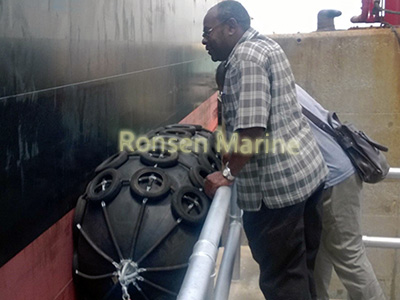
Pneumatic Fenders
Pneumatic Fenders is a hollow bag type anti-collision device made of high-strength synthetic rubber and special skeleton materials, which forms a buffering system with specific pressure and elastic modulus by filling compressed air.
Pneumatic fenders are mainly composed of hollow rubber airbags made of high-strength synthetic rubber and special skeleton materials. Its basic structure includes outer layer adhesive, inner layer adhesive, curtain fabric layer (skeleton material), winding ring, end flange, as well as components such as inflation pipe, deflation valve, one-way valve, etc. The outer layer of adhesive protects the skeleton material and the inner layer of adhesive from external damage; The inner layer of adhesive prevents gas leakage and maintains air pressure; The curtain fabric layer serves as the skeleton material to provide structural strength.
Referring to the patent “An Pneumatic Rubber Fender Structure” (CN202320874102.0), its structure also includes a buffering anti-collision mechanism and a sealing mechanism. The buffer anti-collision mechanism (such as fixed blocks, connecting ropes, and anti-collision tires) cooperates with the inner sealing plate to enhance the buffering and shock absorption effect; Sealing mechanisms, such as flanges and hemispherical sealing shells, can prevent components such as inflation pipes, deflation valves, and check valves from being corroded by water mist, thereby improving their service life.
According to the form of external protection, pneumatic rubber fenders can be divided into unsheathed and sheathed types. Sheath type (such as tire chain mesh, rope tire, wire rope tire mesh, etc.) extends the service life of fenders by wrapping a sheath (such as tire rope mesh) outside the bladder.

Pneumatic Fenders
Its main features include:
1. The absorption of impact energy is relatively large, and the anti impact force on the ship is relatively small.
2. The installation is relatively simple.
3. It has good elasticity and is less likely to undergo permanent deformation under compression.
4. Lightweight. This type of fender has been applied in scenarios such as oil tankers, container ships, yachts, offshore platforms, large shipyards, docks, and bridge piers.
5. The performance is relatively stable under inclined compression conditions.
Some products are made using integral winding technology, with no seams and uniform force distribution at all points. Their overall performance is better than traditional overlapping fenders.
This type of product needs to pass relevant quality system certification and classification society inspection.
