

Pneumatic Fender: What It Is, How It Works, Types, and Selection Guide
Introduction

Pneumatic fenders
A pneumatic fender is a marine fender that uses compressed air as the cushioning medium to absorb the impact energy generated when a vessel berths. Unlike solid rubber fenders, its body is hollow and filled with air, which gives it high energy absorption and relatively low reaction force.
The pneumatic fender was first developed by Yokohama Rubber in 1958 and is now specified worldwide under the international standard ISO 17357. It is widely used in ports, ship-to-ship (STS) operations, and offshore installations.
This guide covers what a pneumatic fender is, how it works, the main types, common applications, how to select the right one, and how to install and maintain it.
What Is a Pneumatic Fender?
The word pneumatic means “filled with air”. A pneumatic fender is a hollow, air-filled marine fender designed to protect both the vessel and the berth structure during docking.
Most pneumatic fenders are made with a reinforced rubber body, which is why they are often called pneumatic rubber fenders. The body usually consists of:
- Inner rubber liner – an airtight layer, usually made from halogenated butyl rubber, that prevents air leakage.
- Synthetic cord layers – high-strength nylon or polyester cords that bear internal pressure and impact loads.
- Outer rubber cover – a wear-resistant layer, usually a blend of natural rubber and SBR, that resists seawater, UV, and abrasion.
- Safety valve – releases pressure automatically if the internal pressure rises above the safe limit.
- Protective covering (optional) – chain-and-tyre net, synthetic rope net, or PU coating.
- End fittings – shackles, chains, flanges, and lifting eyes for suspension and handling.
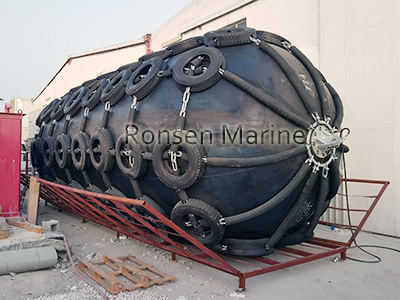
Pneumatic fender
Some manufacturers also offer foam-filled fenders, which use closed-cell foam instead of air. These are not pneumatic fenders because they do not rely on air compression.
How Does a Pneumatic Fender Work?
The working principle is based on air compressibility and can be broken down into three steps:
- Contact and deformation – The vessel presses against the fender, and the body deforms.
- Energy absorption – The air inside is compressed, so the pressure rises. The vessel’s kinetic energy is converted into gas compression energy and a small amount of heat. Because air compresses significantly, the fender deforms greatly while keeping reaction force relatively low.
- Rebound – After the vessel moves away, the compressed air returns the fender to its original shape, ready for the next impact.
Performance reference (isothermal approximation):
E ≈ P₀ × V × ln(P₂ / P₀)
Where:
P₀ = initial air pressure (commonly 50 kPa or 80 kPa)
V = internal volume
P₂ = maximum pressure after compression
This formula shows why larger fenders and higher initial pressure absorb more energy, and why the fender body must be strong enough to contain the pressure safely.
Key Advantages
- High energy absorption, low reaction force – protects both hull and berth structure, especially for large vessels.
- Flexible installation – can be mounted on docks, suspended on ship sides, or used in STS operations.
- Adaptable – tolerates uneven berth surfaces, hull inclination, and tidal changes.
- Floating capability – when suspended, it floats on the water and follows the tide.
- Durable and repairable – when made with the correct rubber compound, it resists marine conditions, and minor damage can often be cold-bond repaired.
Common Types of Pneumatic Fenders
| Type | Protective covering | Typical application |
| Type I - Chain & Tyre net | Heavy-duty chain and tyre protection | Large ports, STS, heavy berthing |
| Type II - Rope net | Synthetic rope net | Vessel-mounted, medium duty |
| Net-less (slender type) | PU coating or rubber only | Light duty, clean quays, yacht berths |
| Floating type | Suspended to float on water |
Note: “Floating” describes how the fender is deployed, while Types I, II, and net-less describe the protective covering. These categories overlap.
Common Applications
- Large vessel berthing – oil tankers, LNG carriers, bulk carriers, container ships
- Ship-to-ship (STS) transfer – cargo, bunkering, and offshore supply
- Floating docks and pontoons
- Ports with large tidal ranges
- Offshore platforms and wind-farm support vessels
- Naval, coastguard, and patrol vessels
Pneumatic Fender vs Foam Filled Fender
| Selection factor | Choose pneumatic | Choose foam filled |
| Energy absorption | High, with low reaction force | High, reaction rises progressively |
| Maintenance | Pressure checks and valve checks needed | Almost maintenance-free |
| Risk of deflation | Possible if punctured | None, no air inside |
| Best for | Large STS, floating docks, large vessels | Tugs, workboats, busy or remote sites |
| Service life | Typically 8-10 years | Typically 8-15 years |
Rule of thumb:
- Choose pneumatic fenders when you need low reaction force, large STS capability, or floating installation.
- Choose foam filled fenders when maintenance resources are limited, or puncture risk is high.
How to Select the Right Pneumatic Fender
Selection is usually based on the following five factors:
- Vessel size (DWT) – larger vessels need larger fender diameter and length.
- Berthing velocity – higher speed means more energy to absorb.
- Tidal range – determines suspension length.
- Hull type and dock structure – affects fender spacing and quantity.
- Initial pressure – usually 50 kPa (0.5 bar) for standard use and 80 kPa (0.8 bar) for heavy-duty use.
Most reputable suppliers calculate requirements according to ISO 17357. Always ask for a calculation sheet or performance data before purchasing.
Common Size Reference
The table above is only a general guide. Actual selection must be based on berthing energy calculations.
Installation Tips
- Inflate the fender to the manufacturer’s recommended pressure before suspending it.
- Use certified chains, shackles, and wire ropes with a suitable safety factor.
- Keep the suspension balanced so the fender hangs vertically and the load is evenly distributed.
- For floating installations, leave enough suspension length so the fender can follow the tide.
- Place fenders opposite the vessel’s main contact points: usually near the bow, stern, and midship.
- For STS operations, follow OCIMF ship-to-ship transfer guidelines.
Maintenance and Inspection
- Before each operation – visual check for obvious damage and correct positioning.
- Monthly (high-use) or quarterly (normal):
Check air pressure with a calibrated gauge and top up if needed.
Inspect the outer body for cracks, cuts, bulges, and ozone cracks.
Check the chain or rope net for wear and loose fittings.
Test the safety valve.
- Annually – thorough inspection, including material thickness at wear points.
- Storage – keep in a shaded, dry place, away from oil, grease, chemicals, and sharp objects.
Signs you should replace or repair the fender:
- Air pressure drops quickly after inflation.
- Visible bulges or delamination.
- Deep cuts reaching the cord layer.
- A faulty safety valve that cannot be repaired.
With proper care, service life is typically 8–10 years.
Common Mistakes to Avoid
- Over-inflation – exceeds the design pressure and risks bursting.
- Under-inflation – reduces energy absorption and can cause the fender to bottom out.
- Ignoring the safety valve – a faulty valve removes the most important safety protection.
- Using the wrong net type – a heavy chain net on a small vessel can cause unnecessary wear.
- Skipping berthing calculations – guessing the size often leads to oversized or undersized fenders.
- Confusing pneumatic with foam filled – they work on different principles and suit different applications.
- Buying only on price – low price often means lower material quality and weaker cord layers.
Frequently Asked Questions
Q: What is a pneumatic fender?
A: A pneumatic fender is a hollow, air-filled marine fender that absorbs berthing impact by compressing the air inside. Most pneumatic fenders have a reinforced rubber body and are also called pneumatic rubber fenders.
Q: Are pneumatic fenders the same as Yokohama fenders?
A: Yes. “Yokohama fender” refers to the pneumatic fender design developed by Yokohama Rubber in 1958. The two terms are used interchangeably in the marine industry.
Q: What pressure should a pneumatic fender be inflated to?
A: Most manufacturers recommend 50 kPa (about 0.5 bar) for standard applications and up to 80 kPa (about 0.8 bar) for heavy-duty berthing. Always follow the product manual.
Q: What does ISO 17357 cover?
A: ISO 17357 is the international standard that specifies requirements for pneumatic fenders, including performance, materials, testing, and marking.
Q: How long do pneumatic fenders last?
A: With correct inflation and regular inspection, service life is generally 8–10 years, depending on usage and environmental conditions.
Q: Can pneumatic fenders be used for ship-to-ship operations?
A: Yes. STS transfer is one of their most common applications. They are usually suspended between the two vessels during the operation.
Conclusion
A pneumatic fender uses compressed air as the cushioning medium and combines it with a reinforced body, usually rubber, to absorb berthing impact. It delivers high energy absorption with low reaction force and can be installed in many different ways, from fixed docks to ship-to-ship operations.
When buying, base your choice on vessel size, berthing conditions, tidal range, and ISO 17357 calculations. Correct inflation, proper suspension, and regular inspection are the keys to long service life and reliable protection.
