

 I. Scope of Application and Definition
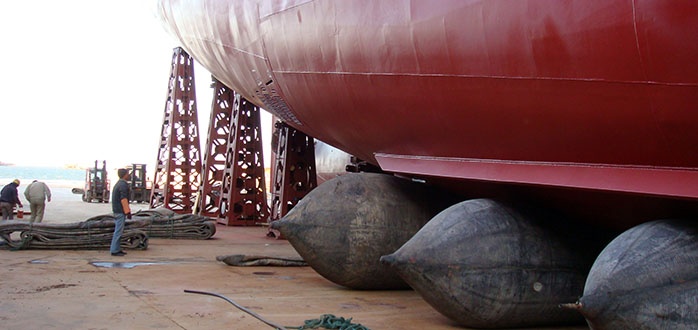
This specification applies to all operations involving the lifting and gradual launching of ships from above their self-supporting structures using an marine airbag system in shipyards, shipbuilding yards, and related dock areas. The marine airbag system typically consists of multiple marine airbag units, an air supply system, a control valve assembly, pressure gauges and pipelines, support and positioning components, as well as cushioning parts that come into contact with the ship’s hull. The launching operation involves various factors such as mechanical loads, hydrodynamics, and environmental impacts, and must be conducted under the premise of ensuring the safety of the ship’s structure, the personal safety of the operating personnel, and the protection of the surrounding environment.
II. Basic Principles and Safety Requirements
With safety as the premise, we adhere to the principle of “who organizes, who is responsible, who operates”, clarifying the responsibilities and authorities of personnel at all levels.
Conduct a risk assessment before the operation, list key risk points and corresponding countermeasures; assign dedicated safety personnel on site to oversee the implementation.
The ship launching airbag and pipeline system should comply with the design parameters, and any modifications must be approved by the design unit or manufacturer and documented in writing.
The operation site should be equipped with necessary risk elimination and emergency evacuation routes, maintain smooth communication, and set up emergency assembly points and rescue equipment when necessary.
The processes of marine ship launching airbag inflation and deflation, hull lifting, and launching need to be controlled synchronously to avoid single-point overload, eccentric loading, or asymmetric stress.
Prioritize environmental protection, prevent incidents such as seawater pollution and gas source leakage, and ensure that all actions are carried out within permissible waters and weather conditions.
III. Organization and Responsibilities Project Supervisor
Fully responsible for the planning, resource allocation, risk control, and final acceptance of the water balloon operation.
Operation team leader (on-site person in charge): coordinate on-site, execute according to procedures, and ensure smooth connection between each link.
Air source and valve control personnel: responsible for connecting the air source system, setting pressure, operating valves, and monitoring safety.
Safety supervisor: Inspect the site, check the completeness of personal protective equipment, area signage, protective facilities, and emergency equipment, and promptly correct any violations.
Command signaler: Pass instructions between the equipment control console and the hull, ensuring accurate and error-free transmission of information.
Observation and recording personnel: Record key data such as the hull’s attitude, marine airbag status, load, and displacement for evaluation and tracking purposes.
IV. Site Preparation and Materials
The site should have a clean working area, a level base, stable lifting points, and necessary anti-slip and anti-collision measures.
The airbag unit, connecting pipeline, pressure relief and exhaust equipment, pressure gauge, valve assembly, control panel, limiting device, damping and buffer components, etc., should be intact and fully inventoried, and should match the ship’s type and weight.
Safety protective equipment, including helmets, safety shoes, gloves, goggles, etc., should be fully equipped. Emergency rescue tools and firefighting equipment should be readily available and functional on site.
The weather and sea conditions must meet the launching requirements, with factors such as wind, waves, visibility, and temperature falling within acceptable ranges; if these conditions are not met, the operation should be postponed.
