

How Shipyards Choose the Right Marine Airbags: Step-by-Step Selection Guide
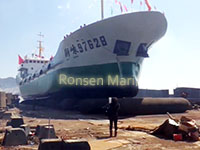
Shipyard marine airbags
Choosing the right marine airbags is the difference between a safe 2-hour vessel launch and a hull-damaging, insurance-triggering failure. Modern shipyards no longer treat ship launching airbags as commodity rubber tubes—they specify them like structural components.
This guide breaks down how shipyards choose the right marine airbags using vessel parameters, ISO 14409 compliance, diameter/ply math, layout logic, and supplier vetting.
Why Airbag Selection Is an Engineering Decision
Marine rubber airbags bear the full displacement weight of a vessel across a deformed contact patch. Undersize them and you get:
- Excessive compression (>30%) → cord-layer fatigue
- Pressure spike beyond working pressure → burst risk
- Uneven hull support → keel bending stress

Shipyard ship launching airbags
A correct selection balances rated working pressure (WP), bearing capacity per meter (kN/m), diameter vs block height, and number of bags × spacing.
Step 1: Define the Vessel Parameters First
Never size an airbag before locking these:
| Parameter | Why it matters |
| Displacement/launching weight(Q,ton) | Drives total kN requirement |
| Length between perpendiculars(LPP) | Contact length distribution |
| Beam(B) | Sets minimum effective airbag length |
| Block coefficient(Cb) | Affects load distribution formula |
| Keel block height | Airbag diameter must clear it (D>block height + 0.3-0.5m) |
| Launch slope & site friction | Affects rolling resistance and pressure swing |
Example: a 440-ton Ro-Ro ferry (Lpp 42.5 m, B 12.5 m, Cb 0.55) needs a different matrix than a 8,000 DWT barge.
Step 2: Use the Standard Sizing Logic (Diameter → Length → Ply)
Diameter (D)
Rule of thumb from yard practice:
Airbag diameter should be at least 0.3–0.5 m larger than keel block height so the hull clears blocks before rolling.

Factory marine airbags
Common diameters: 0.8 m, 1.0 m, 1.2 m, 1.5 m, 1.8 m, 2.0 m, up to 2.5 m.
Effective Length (EL)
EL must be ≥ vessel beam for single-row layout; if EL < beam, use staggered or double-row.
Standard EL: 6–18 m (custom to 24 m+).
Cord Layers / Ply Rating
Ply count sets working pressure and bearing capacity:
| Type | Layers | WP range(Mpa) | Typical use |
| QP ordinary | 4-5 | 0.06-0.14 | <300 ton boats |
| QG medium | 6-8 | 0.10-0.24 | 300-5,000 ton vessels |
| QS super | 9-10+ | 0.18-0.26 | 5,000-100,000 DWT cases |
A 1.5 m × 15 m 6-layer bag runs ~0.13–0.18 MPa WP and ~110–140 kN/m bearing at safe compression.
Step 3: Run the Bearing-Capacity Check
Simplified selection formula used in yard engineering:
N = K1 × Q × g / (Cb × R × Ld) + N_backup
- N = number of airbags
- K1 = safety factor ≥ 1.2
- Q = vessel weight (ton)
- R = allowable unit bearing capacity (kN/m)
- Ld = effective contact length per bag (m)
- N_backup = 2–4 spare bags
If calculated compression at WP exceeds ~25–30% of D, go up one diameter or add one ply layer.
Step 4: Verify ISO 14409 and Class Certifications
Shipyards procuring for classed projects must reject non-certified bags. Minimum checks:
- ISO 14409:2011 – international standard for ship launching air bags (materials, burst test, compression-recovery, marking)
- Class society approval – CCS, BV, DNV, ABS, LR depending on flag
- Mill test reports – rubber tensile ≥18 MPa, elongation ≥400%, cord strength traceability
- Burst pressure ≥ 2× WP, reputable makers run 3× test
Qingdao-based ISO 14409 factories dominate export supply, but audit before bulk order.
Step 5: Match Airbag Layout to Hull Geometry
Selection is not just per-bag—it is system layout:
- Single row – EL ≥ beam
- Staggered – 0.5×beam ≤ EL < beam
- Double row – beam > 2×EL, or catamaran/barge
- Center spacing ≤ 6 m for steel hulls, min spacing ≥ πD/2 + 0.3 m
- Pre-inflation leak test: <5% pressure loss in 1 h
Step 6: Vet the Supplier Like a Class Surveyor
A shipyard’s purchasing checklist:
- 10+ years dedicated airbag production (not general rubber)
- Provides calculation sheet for your vessel, not just a quote
- OEM options: valve type, end ring, 1260D/1670D cord, color marking
- Warranty 12 months + on-site launch support availability
- Reference project list with DWT and launch method (side/end/haul-out)
Low price per bag is irrelevant if WP is overstated by 0.02 MPa.
Quick Selection Cheat Sheet
- Fishing boat 30–80 ton → D1.0×L10m, 4-layer, 5–6 pcs
- 300 ton workboat → D1.2×L12m, 6-layer, 6–8 pcs
- 2,000 ton landing craft → D1.5×L15m, 6-layer, 10–12 pcs
- 10,000 DWT barge → D1.8–2.0m, 7–8 layer, 14–18 pcs staggered
- 50,000+ DWT → engineered matrix, 2.0–2.5 m, QS grade, class-witnessed
Always add 2–4 backup airbags per launch.
FAQ (Snippet Targets)
How do shipyards calculate marine airbag quantity?
Using vessel weight, block coefficient, contact length, and allowable kN/m bearing, with a safety factor ≥1.2 and 2–4 spare bags.
What ply rating is best for ship launching?
4–5 ply for small boats, 6–8 ply for mid-size vessels, 9–10+ for heavy barges and large ships. Ply count tracks working pressure.
Is ISO 14409 mandatory?
Not by law everywhere, but required by most classed shipyards and international buyers. It governs materials, burst test, and marking.
Can one airbag size fit all launches?
No. Diameter depends on block height, length on beam, ply on weight. Reusing wrong-size bags is a top cause of launch incidents.
