

How Do Foam Filled Fenders Work?
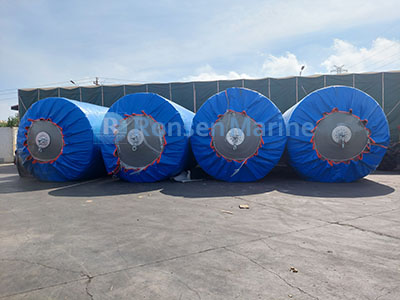
Foam Filled Fenders
If you’re standing dockside watching a 50,000 DWT bulk carrier slide into its berth, the black cylinder soaking up that impact isn’t magic — it’s materials science. A foam filled fender converts a ship’s kinetic energy into reversible compression of a closed-cell foam core. No compressed air, no valve, no pressure gauge. That single difference explains every advantage (and every trade-off) this page covers.
The one-paragraph answer
A foam filled fender works by squeezing a solid block of closed-cell EVA or cross-linked polyethylene foam inside a tough elastomer skin. As the hull presses in, the foam cells compress and the polymer shears, absorbing energy. The reaction force rises progressively, so the hull slows without a spike. When the vessel backs off, the foam rebounds elastically — quality units recover to ≥90% of original diameter within 24 hours. Cut the skin, and it still floats and still cushions, because each foam cell is sealed and holds its own buoyancy.
1. The 3-layer structure (this is what actually does the work)
| Layer | Material | Job |
| Core | Closed-cell EVA/XLPE, thermally laminated | Absorbs energy by cell compression + polymer shear; stays dry if skin is cut |
| Reinforcement | Helical nylon / Kevlar filament | Stops the skin peeling under repeated shear and angled contact |
| Skin | Sprayed polyurethane / polyurea, shore A 75-95 | Shurugs off UV, saltwater, oil, abrasion; optional non-marking grade |
The core density (typically 58–120 kg/m³) sets the energy-to-reaction balance: higher density = stiffer = more energy absorbed, but more reaction force fed back into the hull and berth. Inside larger units, a central steel tube or tension chain carries the hanging and pull loads — the foam handles compression only.
2. The physics, written out
A berthing ship arrives with kinetic energy:
E = \frac{1}{2}mv^2
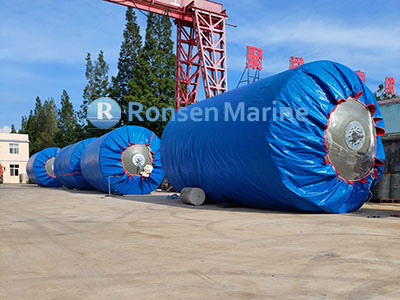
Foam Fenders
The fender dissipates that energy in four steps:
- Hull contacts fender → local pressure rises.
- Closed-cell foam cells compress and the polymer matrix shears.
- Micro gas pockets inside the cells add a pneumatic-like cushioning effect — without any air chamber.
- Vessel decelerates; energy is stored elastically, then released as the foam rebounds.
Because there’s no gas law involved, performance doesn’t drift with temperature, altitude, or small leaks the way a pneumatic fender’s does. Per ISO 17357-1:2014, foam fenders are Type II; pneumatic fenders are Type I.
3. Performance numbers (at 60% deflection, per ISO parallel-compression test)
Energy absorption and reaction force are measured at 60 ± 5% deflection. Example reference values:
| Size (D x L) | Energy Absorption | Reaction Force |
| 1000 x 1500 mm | ~35 kN.m | ~39 kN |
| 1500 x 3000 mm | ~171 kN.m | ~130 kN |
| 2000 x 4000 mm | ~398 kN.m | ~226 kN |
| 3000 x 6000 mm | ~1365 kN.m | ~389 kN |
Tolerance note: per common tender specs, energy is typically quoted with a −10% / +10% reaction tolerance, and skin thickness −10%. Always confirm figures against the manufacturer’s certified performance curve before ordering.
4. Foam filled vs pneumatic (Yokohama): which wins where
This is the comparison every port engineer actually makes:
| Factor | Foam filled | Pneumatic (Yokohama) |
| Energy medium | Closed-cell foam compression | Compressed air (5080 kPa |
| Punctured skin | Still floats, still works | Deflates, loses function |
| Maintenance | None (no inflation) | Periodic pressure checks |
| Reaction force | Moderate-high (grade-dependent) | Very low |
| Temp / altitude sensitivity | Low | Noticeable |
| Angled / STS contact | Good, less uniform | Excellent (air flows) |
| Transport | Bulky, can't deflate | Can be deflated |
| Upfront cost | Higher (can be ~3 x same size) | Lower |
Sources:
The honest take: foam fenders aren’t universally “better.” Pneumatic fenders remain the right call for low-reaction-force STS, LNG/FSO/FSRU work, and variable hull curves. Foam wins for permanent berths, offshore, unattended/remote sites, and debris-heavy ports where a puncture means a deflated fender and a damaged hull.
5. Where they’re used
- Quay and jetty berthing (vertical hung, chain sling)
- Ship-to-ship transfer (LNG, crude, product tankers)
- Offshore platforms, SPM buoys, FPSO boat landings
- Ro-Ro ferries and cruise terminals (non-marking skin)
- Floating drydock faces and lock entrances
- Naval bases and remote jetties
6. How to size one (so it actually works)
Do not size by vessel length. You need:
- Displacement and approach velocity
- Allowable hull pressure — PIANC WG-211 (2024) generally recommends < 200 kN/m²
- Design energy per PIANC / ASTM F2192
- Energy absorption and reaction force at 60% deflection from the maker’s curve — then check that reaction force against your hull and dolphin limits
7. The failure mode nobody advertises
Foam fenders don’t deflate, but they can still fail — at the flange connection. If the foam body, nylon net, and polyurea skin aren’t perfectly integrated into the metal end fitting, repeated shear (a vessel moving sideways along the berth) pulls the body away from the flange. The fender tears there first. This is why 6-monthly inspection of skin and connections matters, and why service life is quoted as 10–15 years with proper checks, not “indestructible forever”.
FAQ
How does a foam fender absorb energy without air?
It compresses a closed-cell foam core; the polymer matrix and sealed cells store elastic energy. No internal air pressure required.
Do foam fenders bounce a ship back?
They rebound elastically (≥90% diameter recovery in 24h), but with less liveliness than pneumatic fenders — better for fixed structures, less ideal for high-angle STS roll.
What happens if a foam fender is punctured?
The closed cells stay dry and buoyant. It keeps cushioning until you patch or re-skin it.
Foam or pneumatic — which is cheaper over 10 years?
Foam usually wins on lifecycle cost in harsh service (no pressure-checks, no deflation repairs); pneumatic wins on upfront price and portability.
