

What Is a Cylindrical Buoy? Definition, Types, Design & Buying Guide
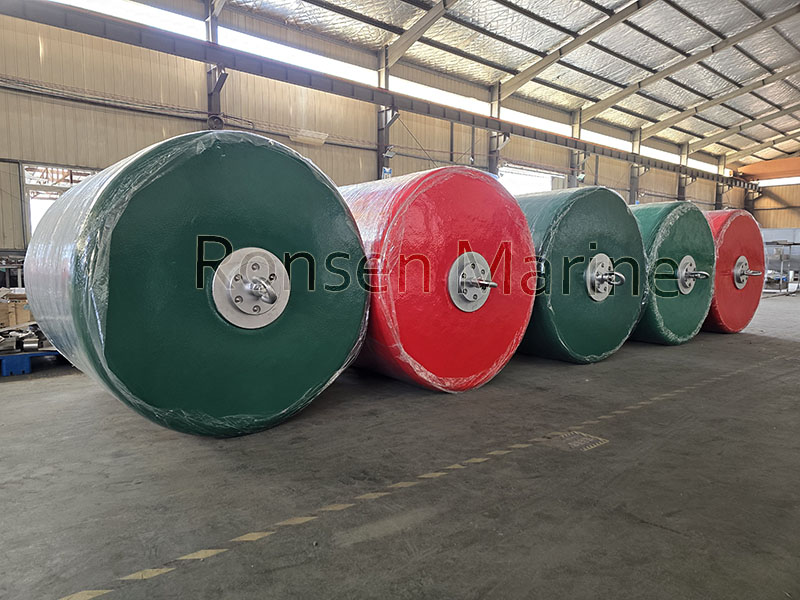
Cylindrical Buoys
Featured snippet target: A cylindrical buoy is a floating marine marker whose exposed body is shaped as a vertical cylinder — IALA defines it as a buoy whose upper body or superstructure has “the shape of a cylinder or nearly so” . In navigation, the cylindrical form is the standard “can” shape used for lateral markers; in mooring and offshore work, the same geometry is used for chain-support and pick-up buoys.
Quick Definition
A cylindrical buoy is any buoy whose waterline section and upper hull form a cylinder or near-cylinder. It is the opposite of the conical “nun” buoy. IALA’s dictionary lists cylindrical buoy as an alternative term for a can buoy .
The shape matters because the hull geometry determines three things at once: how much reserve buoyancy you get, how stable the platform is under payload, and how much drag the mooring line sees. Cylindrical hulls generally give you a taller freeboard and a flat top deck for mounting lanterns, radar reflectors, AIS transponders, solar panels and sensors — which is why they dominate in channel marking and instrument platforms.
Types of Cylindrical Buoys
1. Navigation & channel markers (can buoys)
Can buoys have a flat top. They are the port-hand lateral mark in IALA Region A (Europe, Africa, Asia, Australia) and the starboard-hand mark in IALA Region B (Americas, Japan, Korea, Philippines) .
| IALA region | Port hand | Starboard hand |
| Region A | Red, cylindrical (can) | Green, conical (nun) |
| Region B | Green, cylindrical (can) | Red, conical (nun) |
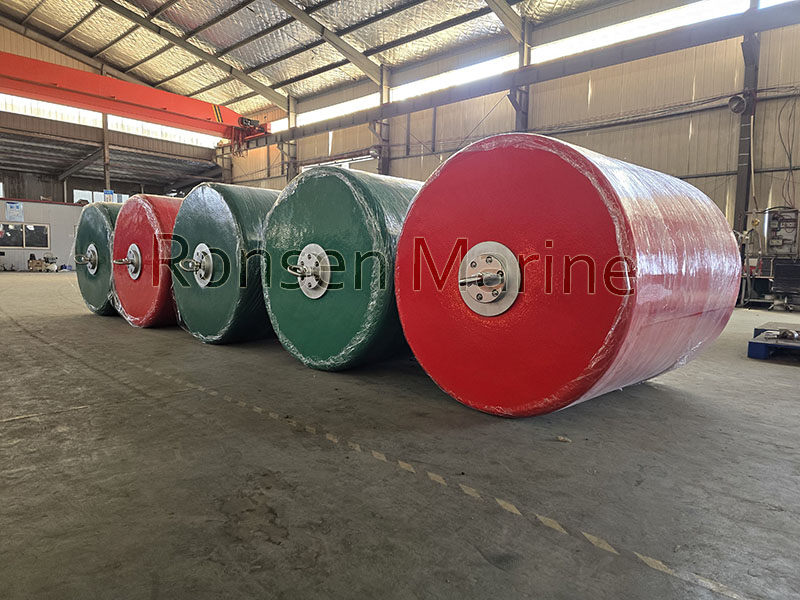
Cylindrical Foam Buoys
Can buoys are also used as regulatory buoys: white body with orange markings and reflective bands, carrying text or a symbol — diamond for hazard warning, diamond with cross for restricted area, circle for controlled area, square for information (“No Wake,” “Slow,” “Swim Area,” “Keep Out,” etc.) .
2. Cylindrical mooring buoys
Used as chain-support buoys in single-point mooring (SPM) systems for tankers and FSOs, and for heavy mooring in ports, offshore oil & gas fields, ship docking, aquaculture sites and pipeline or cable routes .
Three common subtypes :
- Standard cylindrical buoy — central tension member, pad-eye/clevis end fittings, sized to a specified safe working load.
- Chain-through buoy (CTB) — a central tube lets the anchor chain pass through; chain-locking devices at one or both ends secure the buoy to the chain.
- Pick-up buoy (PUB) — small cylindrical, spherical or oval marker for marking and retrieving the end of a rope or chain.
3. Metocean / instrument buoys
Cylindrical hulls make effective sensor platforms because the central structure can carry a moon pool — an open through-hull compartment that routes instruments and cables from the tower down the water column while protecting them during deployment . The central aluminum cylinder typically houses the watertight instrument housing, batteries, power management and data acquisition system .
Cylindrical vs. Spherical Buoy
This is the comparison most buyers are actually searching for.
| Cylindrical buoy | |
| Best evironment | Offshore, open water, high payload |
| Freeboard & deck | Tall freeboard, large flat top for equipment |
| Drag | Higher drag from flat ends |
| Stability | Good; may pitch in long swell |
| Manufacturing | Simpler - rolled/flat plates, easy to scale |
| Typical use | Channel marks, light buoys, large-vessel mooring |
Engineering caveat worth knowing: the cylindrical form is not automatically more stable. A classic textbook case — a 1 m diameter, 2 m high cylinder weighing 7.848 kN in seawater — has a negative metacentric height (GM ≈ −0.44 m) and will not float with its axis vertical without a restraining chain . A comparative study of small wave buoys found the spherical form had better large-inclination and dynamic stability; for long-term autonomous operation, the authors favored spherical over cylindrical . Translation: choose cylindrical for the deck space and visibility, then add internal or external ballast, a keel, or a central tension member to get the stability you need.
Materials & Construction
Rotationally moulded polyethylene (HDPE/LLDPE) — UV-stabilized virgin polyethylene, typically around 16 mm wall thickness for larger ocean buoys, filled with closed-cell polyurethane foam. Fixtures in 316-grade stainless steel. Expected service life exceeds 20 years for well-specified ocean units . Advantages: no painting, lightweight, easy to deploy and service, unsinkable even if the skin is punctured.
Foam-filled cylindrical mooring buoys — closed-cell PE/EVA foam core laminated without adhesives, encapsulated in a spray-applied polyurethane elastomer skin (typically 3–10 mm). The foam will not absorb water if damaged, and the resilient material makes the buoy self-fendering with high impact absorption . For extreme service the PU skin is reinforced with nylon filament. End assemblies use a central steel tube with longitudinal gussets and load-distribution flanges, hot-dip galvanized .
Steel cylindrical buoys — higher load capacity and prominent visibility, with large flat tops for lanterns, radar reflectors, AIS and meteorological sensors. Corrosion management (coal-tar epoxy, galvanizing, sacrificial anodes) is the main lifecycle cost.
Colour follows IALA: red, green, white or yellow, with radar reflectors, AIS and solar marine lanterns as options .
How to Size a Cylindrical Buoy
Start from Archimedes: buoyant force = ρ × V × g, where ρ is water density (~1025 kg/m³ seawater), V the displaced volume, and g ≈ 9.81 m/s² . For a plain cylinder the displaced volume is (π/4) D² × Z, where Z is draft .
A practical sizing sequence:
- List every load — buoy own weight, ballast, tower, lantern, solar array, batteries, sensors, cabling, AIS/radar reflector.
- Add a reserve buoyancy margin — many operators work to a 30–50% reserve, plus allowance for marine growth, water absorption and dynamic wave loading .
- Check the mooring load, not just buoyancy. A 3 m ocean buoy specification lists a maximum mooring load of 2,750 kg, a safe working load of 6,000 kg at one point and 8,630 kg at two points, with reserve buoyancy of 3,170 kg .
- Confirm stability. Verify the center of gravity sits below the metacenter (positive GM). If not, add ballast, lower the payload, or specify a central tension member/chain restraint.
- Match the hardware. Use marine-grade 316 stainless steel or hot-dip galvanized fittings, sized so the shackle pin and breaking strength match the mooring rope — and avoid mixing galvanic materials.
Typical Specification Ranges
Rotational-moulded navigation buoys are commonly stocked around 700×900 mm (150 kg buoyancy) up to 1,800×1,800 mm (1,400 kg buoyancy), with custom sizes and colors available . Foam-filled chain-support cylinders run from roughly 1,000 kg net buoyancy (1,080 mm diameter, 1,500 mm body length) to 3,900 kg (1,705 mm diameter, 2,000 mm body length) . Small coastal monitoring platforms such as the 1.2 m Shearwater supply 500 kg total buoyancy with 300 kg reserve after payload, 180 kg weight and a 1.8 m focal plane . Always treat these as illustrative — request the manufacturer’s certified buoyancy, SWL, GM and IALA compliance documentation for your exact duty.
Applications at a Glance
Shipping channel and harbor approach marking; port operations and temporary anchorage; single-point mooring for tankers and FSOs; offshore oil and gas field perimeter marking; submarine pipeline and cable route markers; aquaculture and fish-farm marking; oceanographic and metocean data collection; marine protected area and reef moorings; water quality and coastal engineering monitoring .
Frequently Asked Questions
What does “cylindrical buoy” mean in navigation?
It refers to the “can” lateral mark: a buoy with a cylindrical or near-cylindrical upper body. IALA uses the two terms interchangeably .
Why choose cylindrical instead of spherical?
You get a taller freeboard, better long-distance visibility, and a flat top for mounting equipment. In strong currents the flat-ended cylinder sees more drag than a sphere, so spherical is often the better pick for sheltered harbors and calm inshore work .
How long do they last?
A properly specified rotationally moulded polyethylene ocean buoy is rated at >20 years service life, commonly supplied with a 5-year warranty .
Are cylindrical buoys unsinkable?
Closed-cell foam-filled and PU-skinned types will not absorb water if the skin is punctured, making them effectively unsinkable — but that does not remove the need for inspection, antifouling management, and mooring-load checks .

