

What Is a Chain Through Buoy? A Complete Guide
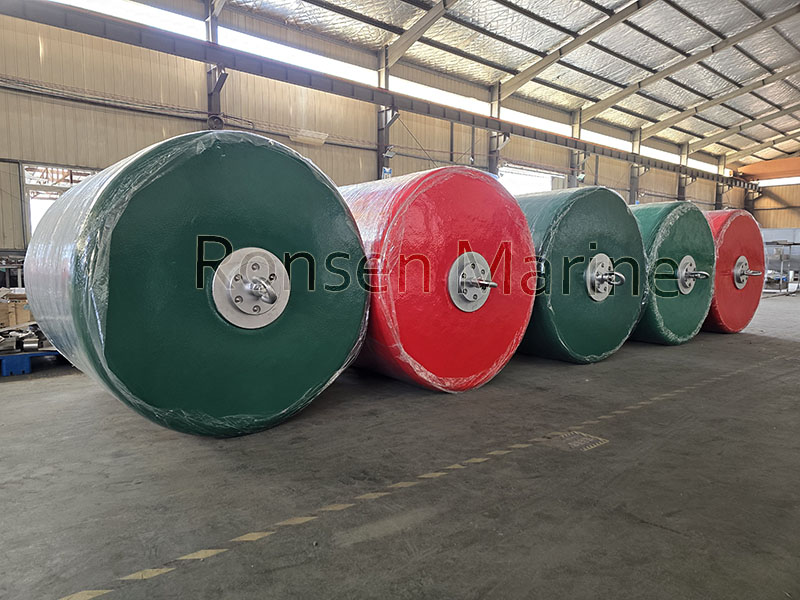
Chain Through Buoys
Quick answer: A chain through buoy (CTB) is a foam-filled offshore support buoy with a central steel tube that lets a mooring chain pass completely through its body. The chain is locked at one or both ends, so the buoy suspends part of the chain’s submerged weight, reduces seabed drag, and rides up and down with tide and waves without losing its connection.
What Is a Chain Through Buoy?
A chain through buoy — also written chain-through buoy or through-chain buoy — is a specialized floating device used in marine and offshore mooring systems. Unlike a conventional buoy that attaches to a chain at a single point or eye, a CTB has an axial passage (central steel guide tube) running through its core. The mooring chain is fed through this tube and secured with stoppers, a chain locking plate, or locking pins on one or both ends.
The buoy itself is typically built from three layers:
| Layer | Material | Job |
| Core | Closed-cell PE/EVA foam | Permanent buoyancy; stays afloat even if punctured |
| Steelwork | Central tube, gussets, end flanges | Carries the actual tensile load - the foam never does |
| Skin | Polyurethane (PU) or polyurea elastomer | Abrasion, UV, and seawater resistance |
This matters: the foam provides displacement, the steel provides strength. Puncture the skin and the sealed closed cells still float — unlike air-chambered or hollow-steel buoys, a CTB won’t suddenly deflate or sink.
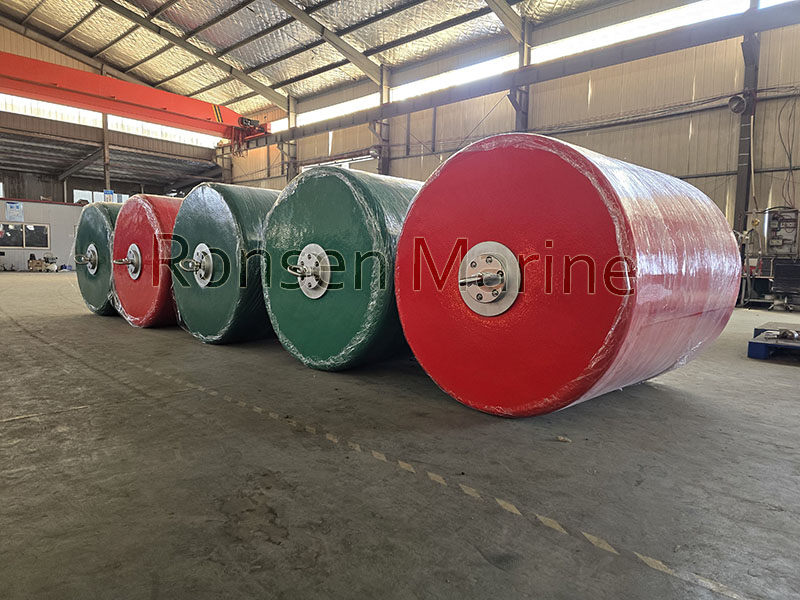
Chain Through Buoys with Pin
How Does a Chain Through Buoy Work?
The operating principle is straightforward:
- Archimedes provides the lift. The foam core displaces a volume of seawater heavier than the buoy’s own weight plus the load it carries. The leftover upward force becomes reserve buoyancy (freeboard).
- The chain passes axially through the body. As tension is applied, the buoy centers on the chain and supports a designed span of its submerged weight.
- The buoy tracks tide and swell. Because it’s solid-displacement foam, it rises and falls with water level, keeping chain geometry stable without powered adjustment.
- Impact is absorbed. When a hull, chain, or tug brushes the buoy, the resilient foam compresses locally and rebounds — a secondary “self-fendering” behavior.
The key engineering rule: size by net buoyancy, not gross diameter, and set the safe working load (SWL) from the steelwork, not the foam.
Chain Through Buoy vs. Cylindrical Buoy vs. Pick-Up Buoy
| Attribute | Chain-Through Buoy(CTB) | Cylindrical Support Buoy(CUB) | Pick-Up Buoy(PUB) |
| Chain path | Passes through central tube, locked at one/both ends | Runs outside, attached to pad-eye/swivel/clevis | Small rope/chain tail only |
| Main load | Axial chain tension + partial chain weight | End-fitting tension; lifts hose/rope/cable span | Line-end marking & retrieval |
| Typical net buoyancy | 1.5-4.5 t (up to 10t) | 1-4 t common | 90 KG-1 t |
| Best use | SPM mid-line chain support, chafe-chain lift | Hose flotation, dredge pipe, cable lay | Mooring-end retrieval, asset marking |
Rule of thumb: if the chain must pass axially through the float and share tension, specify a CTB. If the chain or hose attaches to end fittings and the buoy only lifts a span, use a cylindrical buoy. If you only need to mark and retrieve a submerged line end, a pick-up buoy is enough.
Common Applications
Chain-through buoys are used wherever a mooring chain needs to be supported, guided, or kept clear of the seabed:
- Single Point Mooring (SPM / SBM) systems for tanker loading
- Mid-line chain support on tanker and ship moorings
- Subsea cable, umbilical, and flexible hose lay operations
- Chafe-chain elevation to prevent seabed abrasion
- Oil spill response equipment support
- Underwater pipeline and cable marking
- Tidal energy system guides
- Salvage and offshore construction operations
- Subsurface buoy systems on semi-submersible accommodation units
An important safety note: IMCA documented incidents where subsurface buoys near the surface broke loose under wave loading. Switching to a “chain through” type — with the chain passing through the centre and secured on each side — removed the weak-link pennant and allowed the buoy to sit deeper, clear of surface wave action.
How to Size a Chain Through Buoy
Step 1 — Define what the buoy must lift. List the submerged element and its properties:
- Mooring chain diameter and grade (e.g., 76 mm stud-link, Grade 3)
- Hose outside diameter and fill state (oil-filled hose ≈ 3× empty submerged weight)
- Subsea cable or umbilical wet weight per metre
- Rope or pendant submerged weight
Only the segment the buoy actually suspends counts — not the total chain scope.
Step 2 — Calculate net buoyancy. The standard formula:
B_net = ρ_sw · g · V_displaced − W_buoy
Required: B_net ≥ W_submerged_line + F_freeboard_reserve
Where:
- ρ_sw ≈ 1025 kg/m³ (seawater)
- W_submerged_line = length × (air weight − buoyancy of that line)
- F_freeboard_reserve covers tide, current drag, marine growth, and bird/rope loads
Working rule: load the buoy to roughly 50–60% of its net buoyancy and keep the rest as reserve. A ~20 m span of 76 mm chain submerged weighs approximately 2.4 t.
Advantages and Limitations
Advantages
- Better chain guidance and alignment than external-attachment designs
- Reduces point loads and chafing
- Eliminates the need for a pennant, which is often a weak link
- Rides tide and wave action without losing connection
- Puncture-resistant and unsinkable by design
- Self-fendering against vessel impact
- Compatible with standard SPM/SBM systems and common end fittings (swivel eye, clevis eye, pad-eye, chain locking plate, bail eye)
Watch-outs
- Central tube ID must be large enough for the chain and the shackle — too small is the classic wrong-spec mistake
- Don’t use a cylindrical buoy where the chain must pass axially
- Don’t specify a pick-up buoy to carry a real SPM chain load
- Inspect internal wear surfaces, steelwork corrosion, and buoyancy integrity regularly
Typical Specifications
Chain through buoys are commonly supplied in net buoyancy classes from about 1,000 kg to 5,000 kg, with through-hole diameters typically ranging 150 mm to 500 mm, customizable to project requirements. Common body diameters run ~1,195–1,900 mm with overall lengths around 2,660 mm for the 2,000 mm body class. Units are often ABS, DNV, BV, CCS, LR, or other classification-society approved, with optional third-party inspection and Factory Acceptance Testing (FAT).
Frequently Asked Questions
What is the difference between a chain through buoy and a mooring buoy?
A mooring buoy is what a vessel ties up to. A chain through buoy is a support buoy: its job is to lift and guide a mooring chain (or hose/cable) and share load — it’s operational infrastructure, not an aid-to-navigation.
Can a chain through buoy sink if it gets damaged?
No. The closed-cell PE/EVA foam core won’t absorb water, so even a punctured skin doesn’t cause loss of displacement or a deflation event.
What holds the chain in place?
A chain locking plate, locking pins, or stoppers at one or both ends of the central tube, depending on the configuration and required adjustability.
Is the foam what carries the load?
No. The central steel tube, gussets, and end flanges carry tension. The foam exists for buoyancy only — SWL comes from the steelwork, never the foam.
Key Takeaways
A chain through buoy is the right choice when the mooring chain must pass axially through the float and share tension with it. Size it by net buoyancy, rate it by the steelwork’s SWL, and match the central tube ID to the chain and shackle — not just the chain alone. Get those three things right and a CTB will outlast most alternatives in harsh offshore conditions.

