

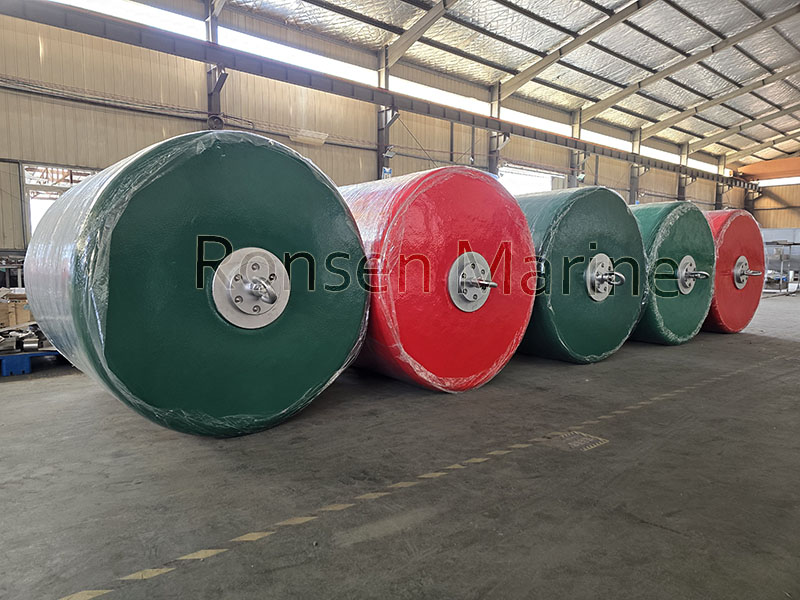
General Surface Support Buoys
Cylindrical · Chain-Through · Pick-Up | Foam-Filled, Steel-Reinforced, Unsinkable
Qingdao Ronsen Marine Supplies Co., Ltd. — Manufacturer & Supplier since 2012
Ronsen Marine general surface support buoys are foam-filled, steel-reinforced offshore floats built to lift and protect mooring chains, loading hoses, umbilicals and subsea cables in single point mooring (SPM), offshore transfer, dredging and permanent mooring systems. With a closed-cell PE/EVA core and a nylon-reinforced polyurethane skin, every unit stays afloat even after the skin is punctured — no inflation, no pressure checks, no sudden loss of buoyancy.
General Surface Support Buoys: The Unsinkable Load-Bearing Float for Offshore Mooring Systems
A general surface support buoy (also called a surface support buoy, chain support buoy or foam support buoy) is not an aid to navigation. It is operational marine infrastructure. Where a navigation buoy marks a channel and a mooring buoy offers a tie-up point for a vessel, a support buoy carries net positive buoyancy into the mooring catenary and controls how much load sits on the seabed.
In a typical SPM or CALM system the buoy is positioned on the mid-span of the mooring line, between the sinker/anchor and the floating hose string. It lifts the chain off the seabed, reduces abrasion on the touch-down zone, lowers fatigue on the chain links, and lets the hose string ride in a designed catenary instead of dragging. For dredging discharge lines, the same principle keeps the hose from snagging on the bottom or collapsing under its own weight.
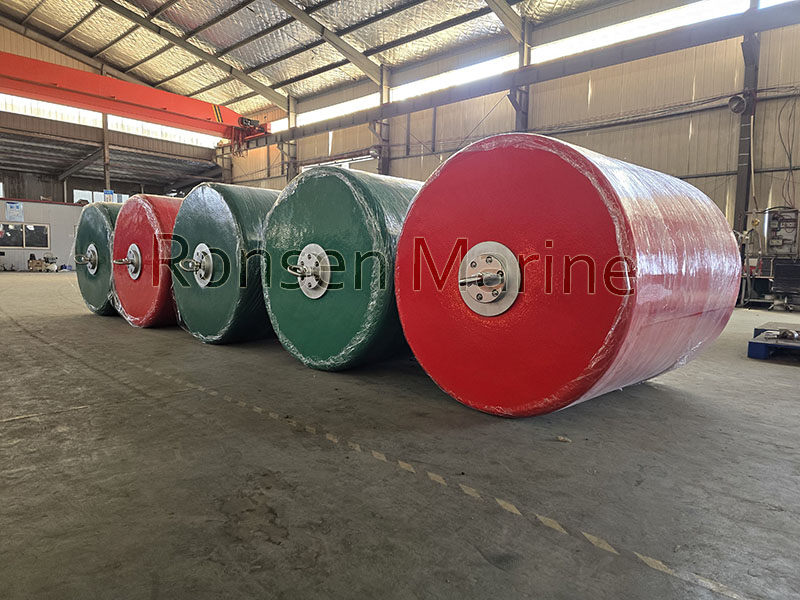
Surface Support Buoys
Three families are supplied as standard:
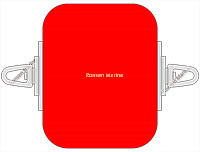
- Cylindrical Buoy (CB) — large foam body with end fittings; the default for hose and midline chain support.
- Chain-Through Buoy (CTB) — the mooring chain passes through a central steel tube; axial load is shared along the line.
- Pick-Up Buoy (PU) — a compact float that marks and retrieves a submerged line end, messenger rope or chain tail.
Surface Support Buoy vs Mooring Buoy vs Navigation Buoy
| Type | Primary job | Key difference |
| Surface support buoy | Lift hoses, cables and chain spans; control catenary tension | Load-bearing float, normally unlit |
| Mooring buoy | Provide a tie-up point for vessels | Fitted with a mooring eye or bollard |
| Navigation buoy (AtoN) | Mark channels, hazards and cardinal points | IALA colour, topmark and lantern required |
Construction: Why a Foam Core Outperforms a Pressurised Tank
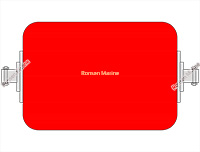 1. Closed-cell PE/EVA foam core — unsinkable by design
The flotation core is built from layers of resilient closed-cell polyethylene or EVA foam, thermolaminated together so the bond is stronger than the foam itself. No adhesives are used, which removes the weak point that fails first in long service. Polyethylene foam does not absorb water; a steel air tank or inflatable sleeve loses buoyancy the moment the hull is breached, while a foam core keeps working.
The same resilience is what makes the buoy self-fendering. When a hull, chain or tug makes contact, the foam compresses and rebounds instead of transferring a hard impact into the mooring line. This is why support buoys are routinely specified without a separate fender.
2. Nylon-reinforced polyurethane skin — abrasion, fatigue and UV resistance
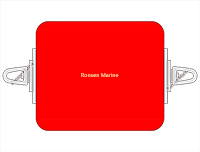 The core is encapsulated in a self-coloured polyurethane elastomer skin, spray-applied and reinforced with nylon filament at the optimum angle. The skin is the working surface: it takes chain chafe, beach drag, rope rub and tropical UV. Standard colours are orange, yellow, red, grey and black; the pigment is in the skin, so there is no paint film to flake off and no repainting cycle. For Arctic, high-current or heavy-chafe sites the skin can be laid up thicker or with an extra reinforcement layer.
3. Central steelwork — the foam carries buoyancy, the steel carries load
A through central steel tube, longitudinal gussets and external load-distribution flanges at each end are encased in the foam body. Buoyancy and impact are carried by the foam; tensile load is carried by the steel. This separation of duties is the reason these buoys survive decades in service. Steelwork is supplied hot-dip galvanised to ISO 1461 or finished in coal-tar epoxy; end fittings are selected to a certified SWL and can be swapped without removing the buoy from the mooring.
Optional end fittings and hardware:
- Bail eye
- Clevis eye
 Swivel assembly (10 t SWL, hot-dip galvanised)
- Chain locking plate / single locking pin
- Pad eye, shackle and thimble
- Removable central mooring tube (replaces without recovering the buoy)
Standard Range & Specification Tables
The tables below are the standard off-the-shelf range. Every dimension is confirmed against the project drawing at order stage — buoy diameter, body length and end fitting detail are the variables that change most often, so treat these figures as the starting point rather than a catalogue limit. Net buoyancy is measured in fresh water with the steelwork fitted; salt water adds roughly 2.5% to the available buoyancy.
Cylindrical Surface Support Buoys (CB)
| Model | Body L (mm) | OAL (mm) | Dia. (mm) | Air weight (kg) | Net buoyancy (kg) |
| CB-1000 | 1550 | 2200 | 1080 | 375 | 1000 |
| CB-1500 | 2000 | 2666 | 1130 | 445 | 1500 |
| CB-2000 | 2000 | 2666 | 1290 | 485 | 2000 |
| CB-2500 | 2000 | 2666 | 1400 | 515 | 2500 |
| CB-2900 | 2000 | 2666 | 1510 | 595 | 2900 |
| CB-3500 | 2000 | 2666 | 1630 | 625 | 3500 |
| CB-3900 | 2000 | 2666 | 1705 | 650 | 3900 |
Chain-Through Surface Support Buoys (CTB)
| Model | Body L (mm) | OAL (mm) | Dia. (mm) | Air weight (kg) | Net buoyancy (kg) |
| CTB-1500 | 2000 | 2666 | 1195 | 520 | 1500 |
| CTB-2000 | 2000 | 2666 | 1325 | 560 | 2000 |
| CTB-2500 | 2000 | 2666 | 1450 | 610 | 2500 |
| CTB-3000 | 2000 | 2666 | 1565 | 658 | 3000 |
| CTB-3500 | 2000 | 2666 | 1680 | 750 | 3500 |
| CTB-4500 | 2000 | 2666 | 1900 | 880 | 4500 |
A central tube with 82.5 mm ID accepts mooring chain up to 20 mm diameter. The tube is not moulded into the body: it slides into a tubular section down the centre of the buoy, so it can be replaced at any stage of the service life without recovering the whole unit.
Pick-Up Buoys (PU)
| Model | Body L (mm) | OAL (mm) | Dia. (mm) | Air weight (kg) | Net buoyancy (kg) |
| PU-90 | 665 | 1000 | 515 | 42 | 90 |
| PU-225 | 914 | 1570 | 690 | 120 | 225 |
| PU-400 | 914 | 1570 | 900 | 155 | 400 |
| PU-800 | 914 | 1570 | 1150 | 180 | 800 |
Applications: Where General Surface Support Buoys Are Deployed
The same three buoy families appear across a surprisingly wide set of offshore and inshore operations. What changes is not the buoy, but the load case — and that is why sizing must always start from the submerged weight of the line being supported.
- Single Point Mooring (SPM) and CALM terminals
The primary application. Support buoys hold the floating hose string in catenary and keep the mid-span chain clear of the seabed through the full tide range. Specified for crude, product and LNG marine terminals.
- Mooring chain and anchor pendant support
Midline chain spans, clump-weight pendants and heavy anchor pendants are lifted to the designed profile, reducing touch-down abrasion and the risk of a parted span.
- Dredging and discharge hose support
Keeps the discharge hose off the bottom, prevents snagging on pipeline, rock or wreck, and maintains flow by stopping the hose from collapsing under its own weight.
- Subsea cable, umbilical and riser support
Export cables, inter-array cables and ROV umbilicals are floated to a controlled shape. The self-fendering foam protects the cable sheath during handling and deployment.
- Offshore wind metocean and pre-installation campaigns
Support buoys hold survey and monitoring equipment during site surveys, and later serve as marker and mooring floats for the installed asset.
- Port, harbour and salvage temporary moorings
Rapid-deploy hose bridges, temporary mooring points and salvage support where a permanent steel structure would be unjustified.
- Aquaculture and scientific moorings
Net-pen mooring support, instrument pendant floats and water-quality monitoring buoys. The smooth PU skin sheds fouling better than a painted steel surface.
Why Engineers Specify Foam-Filled Surface Support Buoys
Unsinkable, even when damaged
Closed-cell PE/EVA foam does not absorb water. Puncture the skin and the buoy keeps its buoyancy.
Self-fendering, high impact absorption
The resilient core compresses and rebounds, removing the need for a separate fender on most applications.
No inflation, no pressure checks
There is no air to lose and no pressure vessel to certify, inspect or maintain.
Lower lifecycle cost than steel air buoys
No repainting, no corrosion pitting, no scheduled pressure testing. Service life of 10 to 25 years is normal.
Customisable to the project, not the catalogue
Net buoyancy, diameter, body length, colour, steel coating, swivel type and chain-locking device are all specified per project.
Third-party witnessed testing on request
Buoyancy, SWL and material tests can be witnessed by BV, ABS, DNV-GL, LR or CCS surveyors.
How to Size a General Surface Support Buoy (With Solved Examples)
Buoyancy is sized against the submerged weight of everything the buoy is asked to carry. The working rule used by mooring engineers is:
Net buoyancy required ≥ submerged weight of chain / hose / cable supported + freeboard reserve
The freeboard reserve is the buoyancy left over after the line load is supported — it determines how high the buoy rides and how much reserve you have at the top of the tide. A common specification is 30% to 50% of net buoyancy held in reserve, but the project’s mooring analysis always governs.
Example 1 — SPM hose string support
A 120 m floating hose string with a wet weight of 12 kg/m hangs in a single mid-span. Submerged weight to support = 120 m x 12 kg/m = 1,440 kg. Adding a 40% freeboard reserve (576 kg) gives a required net buoyancy of roughly 2,000 kg. A CB-2000 or CTB-2000 is the standard match; chain diameter and current load then decide which end fitting to use.
Example 2 — Pick-up buoy for a submerged chain tail
A 25 m submerged chain tail of 16 mm chain is marked for retrieval. The chain’s submerged weight is modest, but the buoy must stay visible and be easy to grab from a workboat. A PU-225 (225 kg net buoyancy, 690 mm diameter, swivels at both ends) is the typical choice and leaves ample reserve for handling load.
For a definitive size, send us these six inputs with your enquiry:
- Required net buoyancy (kg or kN)
- Chain diameter and grade, or hose/cable outer diameter and wet weight
- Buoy diameter and body length limits (deck space, crane capacity)
- Foam type: PE or EVA
- Skin and steelwork finish: standard PU / nylon-reinforced PU, HDG / epoxy
- End fitting type and project environment (harbour, offshore, tropical, Arctic-modified)
Manufacturing, Quality Assurance and Certification
Ronsen Marine is a Chinese manufacturer of marine rubber and foam products, in business since 2012 and formally registered in 2018. Production is carried out at Dianji Industrial Park, Jimo District, Qingdao, with in-house foam lamination, PU spraying, steel fabrication and testing — no outsourcing of the critical path.
| Item | Detail |
| Management system | ISO 9001 (quality) and ISO 14001 (environment) certified |
| Type approval | China Classification Society (CCS) type approval; products testable by BV, ABS, DNV-GL, LR |
| Foam process | Batch-mixed closed-cell PE/EVA, thermolaminated in layers, bond stronger than the foam |
| Skin process | Spray-applied PU elastomer, nylon-reinforced; self-coloured, no paint film |
| Steelwork | Central tube, gussets and flanges; HDG to ISO 1461 or coal-tar epoxy |
| End fittings | Bail eye, clevis eye, swivel, chain locking plate/pin, pad eye — certified SWL |
| Documentation | Material certs, buoyancy test report, SWL cert, coating cert, packing list |
| MOQ / lead time | 1 piece; 15 to 30 days for standard range, longer for custom steelwork |
| Supply ability | 300 pieces per month |
| Packaging / port | Plywood crate or pallet, Qingdao port, ocean freight |
| Warranty | 24 months on materials and workmanship |
Installation and Maintenance: What Actually Wears Out
Support buoys fail from mooring fatigue, connector corrosion and biofouling — not from the foam core. A simple regime prevents almost all premature failures:
| Interval | Action |
| Every 6 months | Visual inspection from the workboat; check position, freeboard and skin condition |
| Every 12 months | Haul out, grease mooring shackles and swivel, replace desiccant if fitted |
| Annually | Calibrate any instruments; record uptime percentage |
| As required | Replace the central tube or end fittings without recovering the buoy body |
PE and foam-core buoys commonly reach 15 years and beyond with anti-foul treatment; steel hulls typically last 10 to 25 years. The smooth PU skin sheds marine growth far better than a painted steel surface, which is why repainting is rarely part of the maintenance budget.
Frequently Asked Questions
What is a general surface support buoy used for?
It supports mooring chains, hoses, ropes and cables in offshore mooring systems, reducing seabed abrasion and controlling catenary tension. It is not an aid to navigation.
Is a surface support buoy the same as a mooring buoy?
No. A mooring buoy is a tie-up point for vessels. A support buoy is an engineering float that lifts equipment and shares load in a mooring system.
Are general surface support buoys unsinkable?
Yes. They are foam-filled with closed-cell PE/EVA foam. Even if the PU skin is punctured, water does not enter the core and the buoy stays afloat.
What is inside a surface support buoy?
A closed-cell foam core, a central steel tube with gussets and load-distribution flanges, and a nylon-reinforced polyurethane skin.
What is a chain-through surface support buoy?
A support buoy with a central tube so the mooring chain passes through the buoy body and shares tension along the line. A locking plate or pin holds the chain position.
Do support buoys need to be inflated?
No. There is no air chamber. This removes the failure mode of pressure loss and the need for scheduled pressure checks.
Can surface support buoys be customised?
Yes. Diameter, body length, net buoyancy, colour, steel coating, swivel type and chain-locking device are all project-specific. OEM and ODM service is available.
What certifications do Ronsen surface support buoys carry?
ISO 9001 and ISO 14001, CCS type approval, with buoyancy and SWL testing witnessable by BV, ABS, DNV-GL and LR.
What is the minimum order quantity and lead time?
MOQ is 1 piece. Standard range ships in 15 to 30 days; custom steelwork takes longer.
How long do foam-filled support buoys last?
Typically 10 to 25 years depending on site conditions, with the steel end fittings and central tube being the items replaced during service.
Request a Quotation
Tell us the net buoyancy you need, the chain or hose you are supporting, and the end fitting you want — we will confirm the model, certify the steelwork SWL and issue a quotation with drawing and test plan.
| Contact | Detail |
| Company | Qingdao Ronsen Marine Supplies Co., Ltd. |
| Address | Dianji Industrial Park Zone, Jimo District, Qingdao City, China |
| Website | www.ronsenmarine.com |
| sales@ronsen-marine.com | |
| Tel / Fax | +86 532 8558 0957 |
| Mobile / WhatsApp | +86 183 5328 0885 |
| Working hours | 08:00 – 22:00 (CST) |