

Ship Launching Airbags: How They Work, Specifications, and Safe Launch Procedure
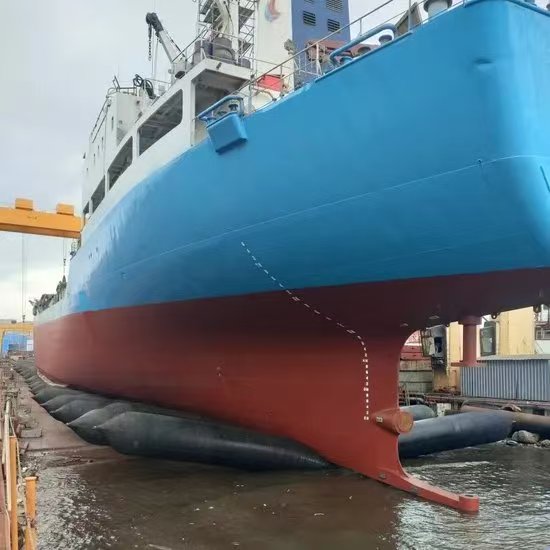
Ship Launching Airbag
Ship launching airbags are cylindrical, cord-reinforced rubber tubes placed transversely under a vessel hull, inflated to 0.05–0.20 MPa, and used to roll the ship down a graded ramp into water without a permanent concrete slipway. Defined by ISO 14409:2011, they replace fixed ways for vessels from ~20 t to ~10,000 t and are reused 80–200 cycles when rinsed, dried, and stored correctly.
What Are Ship Launching Airbags?
A ship launching airbag (also called a marine rubber airbag or pneumatic launching bag) is a tapered-end rubber cylinder built in three layers:
- Inner rubber layer – airtight, seawater-resistant
- Tire-cord reinforcement – 4–12 nylon/polyester plies carrying hoop stress
- Outer rubber layer – abrasion-, UV-, and salt-resistant
They are not marine fenders. Fenders absorb horizontal impact energy; launching airbags carry quasi-static hull weight and rotate under the keel during launch. Different cord angle, different standard, different end fitting.
How Airbag Launching Works
- The slipway is graded (typically 1:70 to 1:10) and cleared of sharp edges.
- Deflated airbags are threaded transversely under the hull at engineered spacing.
- Compressors inflate each bag to working pressure (never above rated).
- Keel blocks are removed progressively; holding winches ease the vessel.
- The bags act as rollers — the hull moves down-slope at 0.5–1 m/s and floats off.
- Bags are deflated, recovered, rinsed, and inspected.
The physics is simple: total uplift = Σ(bag contact length × working pressure × effective width) must exceed vessel displacement with a ≥30% load safety margin, and burst safety factor >4:1 against working pressure.
Standard Specifications (ISO 14409 Reference)
| Parameter | Common Range |
| Diameter | 0.8-2.5 m(up to 3.0 m) |
| Effective length | 6-25m |
| Working pressure | 0.05-0.20 MPa (0.5-2.0 bar) |
| Reinforcement plies | 4-12 |
| Burst safety factor | >4.0:1 |
| Reuse cycles | 80-200 (with crane) |
| Governing standards | ISO 14409:2011, ISO 17682:2013, CB/T 3795 |
A 1.5 m × 12 m, 6-ply bag at safe pressure supports roughly 100–150 t per linear metre of contact.
Snippet target: Typical ship launching airbag working pressure is 0.05–0.20 MPa, with a burst safety factor greater than 4:1 and compliance to ISO 14409:2011.
Step-by-Step Launch Procedure
- Site prep – slope error < 50–80 mm cross-slope; no debris; water depth checked at float-off point.
- Bag layout – transverse placement, spacing calculated from hull weight distribution.
- Pre-inflation test – inflate to 1.1× working pressure, hold 30 min, check for silent leaks.
- Block removal – sequence from stern forward; controller keeps gauges visible.
- Winch release – controlled roll-down; abort if wind > Beaufort 6.
- Float-off & recovery – deflate immediately after vessel frees, rinse with fresh water, dry, store out of UV.
Safety Limits and Common Failures
- Under-spec plies → burst under dynamic load
- Too-wide bag spacing → hull plate overstress
- Sharp slipway → outer rubber puncture, cord exposure
- No pressure-hold test → leak during roll-down
- Overinflation for “faster lift” → cord failure
- Beaufort 6+ wind → stop launch
Relief valve on every compressor. Emergency-stop drill before inflation. Never exceed rated pressure “to save time.”
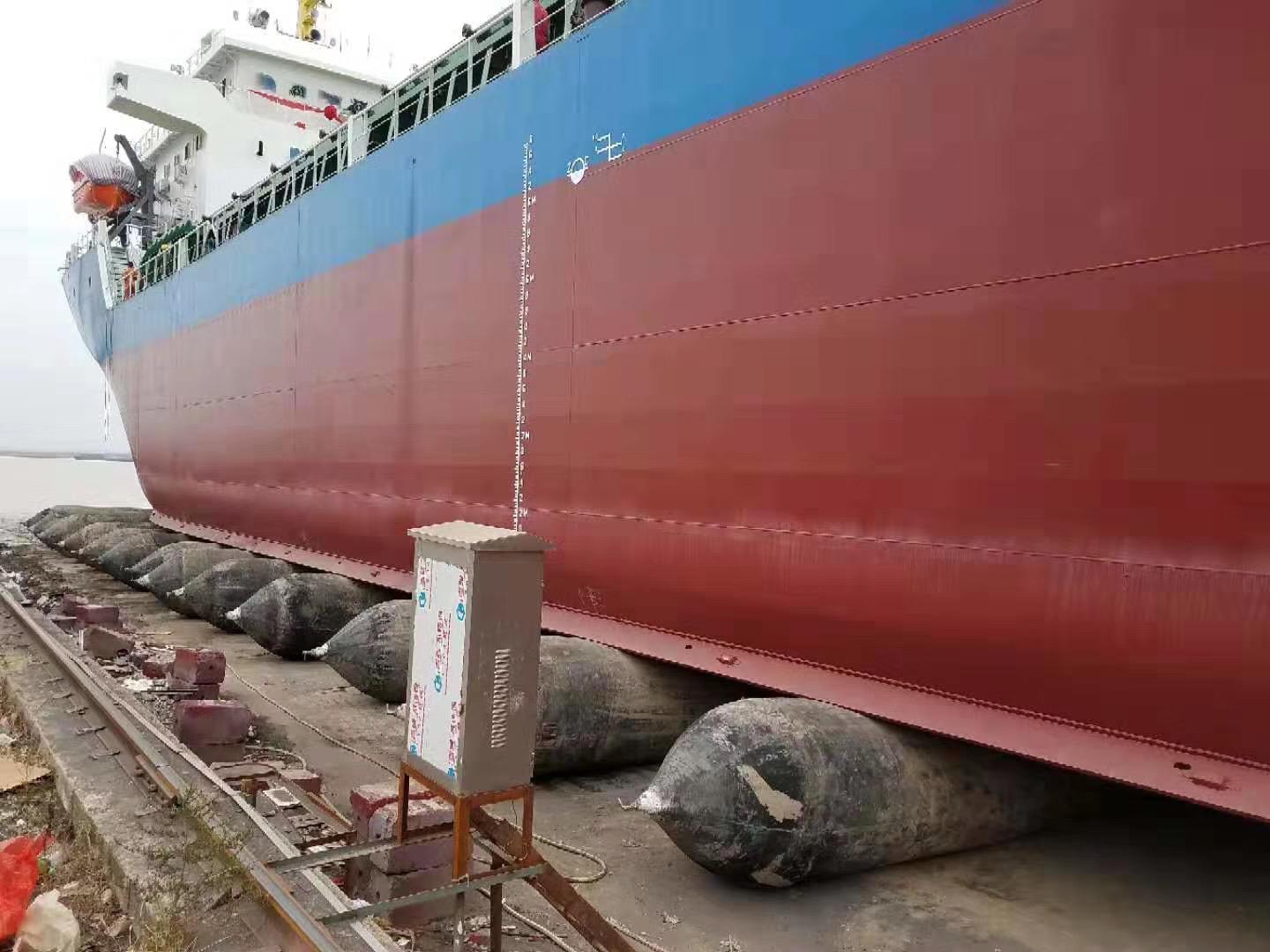
Ship Launching Rubber Airbags
Airbag Launching vs Fixed Slipway
| Factor | Airbag launch | Concrete Slipway |
| Civil cost | 60-80% lower for <5000 t | High upfront |
| Portability | Deflate & move site-to-site | Permanent |
| Surface | Graded beach/soil/concrete | Dedicated way |
| Reuse | 80-200 cycles/bag | Decades |
| Best for | Repair yards, salvage, remote builds | High-volume yards |
Airbags win where infrastructure lock-in is bad; fixed ways win where launch frequency is extreme and hulls are uniform.
Maintenance and Reuse Cycles
After every launch:
- Fresh-water rinse (salt destroys cord adhesive over time)
- Dry before folding — moisture inside causes ply delamination
- Inspect after every 10 launches for cord exposure, blistering, end-fitting wear
- Store cool, dark, off sharp edges, slightly inflated (~10% working pressure)
Properly maintained, a bag delivers 80–200 launches before retirement. Retire early if any ply is visible.
FAQ (Schema-ready)
How many airbags launch a 10,000-ton ship?
Enough bags at correct ply count and spacing — not one or two. Quantity is solved from displacement, hull length, and slope, always with ≥30% margin.
Are launching airbags the same as fender airbags?
No. Launching bags carry weight and roll; fenders absorb docking impact. Different construction and standard.
What pressure do marine rubber airbags use?
Typically 0.05–0.20 MPa depending on diameter and ply count, always below rated working pressure.
Can they be used on a dirt ramp?
Yes — compacted soil or gravel works if graded and cleared of stones; that is a core advantage over concrete ways.
