

Ship Launching Airbags: How They Work, Specifications, and Launching Methods
Introduction
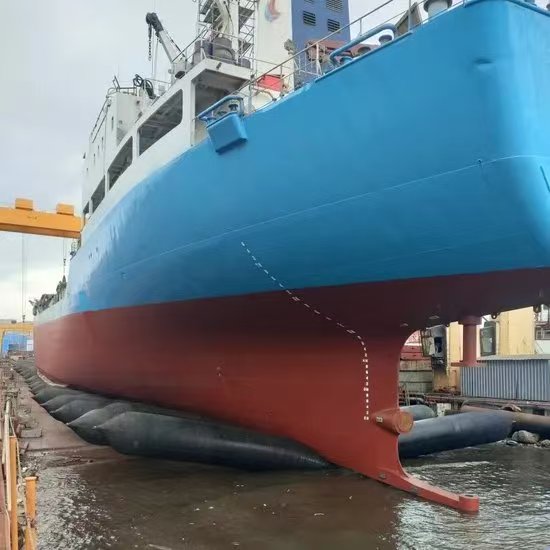
Ship Launching Airbags
Ship launching airbags are heavy-duty inflatable rubber cylinders used to move a vessel from the building berth into the water. They are placed under the hull, inflated, and used as rollers so the ship can be launched without a slipway, rails, or cranes.
The method was developed in China in the early 1980s and is now used in shipyards around the world for vessels from small workboats up to large tankers and bulk carriers of more than 100,000 DWT.
This guide explains how ship launching airbags work, what they are made of, how to choose the right size, how a launch is carried out, and what buyers should check before ordering.
What Are Ship Launching Airbags?
Ship launching airbags are reinforced rubber cylinders filled with compressed air. They act as both a lifting support and a rolling element, so a vessel can be moved over land and into the water.
The term “marine airbags” is also used, but it covers other applications too, such as salvage, heavy lifting, and floating pontoons.
Structure of a Ship Launching Airbag
1.Inner rubber liner
- An airtight layer that holds the compressed air.
- Usually made from a natural rubber and butyl rubber blend.
2.Synthetic cord layers (tyre cords)
- High-strength nylon or polyester cords wound at a set angle.
- They carry the load and internal pressure. This is the main structural layer.
3.Outer rubber wear layer
- Resists abrasion, cuts, and contact with the hull and ground.
- Usually made from a natural rubber compound with good tear resistance.
4.End caps and inflation valves
- Steel or reinforced rubber ends with valves for inflation and pressure release.
5.Protective outer sleeve (optional)
- An extra wear layer for rough surfaces or long transport distances.
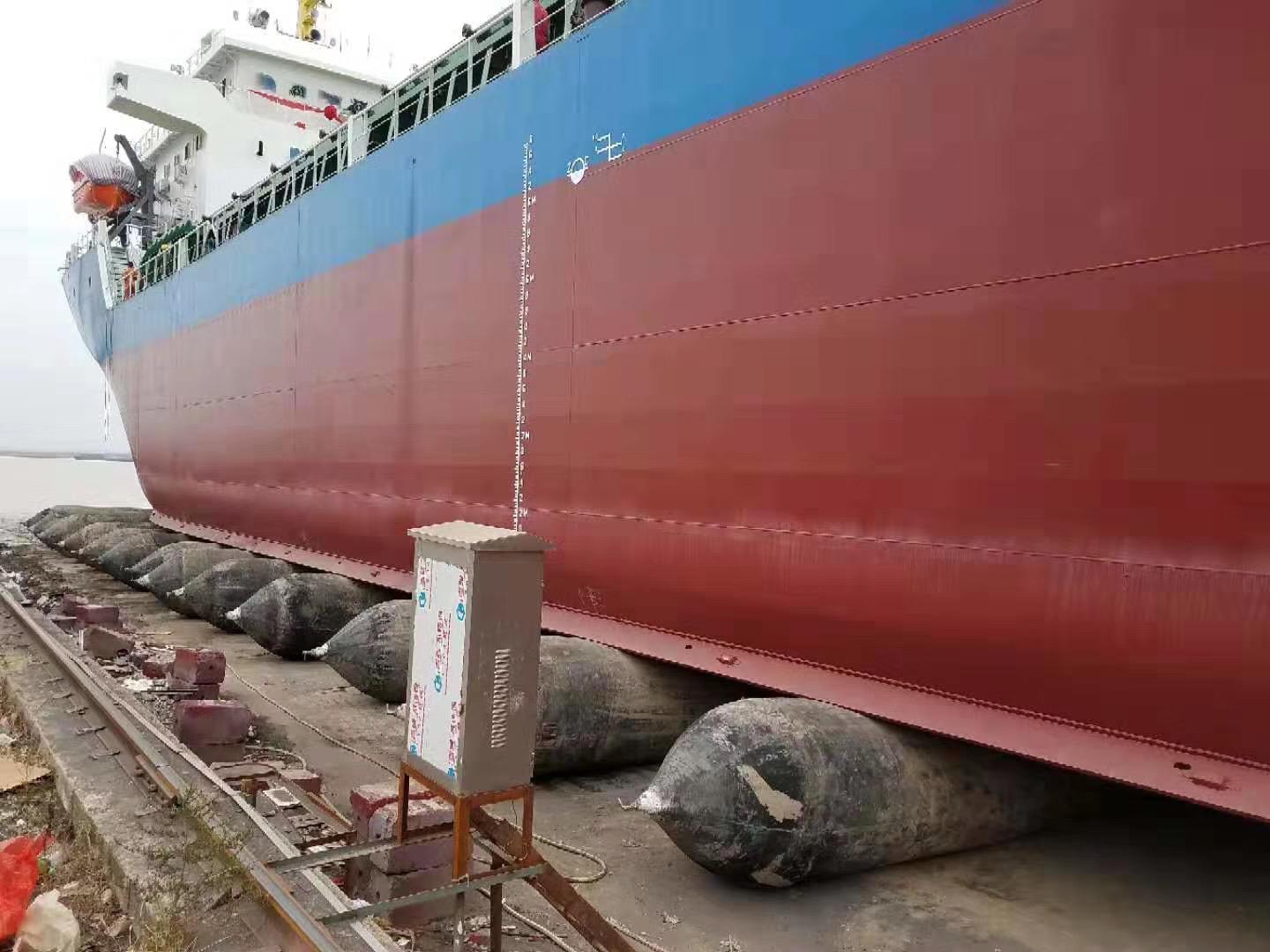
Launchinng Airbags
How Do Ship Launching Airbags Work?
The principle is simple: compressed air carries the load, and the airbag rolls.
- Positioning – Deflated airbags are placed under the vessel’s keel, side by side.
- Inflation – The airbags are inflated to the working height, lifting the vessel off the keel blocks.
- Rolling – As the vessel moves forward under gravity or is pulled by winches, the airbags roll and carry the hull along.
- Entry into the water – As the vessel enters the water, buoyancy gradually takes over the load.
- Release and recovery – Once the vessel is afloat, the airbags are deflated, pulled out, and cleaned for the next use.
Key parameters:
- Working pressure – commonly 0.05–0.20 MPa, depending on size and load.
- Working height – the inflated height under load, usually 0.6–1.5 m.
- Bearing capacity per metre – the load one airbag can carry per metre of length, measured in kN/m.
Always follow the manufacturer’s load table. Overloading is the main cause of airbag failure.
Key Advantages
- Low infrastructure cost – no permanent slipway, rails, or cranes are needed.
- Flexible – one set of airbags can launch vessels of different sizes.
- Fast setup – a launch can be prepared in days rather than months.
- Reusable – a well-maintained set can be used for many launches.
- Gentle on the hull – the airbags spread the load evenly and reduce point loading.
Specifications
Ship launching airbags are described by diameter × effective length. Standard sizes range from about 0.8 m to 2.5 m in diameter and 6 m to 25 m in length. Larger sizes are made to order.
Typical Size Reference
| Size (DxL) | Typical application |
| 0.8x6-10m | Small craft, fishing boats |
| 1.0x10⁻¹⁵m | Tugs, workboats, yachts |
| 1.5x12-20m | Medium vessels, barges |
| 2.0x15-25m | Large cargo vessels |
| 2.5m and above | Very large vessels, multi-airbag launches |
What to Check on a Specification Sheet
- Diameter, effective length, and total length
- Number of cord layers – usually 4–10, more for heavier loads
- Working pressure and working height
- Bearing capacity (kN/m) at the stated working height
- Burst pressure – typically 3–4 times the working pressure
- Weight and number of lifting lugs
- Valve type and inflation connection
- Standard compliance – usually ISO 14409:2011, the international standard for ships and marine technology: ship launching airbags
Launching Methods
1. End Launching
The vessel is built with its stern facing the water. Airbags are placed along the keel, and the vessel moves straight down the slipway into the water. This is the most common method.
2. Side Launching
The vessel is built parallel to the shore and moved sideways into the water. It needs a wider, flatter launching area and more careful control.
3.一对一拖带下水
For larger vessels, airbags are used together with winches and side-leading lines so the launch speed and direction stay under control.
4. Differential Airbag Launching
Airbags at the stern are inflated to a higher pressure than those at the bow. This tilts the vessel slightly and controls how it enters the water.
Every launch should be planned with a launch calculation that covers vessel weight, slope gradient, friction, buoyancy curve, and the number of airbags. This is normally done by the shipyard together with the airbag supplier.
How to Select the Right Airbags
Selection is usually based on five factors:
- Vessel weight (lightship displacement) – the total load the airbags must carry.
- Number of airbags – calculated from total weight divided by the safe bearing capacity of each airbag, with a safety margin.
- Slope gradient – a steeper slope needs more braking control.
- Ground conditions – the surface must be flat, firm, and free of sharp objects.
- Vessel length and hull shape – these affect airbag spacing and length.
Most reputable suppliers produce a launch plan that covers airbag size, quantity, spacing, pressure, and winch requirements. Always ask for one before ordering.
Installation and Launch Procedure
- Prepare the ground – level the launching area and remove debris, stones, and sharp edges.
- Place the airbags – position deflated airbags under the keel at the calculated spacing.
- Inflate to working height – inflate evenly and check that all airbags reach the same height.
- Remove the keel blocks – take out the building blocks so the vessel rests fully on the airbags.
- Control the launch – release the vessel under controlled winch or braking lines.
- Monitor pressure – watch the pressure in every airbag throughout the launch.
- Recovery – once the vessel floats, deflate the airbags and pull them out.
Inspection and Maintenance
- Before each use:
Check the outer rubber for cuts, wear, and exposed cord.
Test the valves for leaks.
Inflate to working pressure and check that it holds.
- After each use:
Wash off mud, salt, and debris.
Dry before storage.
Check the inner liner and cord layers if any damage is visible.
- Storage:
Store partly inflated or flat, never fully inflated for long periods.
Keep in a shaded, dry place away from oil, chemicals, and direct sunlight.
- Repair:
Minor damage can be cold-bond repaired with vulcanising patches.
Airbags with damaged cord layers should be taken out of service.
With proper care, a set of ship launching airbags can last 8–15 years and be used for many launches.
Case Study: Launching a Vessel with Airbags
The following is an example. Replace it with your own real project.
In one project, a 12,000 DWT bulk carrier was launched using 18 airbags of 2.0 × 18 m, arranged at 3 m intervals under the keel. The slope gradient was 1:14, and the vessel moved about 120 m from the berth to the water in under four minutes. All airbags were recovered, inspected, and reused for the next hull.
What this shows:
Larger vessels need more airbags at closer spacing, not just bigger airbags.
Controlled winch lines are essential for safe launch speed.
Post-launch inspection allows the same set to be reused.
To make this section rank and convert, replace it with your own project: vessel name, DWT, airbag size and quantity, slope, launch time, and photos.
Common Mistakes to Avoid
- Underestimating vessel weight – always include outfitting weight and a safety margin.
- Using too few airbags – this overloads each airbag and can cause a burst.
- Ignoring ground conditions – sharp stones and uneven ground are the most common cause of damage.
- Skipping the launch calculation – every launch must be calculated, not guessed.
- Mixing airbags of different sizes or wear levels – they inflate to different heights and share the load unevenly.
- Buying on price alone – cord quality and rubber thickness determine both safety and service life.
Frequently Asked Questions
Q: What are ship launching airbags?
A: They are reinforced inflatable rubber cylinders placed under a vessel’s hull to lift and roll it from the building berth into the water.
Q: What standard applies to ship launching airbags?
A: ISO 14409:2011 (Ships and marine technology — Ship launching airbags) specifies requirements for materials, construction, testing, and marking.
Q: How many airbags are needed to launch a vessel?
A: It depends on the vessel’s weight, airbag size, working height, and bearing capacity. A launch plan should always be calculated by the supplier or shipyard.
Q: What pressure do ship launching airbags use?
A: Working pressure is commonly 0.05–0.20 MPa, depending on the size and load. The burst pressure is typically 3–4 times the working pressure.
Q: Can ship launching airbags be reused?
A: Yes. With proper inspection, cleaning, and storage, a set can be reused for many launches over a service life of roughly 8–15 years.
Q: What is the largest vessel launched with airbags?
A: Airbag launches have been reported for vessels above 100,000 DWT, including a 115,000 DWT tanker. Each project needs an individual launch calculation.
Q: How long does a launch take?
A: The rolling itself usually takes only a few minutes. Preparing the ground, placing the airbags, and inflating them takes one to several days.
Q: Can airbags be used for purposes other than launching?
A: Yes. The same technology is used for salvage, heavy lifting, moving vessels on land, and floating structures such as pontoons.
Conclusion
Ship launching airbags offer a low-cost, flexible way to launch vessels without a permanent slipway. They work by carrying the hull on inflated, rolling rubber cylinders and are widely used for vessels from small craft up to large tankers.
When buying, focus on ISO 14409 compliance, cord-layer construction, working height, and bearing capacity, and always ask for a launch calculation. Correct inflation, even load sharing, and regular inspection are the keys to safe launches and a long service life.
