

Ship Launching Airbags: What They Are, How They Work, Types, and Selection Guide
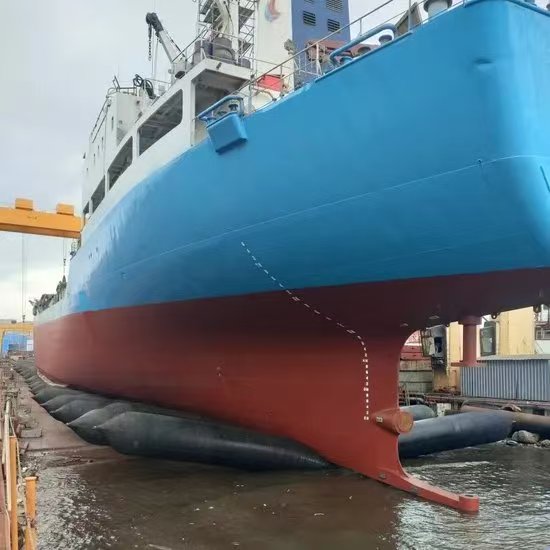
Ship Launching Airbags
Introduction
Ship launching airbags (also called marine airbags or rubber roller bags) are cord-reinforced rubber cylinders that are inflated with compressed air to lift a vessel off its keel blocks and roll it down a slipway into the water.
The technology was pioneered in China in the early 1980s, inspired by the ancient method of rolling heavy loads on logs. It replaced expensive fixed slipways and dry docks for many small and medium-sized shipyards. Today it is covered by ISO 14409:2011 for airbag construction and testing, and ISO 17682:2013 for the launch methodology.
This guide explains what ship launching airbags are, how they work, the main types, how to select the right size and quantity, and how to inspect, use, and store them safely.
What Are Ship Launching Airbags?
A ship launching airbag is a reinforced rubber cylinder filled with compressed air. It carries the vessel’s weight on its curved surface and rotates under the hull like a roller, so the hull rolls instead of slides into the water.
Structure of the Airbag
1.Inner rubber layer
- An airtight layer that seals the compressed air.
- Usually a blend of natural rubber (NR), SBR, and butyl rubber (IIR) for airtightness and fatigue resistance.
2.Synthetic cord reinforcement layers (plies)
- High-strength nylon or polyester tyre cord, crisscrossed at design angles and bonded with RFL adhesive.
- The cord layers carry the hoop stress from internal pressure and determine the maximum working pressure. Outer rubber thickness does not.
- Common configurations: 4–5 plies for light duty, 6–8 plies for standard commercial launching, 10–12 plies for heavy vessels.
3.Outer rubber layer
- An abrasion-, UV-, and salt-resistant natural rubber compound.
- Protects the cord layers on rough slipways and provides a low-friction rolling surface.
4.End fittings
- Steel flanges, inlet valve, pressure gauge, safety relief valve, and sealing rings.
Shape
The airbag has a cylindrical centre section with cone-shaped ends. Only the cylindrical part carries load, so the effective length excludes the conical ends.
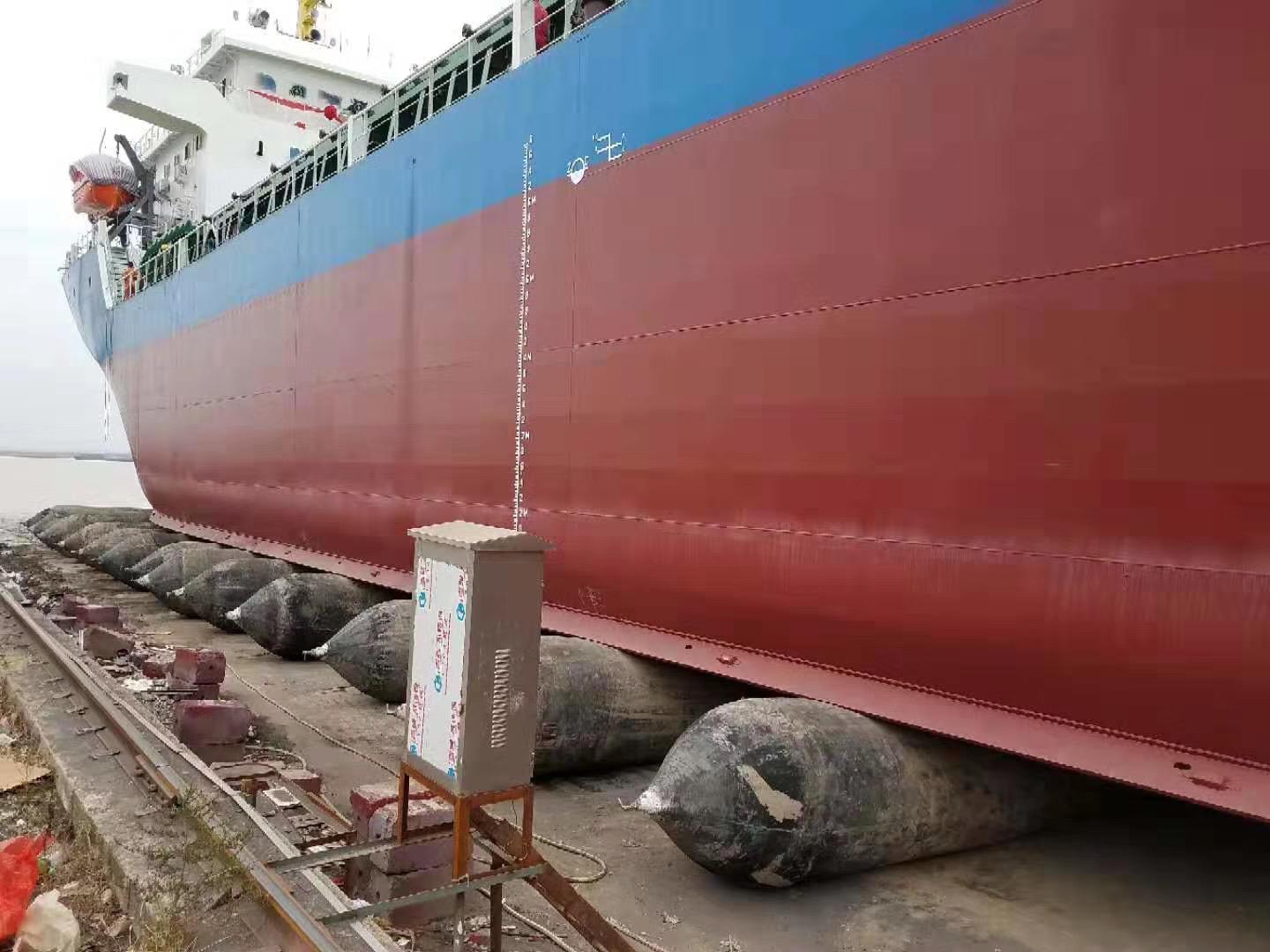
Launching Airbags
How Do Ship Launching Airbags Work?
The principle is rolling support, not impact absorption:
- Positioning – Deflated airbags are laid flat under the hull, either longitudinally for end launching or transversely for side launching. Spacing is calculated so the unsupported hull span stays within plate and keel stress limits.
- Inflation and lift – Compressors fill the bags to working pressure (typically 0.05–0.20 MPa). Internal pressure acting on the contact footprint lifts the hull off the keel blocks.
- Block removal – All keel blocks and shores are removed. The hull now rests entirely on the top arc of the airbags.
- Rolling launch – The holding winch is released. Gravity on a sloping slipway, assisted by tug or winch, moves the vessel. The bags rotate under the keel like conveyor rollers, so the hull rolls instead of slides. Rolling friction is far lower than greased wooden ways.
- Buoyancy take-over – As the stern enters the water, hydrostatic lift carries part of the weight and the forward bags shed load progressively.
- Recovery – After the vessel floats free, the bags are collected, deflated, rinsed, and stored.
Static equilibrium in one line:
Vessel weight per unit length ≤ Working pressure × Contact width × Safety derating
There is no kinetic-energy integral like a fender. This is a quasi-static load path, not an impact curve.
Ship Launching Airbags vs Pneumatic Rubber Fenders
| Factor | Ship launching airbags | Pneumatic rubber fenders |
| Purpose | Lift and roll a vessel | Absorb berthing impact |
| Load type | Static weight | Dynamic impact energy |
| Orientation | Long cylinder under the hull | Short, fat fender on the side |
| Pressure | 0.05-0.20 MPa | 50-80 kPa |
| Standard | ISO 14409 | ISO 17357 |
They are the same family of air-filled rubber products, but they are not interchangeable.
Key Advantages
- Low infrastructure cost – no permanent ramp, rails, or cradle are needed.
- Portable and reusable – one set can serve several berths or shipyards.
- Fast deployment – a site can be ready in 1–2 months, compared with 8–14 months for a new slipway.
- Even hull load – airbags distribute load continuously and absorb minor ground unevenness by elastic deformation, reducing point stress on the hull.
- Controllable – pressure is visible on gauges, each bag can be adjusted, trim can be corrected before movement, and winches control launch speed.
- Multi-purpose – the same set can be used for haul-out, heavy transport, caisson moving, and salvage refloating.
Common Types by Ply Rating
| Type | Cord layers | Typical use |
| QP-General purpose | 3-5 plies | Lighter vessels, general launch and haul-out |
| QG-High bearing | 6-8 plies | Heavier vessels, higher working pressure |
| QS-Super-high bearing | 9+ plies | Large vessels and heavy structure transport |
Source:
Common Applications
- New-build launching – from small workboats to large vessels
- Haul-out and landing for repair and inspection
- Heavy object transport on land
- Marine salvage and refloating
- Caisson and bridge-element moving
- Underwater buoyancy aid
How to Select Ship Launching Airbags
Selection depends on five factors:
- Total launch weight – lightship plus outfitting margin and any water trapped in the hull.
- Hull length and bottom shape – determines how many bags fit under the hull.
- Slipway slope and surface – typical gradient 1:20 to 1:10 (3–6°); concrete, compacted soil, or sand/gravel are all workable.
- Water depth – rule of thumb: depth ≥ 1.5 × vessel draft + 0.5 m.
- Working pressure and ply rating – matched to vessel weight and contact area.
Typical Size Ranges
| Diameter | Effective length | Typical vessel range |
| 0.8-1.0 m | 6-10 m | Small boats, workboats(<100t) |
| 1.2-1.5 m | 10-18 m | Tugs, barges(100-800t) |
| 1.5-2.0 m | 15-22 m | Medium cargo, fishing vessels (800-3000t) |
| 2.0-2.5 m | 20-26 m | Large barges, offshore vessels (3000-10000+t) |
Source:
Estimating Airbag Quantity (Simplified)
Single-bag capacity ≈ Working pressure × Contact width × Effective length × Derating (0.7–0.8)
Contact width ≈ Diameter × 0.6
Required count = Total vessel weight ÷ Single-bag capacity
Example: 500-ton barge, 1.5 m diameter bags, 12 m effective length, 0.10 MPa working pressure.
- Contact width ≈ 0.9 m
- Single-bag capacity ≈ 0.10 MPa × 0.9 m × 12 m × 0.75 ≈ 81 kN ≈ 8.3 tons
- Required count ≈ 500 ÷ 8.3 ≈ 60 bags
Always add a 15–20% buffer for slope irregularities, uneven inflation, and tidal timing.
This is a screening calculation only. The final arrangement must be engineered by the supplier, because the critical moment is stern-first water entry, when the remaining bags in contact carry the highest load.
Installation and Launch Procedure
- Lay bags according to the pre-calculated spacing plan, usually one every 3–5 m along the hull, plus 1–2 spare units.
- Inflate evenly across the whole bag grid; uneven inflation is a leading cause of hull damage.
- Keep the bags aligned with the slope direction to avoid twisting during rolling.
- Maintain holding winch control at all times; never rely on gravity alone without a braking plan.
- Clear all sharp objects from the slipway and hull.
- Check tide, wind, and water depth before committing to the launch window.
Inspection and Maintenance
- Before every launch:
Visual check: no cuts over 50 mm, no exposed cord
Pressure hold test: inflate to 1.1 × working pressure, hold 30 minutes, pressure drop below 5%
Confirm the relief valve is calibrated and the pressure gauge is within its 12-month certification
- After every 10 launches – detailed inspection of the outer rubber and cord layers.
- Cleaning – rinse off sand and salt, dry fully, and apply talcum powder before folding.
- Storage – folded, in a shaded and ventilated place, away from oil, chemicals, and rodents.
- Replace when: cord layers show through the outer rubber, or burst pressure falls below 2.5 × working pressure.
With proper care, 80–200 launch cycles and a service life of 6–15 years are realistic.
Common Mistakes to Avoid
- Under-specifying ply count – the bag bursts or deforms too much under load.
- Too few bags or too-wide spacing – the hull sags between bags.
- Uneven inflation – some bags overload while others are slack.
- Over-inflating to “lift faster” – this removes the safety margin.
- Launching over sharp debris – the most common cause of puncture.
- Ignoring cross-slope and tide – the vessel can drift off line.
- No holding winch or emergency stop – gravity-only launches are not controllable.
- Buying by diameter alone – diameter without ply rating and working height means nothing.
Frequently Asked Questions
Q: What are ship launching airbags?
A: They are cord-reinforced, air-filled rubber cylinders laid under a hull to lift it off the blocks and roll it down a slipway into the water.
Q: Are ship launching airbags the same as marine fenders?
A: No. Fenders absorb berthing impact on the ship’s side. Launching airbags carry static hull weight under the keel and are built for rolling contact, not impact.
Q: What is the largest vessel launched with airbags?
A: Commercial projects have launched vessels of several thousand tons, and suppliers report launches up to 75,000 DWT with engineered multi-bag arrangements.
Q: Can airbags be used on a sandy or muddy beach?
A: Yes, provided the slope is graded and compacted. Use geotextile or steel plates over soft ground to reduce rolling resistance and abrasion.
Q: What water depth is needed?
A: A common rule is depth ≥ 1.5 × vessel draft + 0.5 m, timed with the tide.
Q: What certificates should I ask for?
A: ISO 14409:2011 compliance, a hydrostatic burst test report, rubber compound test data, and classification society approval (CCS, BV, ABS, DNV, LR) if your flag state requires it.
Q: How many times can they be reused?
A: Typically 80–200 cycles with correct cleaning, storage, and inspection.
Conclusion
Ship launching airbags turn a capital-heavy, fixed-infrastructure operation into a portable and repeatable marine engineering process. They cut setup cost and time, spread hull load evenly, and can be reused for haul-out, transport, and salvage.
When buying, base your choice on vessel weight, hull form, slope, and water depth, and specify ISO 14409 compliance with a supplier-engineered bag layout. Correct inflation, disciplined winch control, and a pre-launch inspection routine are the keys to a safe launch and a long service life.
