

Floating Marine Fender: What It Is, How It Works, Types, and Selection Guide
Introduction

floating marine fender
A floating marine fender is a marine fender that floats on the water surface and absorbs the impact energy between a vessel and a dock, jetty, or another ship. Unlike fixed berth fenders that are bolted to a quay wall, a floating marine fender moves with the tide and follows the vessel’s movement. This makes it the preferred choice for ship-to-ship (STS) transfer, floating docks, and ports with large tidal ranges.
The term “floating marine fender” covers several different designs: the most common is the floating pneumatic rubber fender, followed by foam-filled, solid EVA, wood, and composite fenders.
This guide covers what a floating marine fender is, how it works, the main types, how to select the right one, and how to install and maintain it correctly.
What Is a Floating Marine Fender?
The name describes how the fender is used and where it works:
- Floating – the fender is suspended or buoyant, so it stays on the water surface and moves with the tide and the vessel.
- Marine fender – a device that absorbs berthing impact energy to protect both the vessel and the berth structure.
Basic Structure
Most floating marine fenders share the following components:
- Energy-absorbing body
- Compressed air, closed-cell foam, or solid elastomer, depending on the type.
2. Outer cover or skin
- Rubber or polyurethane (PU), which resists seawater, UV, abrasion, and impact.
3. Protective covering (optional)
- Chain-and-tyre net, synthetic rope net, or PU coating.
4. Suspension fittings
- Chains, wire ropes, shackles, and lifting eyes for suspension and handling.
5. Safety valve (pneumatic types only)
- Releases pressure automatically if internal pressure rises above the safe limit.
How Does a Floating Marine Fender Work?
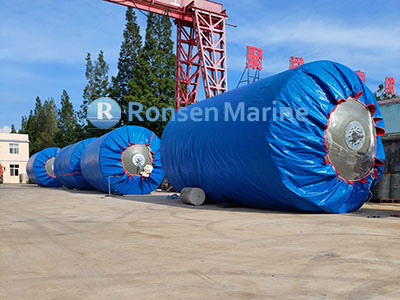
marine floating fenders
All floating marine fenders work on the same basic principle: elastic deformation converts impact energy into stored energy. The difference lies in the energy-absorbing medium:
- Contact and deformation – The vessel presses against the fender, and the fender body deforms.
- Energy absorption – The internal air, foam, or elastomer compresses, converting the vessel’s kinetic energy into stored energy and a small amount of heat. Because the fender deforms significantly, the reaction force on the hull stays relatively low.
- Rebound – After the vessel moves away, the fender returns to its original shape, ready for the next impact.
Performance reference (pneumatic types):
E ≈ P₀ × V × ln(P₂ / P₀)
Where:
- P₀ = initial air pressure (commonly 50 kPa or 80 kPa)
- V = internal volume
- P₂ = maximum pressure after compression
For foam and solid types, energy absorption depends on foam density, core design, and material formulation. Always use the manufacturer’s performance data rather than a general formula.
Key Advantages
- Follows the tide automatically – no need to reposition the fender as the water level changes.
- Low reaction force – protects both hull and berth structure, especially for large vessels.
- Flexible installation – can be suspended from vessels, floating docks, or pontoons.
- Adaptable – tolerates uneven berth surfaces, hull inclination, and tidal changes.
- Easy to relocate – can be moved between berths or vessels as needed.
Common Types of Floating Marine Fenders
| Type | Energy-absorbing medium | Typical application |
| Floating pneumatic rubber fender | Compressed air | Large ports, STS, large tankers |
| Foam-filled fender | Closed-cell EVA or PE foam | Tugs, workboats, high-puncture sites |
| Solid EVA fender | Solid elastomer | Small craft, marinas |
| Wood / composite fender | Wood or composite core | Traditional docks, historic ports |
Pneumatic vs Foam-Filled: A Common Question
| Selection factor | Choose pneumatic | Choose foam-filled |
| Large STS operations | Preferred | Less common |
| Very low reaction force needed | Usually better | Check data first |
| Limited maintenance resources | Regular checks needed | Virtually maintnance-free |
| High puncture risk (ice, debris) | Higher risk | Cannot deflate |
Common Applications
- Ship-to-ship (STS) transfer – oil, LNG, bulk cargo, and bunkering
- Floating docks and pontoons
- Ports with large tidal ranges
- Tugboats and workboats
- Temporary or seasonal berths
- Offshore platforms and wind-farm support vessels
- Naval, coastguard, and patrol vessels
- Marinas and yacht berths
How to Select the Right Floating Marine Fender
Selection is usually based on the following five factors:
- Vessel size (DWT) – larger vessels need larger fenders.
- Berthing velocity – higher speed means more energy to absorb.
- Tidal range – determines suspension length.
- Hull type and dock structure – affects fender type, spacing, and quantity.
- Operating environment – ice, debris, oil, and UV exposure affect the choice between pneumatic and foam-filled types.
- For pneumatic types, most reputable suppliers calculate requirements according to ISO 17357. Always ask for a calculation sheet or performance data before purchasing.
Common Size Reference (Pneumatic Types)
| Fender size (D x L) | Typical use |
| 500 x 1000 mm | Small boats, yachts |
| 1700 x 3000 mm | Medium vessels, tugs |
| 2500 x 5500 mm | Large vessels, STS |
| 3300 x 6500 mm and above | Very large crude carriers, large STS |
This table applies to pneumatic floating fenders only and is a general guide. Actual selection must be based on berthing energy calculations.
Installation Tips
- For pneumatic types, inflate to the manufacturer’s recommended pressure before suspending.
- Use certified chains, shackles, and wire ropes with a suitable safety factor.
- Keep the suspension balanced so the fender hangs vertically and the load is evenly distributed.
- Leave enough suspension length so the fender can follow the tide.
- Place fenders opposite the vessel’s main contact points: usually near the bow, stern, and midship.
- For STS operations, follow OCIMF ship-to-ship transfer guidelines.
Maintenance and Inspection
- Before each operation – visual check for obvious damage and correct positioning.
- Monthly (high-use) or quarterly (normal):
Pneumatic types: check air pressure with a calibrated gauge and top up if needed.
Inspect the outer cover for cracks, cuts, bulges, and wear.
Check the chain or rope net for wear and loose fittings.
Test the safety valve on pneumatic types.
- Annually – thorough inspection, including cover thickness at wear points.
- Storage – keep in a shaded, dry place, away from oil, grease, chemicals, and sharp objects.
Signs you should replace or repair the fender:
- Air pressure drops quickly after inflation (pneumatic types).
- Visible bulges or delamination.
- Deep cuts reaching the cord layer or foam core.
- A faulty safety valve that cannot be repaired.
With proper care, service life is typically 8–10 years for pneumatic types and 8–15 years for foam-filled types.
Common Mistakes to Avoid
- Over-inflation – exceeds the design pressure and risks bursting.
- Under-inflation – reduces energy absorption and can cause the fender to bottom out.
- Choosing the wrong type – foam-filled fenders may have higher reaction force than expected; pneumatic fenders need regular pressure checks.
- Skipping berthing calculations – guessing the size often leads to oversized or undersized fenders.
- Ignoring suspension length – too little slack prevents the fender from following the tide.
- Buying only on price – low price often means lower-quality materials.
Frequently Asked Questions
Q: What is a floating marine fender?
A: It is a marine fender that floats on the water surface and absorbs berthing impact between a vessel and a dock or another ship. It moves with the tide, unlike fixed fenders mounted on a quay wall.
Q: Are all floating marine fenders pneumatic?
A: No. Pneumatic rubber fenders are the most common, but foam-filled, solid EVA, wood, and composite floating fenders are also used, each suited to different applications.
Q: Are floating marine fenders suitable for ship-to-ship operations?
A: Yes. STS transfer is one of their most common applications. They are usually suspended between the two vessels during the operation.
Q: What size floating marine fender do I need?
A: Size depends on vessel tonnage, berthing speed, tidal range, and hull type. Suppliers usually calculate this using ISO 17357-based formulas or selection charts.
Q: How long do floating marine fenders last?
A: Pneumatic types typically last 8–10 years, and foam-filled types 8–15 years, depending on usage and environmental conditions.
Q: Can they be used in cold or icy water?
A: Yes, but special materials and more frequent inspections are recommended in icy conditions. Ask the manufacturer for a cold-climate specification.
Conclusion
A floating marine fender absorbs berthing energy while floating on the water, so it follows the tide and protects vessels and docks with low reaction force. The most common type is the floating pneumatic rubber fender, while foam-filled fenders suit sites where maintenance is limited.
When buying, base your choice on vessel size, berthing conditions, tidal range, and ISO 17357 calculations where applicable. Correct installation and regular inspection are the keys to long service life and reliable protection.

