

Foam Filled Fender: What It Is, How It Works, and How It Compares to Pneumatic Fenders
Introduction
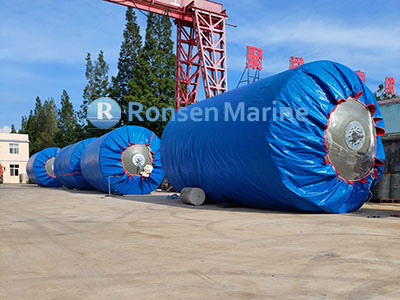
Foam filled fender
A foam filled fender (also called an foam-filled fender or EVA foam fender) is a marine fender with a solid core of closed-cell foam inside a reinforced rubber or polyurethane (PU) skin. Unlike a pneumatic fender, it contains no air and no internal pressure.
Because it cannot deflate or burst, the foam filled fender is a popular choice for harbour craft, tugboats, workboats, and locations where maintenance time is limited.
This guide explains what a foam filled fender is, how it works, its advantages and disadvantages, how it compares with pneumatic fenders, where it is used, and how to select and maintain it.
What Is a Foam Filled Fender?
A foam filled fender is a non-pressurised, solid-core marine fender. It absorbs impact energy through the compression of foam rather than compressed air.
Typical construction has three layers:
- Core – closed-cell EVA or polyethylene (PE) foam
- The cells are sealed, so the foam does not absorb water even if the outer skin is damaged.
- It is the main energy-absorbing material.
- Density is usually graded so the core is softer in the centre and firmer towards the outside. This gives a progressive reaction force.
2. Reinforcement layer (optional on larger sizes)
- A fabric or cord layer adds strength and helps the skin resist tearing.
3. Outer skin – polyurethane (PU) or rubber
- PU spray coating is common because it is tough, abrasion-resistant, and available in many colours.
- Rubber skins offer excellent elasticity and impact resistance.
- The skin is usually UV-stabilised and resistant to seawater, oil, and chemicals.
Key point: Because there is no air inside, a foam filled fender does not need inflation, pressure checks, or a safety valve.
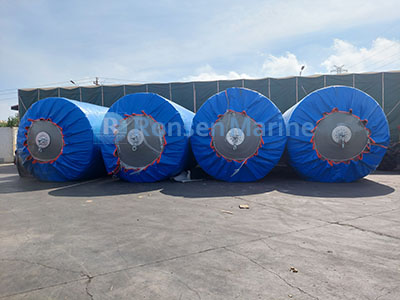
Foam fenders
How Does a Foam Filled Fender Work?
The working principle is foam compression:
- Contact – The vessel presses against the fender and the outer skin deforms.
- Energy absorption – The closed-cell foam cells compress. Impact energy changes into elastic deformation energy inside the foam. The reaction force rises gradually as compression increases.
- Recovery – When the vessel moves away, the foam expands back towards its original shape.
Main differences from pneumatic fenders:
| Foam filled fender | Pneumatic fender | |
| Medium | Closed-cell foam | Compressed air |
| Pressure | None | 50-80 kPa |
| Energy curve | Progressive, rises steadily | Softer at first, then rises faster |
| Failure mode | Skin wear or tear | Air leakage, valve, or skin failure |
Note: Exact energy absorption and reaction force depend on the foam density, core design, size, and skin material. Always refer to the manufacturer’s performance data rather than estimating from a formula.
Key Advantages
- No risk of deflation – it cannot burst or go flat, so it stays protective even with minor skin damage.
- Virtually maintenance-free – no pressure checks, inflation, or valves.
- Highly durable skin – PU coatings resist abrasion, UV, oil, and chemicals.
- Safe for busy or remote sites – no need for compressors or regular inspections.
- Custom shapes and colours – easy to mould into different shapes and brand colours.
- Good for small craft – commonly used on tugs, pilot boats, and workboats.
Disadvantages to Consider
- Reaction force can be higher than a pneumatic fender of similar energy rating, which matters for lightweight docks or hulls.
- Heavier per unit for very large sizes, which affects handling and suspension.
- Less elastic rebound – the foam recovers more slowly than compressed air.
- Skin repair required – if the skin is torn and not repaired, seawater can gradually affect the outer foam layers.
Foam Filled Fender vs Pneumatic Fender: Which Should You Choose?
| Selection factor | Choose foam filled | Choose pneumatic |
| Maintenance resources | Limited or remote sites | Staff available for checks |
| Risk of puncture | High (ice, debris, heavy traffic) | Lower |
| Large STS operations | Less common | Preferred |
| Tug and workbooat use | Very common | Less common |
| Low reaction force needed | Check data first | Usually better |
| Custom colour oor shape | Easy | Limited |
Rule of thumb:
- Choose foam filled fenders for tugs, workboats, busy harbour areas, and sites where reliability with minimal maintenance matters most.
- Choose pneumatic fenders for large ship-to-ship (STS) transfers, floating docks, and situations where very low reaction force is important.
Common Types and Shapes
- Cylindrical (tubular) – the most common shape, used on tugboats, docks, and pontoons.
- Donut (toroidal) – donut-shaped, suitable for corners and posts.
- Square or rectangular – used on barges, pontoons, and floating platforms.
- Keyhole – used on docks where the fender must sit flush against the wall.
- Custom profiles – made for specific vessels or dock designs.
Common Applications
- Tugboats and towing operations
- Pilot boats and harbour craft
- Workboats and crew boats
- Floating docks and pontoons
- Marinas and yacht berths
- Barges and offshore supply vessels
- Ports with ice or heavy debris
- Temporary or emergency berthing
How to Select the Right Foam Filled Fender
Selection is normally based on the following five factors:
- Vessel size and displacement – larger and heavier vessels need larger fenders.
- Operating speed and impact energy – fast manoeuvring craft need higher energy absorption.
- Required reaction force – check this against the dock or hull strength.
- Shape and mounting method – welded brackets, chains, ropes, or bolt-on fixing.
- Environment – ice, oil, UV exposure, and chemical contact affect skin choice.
Ask the supplier for a performance data sheet showing energy absorption (kJ) and reaction force (kN) at rated compression, usually 40–60%. Compare these figures directly rather than relying only on size.
Installation Tips
- Use the mounting method recommended by the manufacturer: welded brackets, chain slings, or rope suspension.
- For cylindrical fenders on tugs, fit them along the hull with even spacing and secure end brackets.
- Make sure the fender cannot rotate or shift under impact.
- Leave small gaps between fenders on long runs so each one can compress freely.
- For floating installations, use buoyancy aids if the fender itself does not float enough.
Maintenance and Inspection
Foam filled fenders need much less maintenance than pneumatic fenders, but they still need checks:
- Weekly or monthly visual inspection:
Look for cuts, tears, and abrasion on the skin.
Check that brackets, chains, and bolts are secure.
- Skin repair:
Small cuts can be repaired with PU repair kits or cold-bonded rubber patches.
Repair promptly to prevent water reaching the foam.
- Cleaning:
Wash off oil, salt, and debris with fresh water and a mild detergent.
- Replacement signs:
Deep tears that expose the core.
Visible loss of shape or permanent compression.
Loose or damaged mounting hardware.
With proper care, foam filled fenders typically last 8–15 years, and the PU skin can often be refurbished.
Frequently Asked Questions
Q: What does “foam filled” mean?
A: It means the fender’s core is made of solid closed-cell foam rather than air. The fender absorbs energy by compressing the foam.
Q: What kind of foam is used in foam filled fenders?
A: Most use closed-cell EVA (ethylene-vinyl acetate) or polyethylene (PE) foam. The cells are sealed so the foam does not soak up water.
Q: Do foam filled fenders need inflation?
A: No. They contain no air and need no inflation, pressure checks, or safety valves.
Q: Are foam filled fenders better than pneumatic fenders?
A: Neither is better in every case. Foam filled fenders are more reliable where maintenance is limited and puncture risk is high. Pneumatic fenders usually offer lower reaction force and are preferred for large STS and floating operations.
Q: Can foam filled fenders be used for ship-to-ship operations?
A: They can be used for smaller vessel STS work, but large tanker STS operations usually prefer pneumatic fenders because of their lower reaction force and established OCIMF guidelines.
Q: How long do foam filled fenders last?
A: Typically 8–15 years, depending on usage and environment. Damaged skins can often be repaired or replaced to extend service life.
Conclusion
A foam filled fender uses closed-cell EVA or PE foam inside a tough PU or rubber skin to absorb berthing energy. It needs no air, no pressure checks, and cannot deflate, which makes it a reliable, low-maintenance choice for tugs, workboats, floating docks, and busy harbour areas.
When selecting one, compare the manufacturer’s energy absorption and reaction force data, match the shape to your mounting method, and choose a skin material suited to your operating environment. Regular visual checks and prompt skin repairs will maximise service life.
