

What Is a Pneumatic Fender and How Does It Work? A Complete Guide
Introduction

Pneumatic Fender
A pneumatic fender (also widely known as a Yokohama fender) is a type of marine fender used to absorb the kinetic energy generated when a vessel berths against a dock, jetty, or another ship. Instead of solid rubber, it uses compressed air inside a reinforced rubber body as the cushioning medium.
First developed by Yokohama Rubber in 1958, the pneumatic fender has become one of the most widely used fender types in ports, ship-to-ship (STS) operations, and offshore installations worldwide.
What Is a Pneumatic Fender?
A pneumatic fender is a hollow, air-filled marine fender designed to protect both the vessel and the berth structure during docking. Unlike solid rubber fenders, its energy absorption comes from the compressibility of air.
A typical pneumatic fender consists of the following components:
- Outer rubber layer – resists abrasion, seawater corrosion, and external impact.
- Synthetic cord layers (tyre cords) – provide tensile strength and contain internal pressure.
- Inner rubber liner – prevents air leakage.
- Safety valve – releases excess pressure to prevent bursting.
- Chain-and-tyre net or rope net (optional) – protects the fender body from friction and punctures.
- End fittings – shackles, chains, and flanges for suspension and lifting.
How Does a Pneumatic Fender Work?
The working principle is based on air compressibility, and can be broken down into three steps:
- Contact and compression – When the vessel touches the fender, the outer shell deforms and the internal air volume decreases.
- Energy absorption – The compressed air pressure rises, converting the vessel’s kinetic energy into gas compression energy (and a small amount of heat). Because air is highly compressible, the fender deforms significantly while keeping reaction force relatively low.
- Rebound – Once the vessel moves away, the compressed air pushes the fender back to its original shape, ready for the next berthing.
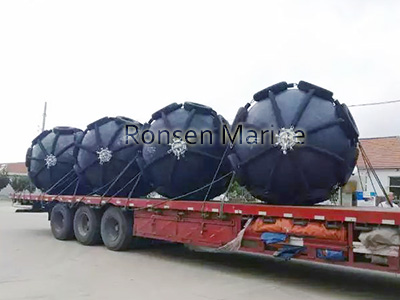
Pneumatic Rubber Fenders
Performance estimation (reference):
The energy absorption can be roughly estimated by isothermal gas compression:
E ≈ P₀ × V × ln(P₂ / P₀)
Where:
P₀ = initial air pressure (commonly 50 kPa or 80 kPa)
V = internal volume of the fender
P₂ = maximum pressure after compression
As the formula shows, larger fenders and higher initial pressure generally mean greater energy absorption capacity.
Key Advantages
- High energy absorption, low reaction force – gentler on both hull and berth structure, ideal for large vessels.
- High adaptability – tolerates uneven berth surfaces and hull inclination.
- Flexible installation – can be mounted on docks, hung on ship sides, or used in ship-to-ship operations.
- Easy maintenance – mainly involves periodic pressure checks, topping up air, and visual inspection of the rubber.
Common Applications
- Large vessel berthing (oil tankers, bulk carriers, container ships)
- Ship-to-ship (STS) transfer operations
- Floating docks and temporary berths
- Naval vessels and offshore platforms
Types of Pneumatic Fenders
| Type | Feature | Best for |
| Type I - Chain & Tyre Net | Heavy-duty chain and tyre protection | High-load port terminals |
| Type II - Rope Net | Lighter synthetic rope net | Vessel-mounted, own use |
| Net-less Type | Lower cost, no protective net | Light-duty or temporary use |
Selection mainly depends on four parameters: vessel DWT (deadweight tonnage), berthing velocity, dock structure, and tidal range.
Installation and Maintenance Tips
- Inflate to the manufacturer’s recommended pressure, commonly 50 kPa or 80 kPa initial pressure.
- Ensure the chain or rope net is evenly tensioned, with no twists.
- Inspect air pressure and check for bulges, cracks, and abrasion at least quarterly.
- Store away from prolonged direct sunlight, oil, and sharp objects.
Frequently Asked Questions
Q: Are pneumatic fenders the same as Yokohama fenders?
A: Yes. “Yokohama fender” is a trade name derived from the inventor, and it is now used interchangeably with pneumatic fender in the marine industry.
Q: How long do pneumatic fenders last?
A: With proper use and maintenance, service life typically ranges from 8 to 10 years, depending on operating frequency and environmental conditions.
Q: Can pneumatic fenders be used for ship-to-ship operations?
A: Absolutely. STS operation is one of their most common applications, with fenders typically suspended along the ship’s side between the two vessels.
Q: What initial pressure should a pneumatic fender be inflated to?
A: Most manufacturers recommend 50 kPa (about 0.5 bar) for standard applications, and up to 80 kPa (about 0.8 bar) for heavy-duty or high-energy berthing. Always follow the specific product manual.
