

What Are Foam Filled Fenders: Materials, Types, Sizing and Selection Guide
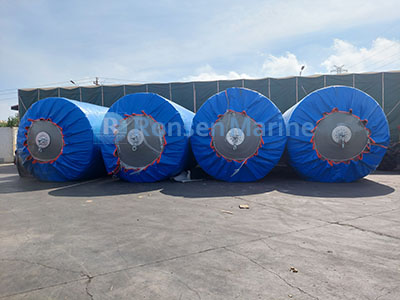
foam filled fenders
Last updated: 28 October 2026 · Reading time: 13 min · Author: [Jack], Marine Fender Engineer, 12 years specifying fender systems for ports and vessel owners · Applicable standards: ISO 17357-2 (foam-filled fenders), PIANC 2024 Marine Fenders: Recommendations for Design, Procurement and Installation, OCIMF Mooring Equipment Guidelines (MEG4)
If you typed this phrase into Google, you are probably choosing between foam-filled and pneumatic fenders, or between EVA and polyurethane foam. This guide answers both. It explains what foam filled fenders are made of, how they perform, which type fits which berth, and how to size one correctly using energy and reaction-force calculations. No marketing claims — just the engineering.
What this guide covers
- Definition and construction
- EVA vs polyurethane foam — the real difference
- Performance: why the reaction-force curve matters more than the brochure number
- Types and where each belongs
- How to size a foam fender (with worked example)
- Foam filled vs pneumatic vs solid rubber — a decision table
- Installation and inspection
- Common mistakes
- Frequently asked questions
1. Definition and construction
A foam filled fender is a marine fender whose core is a closed-cell foam body fully enclosed in a reinforced elastomeric skin. It absorbs berthing energy by compressing the foam, not by air pressure. The skin is typically a polyurethane- or polyurea-based elastomer applied by spraying, often reinforced with nylon or aramid fibre cord. Inside the core is a steel or HDPE central mandrel that carries the mounting hardware.
Because the core is solid foam, the fender cannot deflate, burst or lose performance if punctured. This is the single biggest reason ports choose it for high-traffic berths, exposed locations and cranes that handle heavy lifts near the quay.
Two points that matter in procurement:
- The performance comes from the foam density profile and the skin formulation, not from the diameter alone.
- ISO 17357-2 is the reference standard for foam-filled fenders. Ask suppliers for a type-test report against it, including the force-deflection curve, energy absorption and compression set.
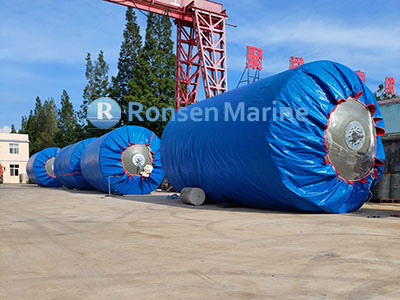
foam fenders
2. EVA vs polyurethane foam — the real difference
Most suppliers offer one of two core materials. The difference is not the brand name on the brochure.
| Property | Cross-linked PE/EVA foam | Polyurethane (PU) foam |
| Energy absorption per unit weight | Higher | Moderate |
| Water absorption (closed cell) | Near zero | Low, but varies with formulation |
| Compression set after long load | Excellent | Good |
| Skin bond strength | Very good | Depends on primer system |
| Typical use | Heavy berths, tug boats, offshore | General port and vessel fenders |
EVA (or cross-linked polyethylene) foam is the premium choice for high-cycle, heavy-load berths. It recovers better after long compression and absorbs more energy for the same weight. Polyurethane foam is common and cost-effective for general use, provided the formulation is marine-grade and closed-cell.
The skin matters as much as the core. Polyurea skins generally outperform polyester polyurethane on abrasion and tear resistance, which is why many offshore and tug fender specifications now call for a polyurea or polyurea-hybrid skin.
3. Performance: read the curve, not the number
Every foam fender has a force-deflection (reaction force vs deflection) curve and an energy-absorption curve. These are what your fender designer uses — not the single “energy absorption” figure printed on a datasheet.
Key things to check:
- Reaction force at design deflection. Too high, and the fender damages the vessel or the dock structure. Too low, and it bottoms out.
- Design deflection. Most foam fenders are designed for 50–60% deflection at the rated energy. Ask for the deflection at which the stated energy is absorbed.
- Performance curve family. A fender that is linear is easy to predict. One with a steepening curve at high deflection gives more energy capacity but can surprise you on reaction force.
- Compression set. PIANC recommends checking residual deformation after long-term load. A fender that sits compressed for weeks and does not recover is a structural problem, not a cosmetic one.
A note on performance claims: Some suppliers publish a single “energy absorption” value measured at an undisclosed deflection, then compare it with a competitor’s number measured at a different deflection. Always ask for the full curve and the test report.
4. Types and where each belongs
Donut / doughnut fenders — toroidal shape, often used on tug boats and small craft. Good all-round performance, easy to handle.
Cone fenders (foam filled) — high energy capacity, low reaction force for the size, suitable for large container and bulk terminals.
Cylindrical / Element fenders — modular, used where a long continuous face is needed, such as along a quay or on a floating pontoon.
Keyhole fenders — designed to fit into a steel frame or pocket on a dock face; common on smaller berths and jetties.
W-type (wing) and other shaped fenders — project further from the structure, used where clearance is needed between vessel and dock.
Tug and boat fenders — typically donut or cylindrical, sized for the tug’s bollard pull and the contact geometry.
Offshore / splash zone fenders — heavy-duty, polyurea-skinned, specified for exposed locations where punctures and UV are concerns.
5. How to size a foam fender — the calculation
The correct method is energy-based, not diameter-based.
Step 1 — Calculate berthing energy
For normal berthing, the kinetic energy is:
E = ½ · M · V² · Cₑ · Cₘ · Cₛ
Where:
M = effective mass of the vessel (displacement × a virtual mass factor, often 1.1–1.3)
V = berthing velocity (m/s) — from OCIMF or port design code
Cₑ = eccentricity factor (how far the contact point is from the centre of gravity)
Cₘ = virtual mass factor
Cₛ = softness factor (accounts for fender deflection and hull flexibility)
Step 2 — Select the fender
Choose a fender whose rated energy ≥ E, and whose reaction force at design deflection ≤ the allowable reaction of the fender panel, dolphin, bollard and vessel hull.
Step 3 — Check deflection and clearance
Confirm that at the design energy, the fender deflects within the manufacturer’s design range and that the vessel does not strike the structure behind the fender.
Step 4 — Check spacing and number
Space fenders so that the vessel’s hull is supported along its length, with no unsupported spans that cause local hull stress. For continuous berths, element fenders are often used in a line.
Worked example — 5,000 t container feeder, 0.15 m/s berthing velocity:
Assuming M = 5,500 t (including virtual mass), Cₑ = 0.8, Cₘ = 1.2, Cₛ = 0.9:
E = 0.5 × 5,500,000 × 0.15² × 0.8 × 1.2 × 0.9 ≈ 356 kJ
Select a foam fender rated ≥ 356 kJ at ≤ 60% deflection, with reaction force within the dolphin’s allowable load. A typical supplier selection for this energy would be a cone or large element fender, but always confirm with the manufacturer’s performance curve.
6. Foam filled vs pneumatic vs solid rubber
| Criterion | Foam filled | Pneumatic (ISO 17357-1) | Solid rubber |
| Puncture consequence | Performance retained | Pressure loss, repair needed | Unaffected |
| Energy absorption per size | High | Very high | Moderate |
| Reaction force | Moderate, predictable | Low, very predictable | Higher |
| Weight | Heavy | Light to moderate | Heavy |
| Maintenance | Low | Valve, pressure checks | Very low |
| Best for | High-traffic, exposed, heavy berths | Ship-to-ship, temporary berths | Small craft, fixed structures |
Rule of thumb: Choose foam filled when the berth cannot tolerate a sudden fender failure, when traffic is high, or when the fender sits in an exposed location. Choose pneumatic when low reaction force and light weight matter most, such as ship-to-ship transfer. Choose solid rubber for small craft and low-energy berths.
7. Installation and inspection
Installation
- Align the fender so the load transfers through the mandrel to the support structure. Misalignment causes skin tears.
- Use the correct grade and torque for mounting bolts; check against the manufacturer’s drawing.
- For fenders mounted on panels or dolphins, confirm the structure’s allowable reaction before installation.
- Keep the fender face clear of sharp edges, weld beads and marine growth.
Inspection (quarterly, or per PIANC guidance)
- Visual check of the skin for cuts, tears and abrasion.
- Check for exposed foam or cord at the skin surface.
- Measure residual deflection after a loaded period — excessive set indicates core or skin failure.
- Check mounting bolts and welds for movement or corrosion.
- Keep a log of inspections; ports using ISO 17357-2 compliant fenders should retain the type-test report on file.
8. Common mistakes
- Sizing by diameter — ignoring energy, reaction force and deflection.
- Comparing brochure numbers at different deflections — always ask for the curve.
- Specifying only “EVA” — the skin formulation and bond quality matter as much.
- Ignoring the support structure — a fender that overruns its allowable reaction damages the dock.
- Buying on price alone — the cheapest fender is the one that fails in year two and closes a berth.
- Skipping the type-test report — without ISO 17357-2 compliance, you have no verified performance data.
- Poor storage before installation — foam fenders should be stored flat, out of direct UV, and not stacked under heavy loads.
9. Frequently asked questions
What are foam filled fenders made of?
A closed-cell foam core (usually cross-linked PE/EVA or polyurethane) inside a reinforced elastomeric skin, mounted on a steel or HDPE mandrel.
Are foam filled fenders better than pneumatic?
For high-traffic and exposed berths, yes — they cannot deflate and retain performance if punctured. For ship-to-ship and low-reaction applications, pneumatic fenders are often the better choice.
What standard applies to foam filled fenders?
ISO 17357-2 is the international reference. PIANC 2024 and OCIMF MEG4 provide complementary guidance on fender system design and mooring.
How long do foam filled fenders last?
With correct specification, installation and inspection, 10–15 years is normal. Skin life depends on abrasion and UV exposure; the foam core generally outlasts the skin.
Can foam filled fenders be repaired?
Yes — local skin repair is possible if the foam core is intact. Ask the manufacturer for the repair procedure and materials. A damaged core usually requires replacement.
About the author
[Jack], [credentials], lead fender engineer at [Ronsen Marine]. 12 years specifying fender systems for container terminals, bulk ports, tug operators and offshore facilities. Contact: [email] · +[phone]
