

Marine Airbags for Ship Launching: The Complete Guide for Shipyards, Salvage Contractors, and Marine Engineers
What Are Marine Airbags?
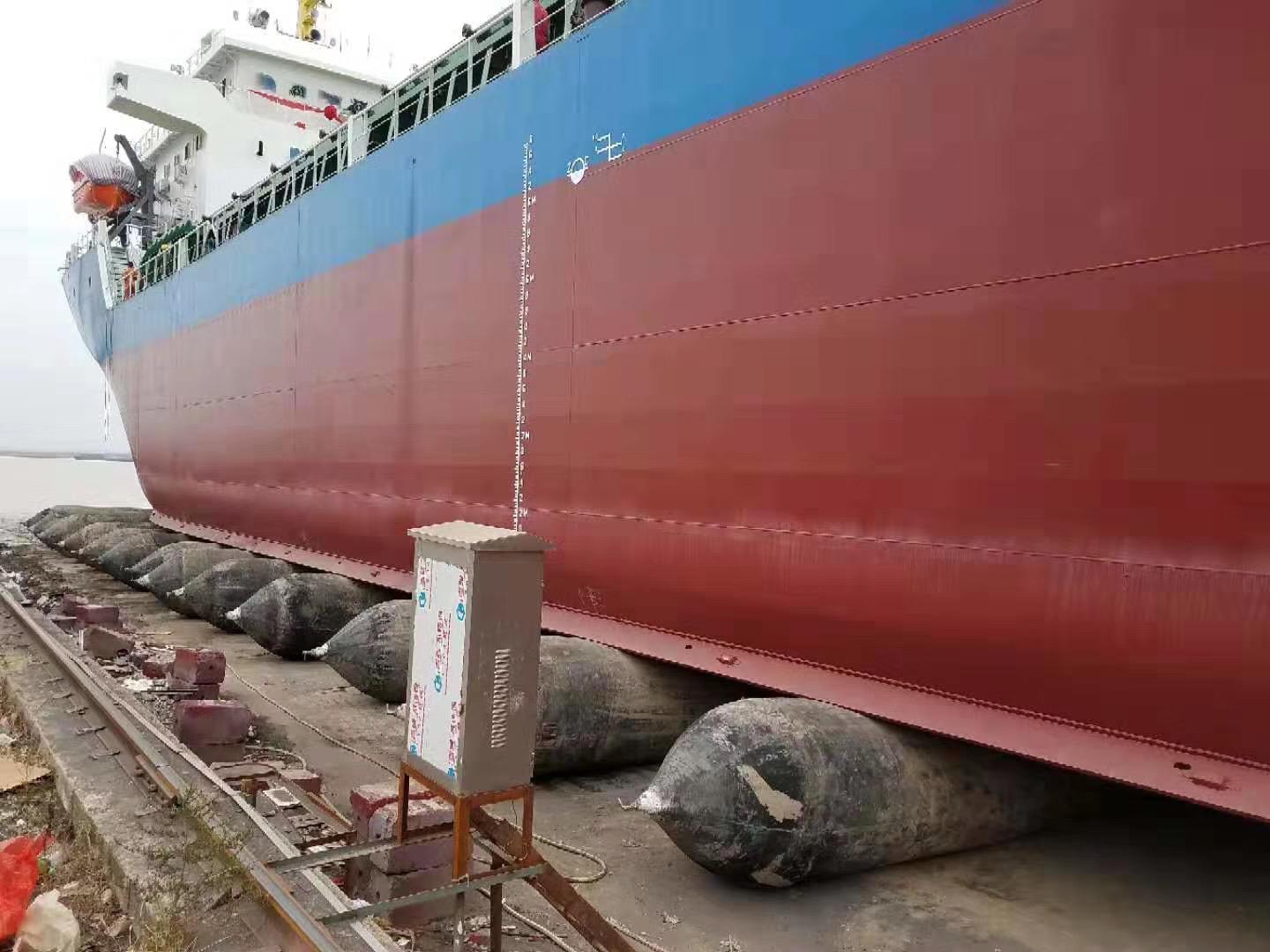
Marine Airbags
Marine airbags are heavy-duty, inflatable rubber cylinders reinforced with high-strength synthetic tire-cord layers. They are designed to lift, support, roll, launch, haul out, move, or refloat ships, barges, caissons, and other heavy marine structures.
Marine airbags are also known as:
- Ship launching airbags
- Marine rubber airbags
- Vessel launching airbags
- Inflatable marine roller bags
- Marine salvage airbags
- Heavy-lift airbags
A marine airbag generally consists of three main components:
- Inner rubber layer – forms an airtight barrier and helps retain compressed air.
- Synthetic tire-cord reinforcement layers – carry the hoop stress generated by internal air pressure.
- Outer rubber layer – protects the reinforcement from abrasion, seawater, UV exposure, and aging.
Quality marine airbags are manufactured through controlled rubber compounding, cord-layer winding, and high-temperature vulcanization. The end fittings usually include an inflation valve, pressure gauge connection, safety or relief valve, and lifting or towing attachments.
Key point: Marine airbags are not pneumatic fenders. Fenders absorb impact energy during berthing. Launching airbags support static and rolling loads while moving a vessel.
How Do Marine Airbags Work?
Marine airbags work through a combination of controlled internal air pressure, distributed hull support, and cylindrical rolling contact.
The basic process is:
- Deflated airbags are positioned under the vessel in calculated rows.
- Compressed air raises internal pressure and lifts the hull off its keel blocks.
- The vessel’s weight transfers to the curved upper surface of the airbags.
- Winches, gravity, tugs, or controlled guidance move the hull along the prepared launch path.
- The airbags rotate beneath the hull, reducing sliding friction.
- As the stern enters the water, hydrostatic buoyancy gradually takes over.
- The airbags are recovered, deflated, inspected, and prepared for reuse.
In simple terms:
Controlled air pressure creates lift. Cylindrical rolling contact turns that lift into smooth, low-friction vessel movement.
The actual working pressure depends on the airbag diameter, reinforcement layers, rubber formulation, end-fixture design, contact conditions, and manufacturer’s certified load data. Buyers should never assume that all airbags of the same diameter have the same pressure rating or load capacity.
Marine Airbags for Ship Launching
Why Shipyards Use Marine Airbags
1. Lower Infrastructure Cost
Compared with permanent slipways, rail systems, heavy cradles, or large crane operations, marine airbags can reduce site preparation and launching-system costs. The final saving depends on vessel size, launch frequency, terrain, access to equipment, and engineering requirements.
2. Reusable Equipment
A properly manufactured, inspected, and maintained marine airbag fleet can be used across multiple vessel movements. This makes airbags especially attractive for shipyards with repeated launching, haul-out, or salvage work.
3. Flexible Launch Sites
Marine airbags can be used on suitable concrete, compacted soil, sand, gravel, and prepared slipway surfaces. Site feasibility must be confirmed by a qualified engineer before every project.
Distributed Hull Support
Because the inflated airbag conforms to part of the hull shape, contact pressure can be distributed more evenly than with hard, narrow supports. This can reduce local keel and bottom-plate stress when the airbag layout is correctly engineered.
4. Portability
Deflated airbags occupy relatively little space. They can be transported to remote shipyards, islands, beaches, shallow-water sites, and emergency-response locations.
Marine Airbags vs. Traditional Launching Methods
| Factor | Marine Airbags | Concrete Slipway | Dry Dock | Crane Launch |
| Infrastructure investment | Low to moderate | High | Very high | Moderate to high |
| Siite flexibility | High | Low | Low | Moderate |
| Reusability | High | High | High | Moderate |
| Vessel-size flexibility | Wide range | Best for repeated similar vessels | Best for repair and maintenance | Limited by crane capacity |
| Best application | Launching, haul-out, salvage, heavy transport | High-volume fiixed shipyards | Repair, inspection, refit | Small craft and specialized lifts |
Marine airbags are not automatically the best choice for every vessel or shipyard. Steep gradients, unstable ground, sharp debris, poor access, unusual hull forms, and inadequate supervision can make an airbag launch unsafe.
Main Applications of Marine Airbags
Ship Launching
Marine airbags are widely used to launch:
- Fishing vessels
- Workboats
- Tugboats
- Barges
- Ferries
- Cargo ships
- Bulk carriers
- Tankers
- Offshore support vessels
The airbag layout, vessel weight, launch direction, slope, and hull strength must be evaluated before the operation.
Ship Landing and Haul-Out
Airbags can support controlled vessel landing, haul-out, and movement for:
- Hull inspection
- Hull cleaning
- Painting and coating
- Propeller or shaft repair
- Keel and bottom-plate maintenance
Dry-Dock Alternative
For shipyards without a graving dock or syncrolift, marine airbags can provide a temporary heavy-lift and vessel-movement solution. They do not replace all dry-dock functions, especially where deep underwater access or long-term stabilization is required.
Marine Salvage and Refloating
Salvage airbags can help refloat grounded, stranded, or sunken vessels and structures. Salvage operations require detailed underwater surveys, stability calculations, lifting plans, and environmental-risk assessments.
Heavy Transport and Marine Construction
Marine airbags are sometimes used to move or support:
- Caissons
- Bridge girders
- Prefabricated modules
- Concrete structures
- Offshore equipment
- Heavy industrial cargo
Marine Airbag Construction and Materials
Inner Rubber Layer
The inner rubber compound must provide long-term air retention. Common quality indicators include:
- Low air permeability
- Flex-fatigue resistance
- Tear resistance
- Aging resistance
- Compatibility with vulcanization and cord layers
Synthetic Tire-Cord Reinforcement
The reinforcement layers carry most of the tensile stress created by internal pressure. Key properties include:
- Cord tensile strength
- Cord density
- Adhesion between rubber and cord
- Fatigue resistance
- Dimensional stability under load
The cord-ply count, cord angle, winding method, and rubber bonding are often more important than the outer rubber thickness alone.
Outer Rubber Layer
The outer layer protects the airbag from:
- Abrasion
- Seawater
- UV radiation
- Oil and chemical exposure
- Ozone
- Surface debris
For rough ground, rocky beaches, or high-cycle operations, the outer compound and cord protection should be selected carefully.
Typical Marine Airbag Parameters
The following ranges are examples only. Actual values must come from the manufacturer’s certified product data and project calculation.
| Parameter | Typical Range |
| Nominal diameter | 0.8-2.5 m |
| Effective length | 6-25 m |
| Cord reinforcement layers | 4-12 plies, model-dependent |
| Working pressure | Determined by diammeter, ply count, and certified load curve |
| Applications | Launching, landing, haul-out, lifting, salvage, transport |
Do not select an airbag only by diameter. Two airbags with the same diameter may have completely different pressure limits, load ratings, and safety margins because of differences in cord layers, rubber quality, and manufacturing control.
Standards and Quality Requirements
ISO 14409:2011
ISO 14409:2011, Ships and marine technology — Ship launching air bags, covers design, materials, dimensions, testing, acceptance, marking, documentation, packaging, transport, and storage for synthetic-tire-cord reinforced ship-launching airbags.
The standard commonly references requirements such as:
- Rubber tensile strength of at least 18 MPa
- Elongation at break of at least 400%
- Shore A hardness around 60 ± 10
- Tear strength of at least 400 N/cm
- Compression-set limits
- Aging and ozone-resistance requirements
- Air-tightness testing
- Compression and compression-recovery testing
- Bearing-capacity testing
- Burst-pressure testing
ISO 17682:2013
ISO 17682 provides guidance on the methodology for launching ships using airbags. It addresses planning, preparation, airbag selection, positioning, inflation, vessel movement, safety, and contingency measures.
ISO 14409 defines product requirements. ISO 17682 addresses operational methodology. A buyer needs both product quality and correct field procedure.
Other Standards and Class Involvement
Some suppliers refer to national standards, classification-society surveys, or third-party inspection. Buyers should verify:
- Whether the certificate covers the product, factory, management system, or a specific project
- The certificate number and validity period
- The scope of inspection
- Whether test reports are traceable to each airbag or production batch
- Whether the classification society approved the product or only witnessed a test
A class certificate or ISO certificate alone does not authorize an unsafe launch.
How to Select the Right Marine Airbags
Airbag selection should be performed by a qualified marine engineer, naval architect, or shipyard launching supervisor. The following inputs are normally required:
Vessel Data
- Lightweight or displacement
- Length overall
- Beam
- Draft
- Hull material
- Block coefficient
- Center of gravity
- Keel and bottom-plate construction
Launch Site Data
- Slipway gradient
- Surface material
- Surface condition
- Obstructions
- Tidal range
- Water depth
- Available winches and compressors
- Wind, current, and wave conditions
Airbag Data
- Certified diameter
- Effective length
- Cord layers
- Rated working pressure
- Bearing capacity per meter
- Minimum burst pressure
- Safety factor
- End-fitting specification
- Manufacturer’s load and deformation curves
Basic Number-of-Airbags Formula
A commonly referenced calculation is:
N = K₁ × (Q × g) / (C_b × R × L_d)
Where:
- N = number of airbags
- K₁ = safety coefficient
- Q = vessel weight
- g = gravitational acceleration
- C_b = block coefficient
- R = allowable bearing capacity per unit length
- L_d = effective contact length
This formula is only a planning starting point. Final design must account for hull-pressure limits, airbag spacing, uneven loading, dynamic effects, launch angle, site conditions, and manufacturer-specific performance data.
Airbag Spacing Rules
Airbag spacing affects both hull support and rolling behavior. A simplified industry practice is:
Maximum spacing:
L / (N − 1) ≤ 6k
Where:
- L = hull or keel-support length
- N = number of airbags
- k = 1.0 for steel vessels
- k = 0.8 for wood, aluminum, or FRP vessels
Minimum spacing:
L / (N − 1) ≥ (π × D_v)/2 + 0.3
Where D_v is the nominal airbag diameter in meters.
These are general guidance values, not universal engineering rules. The shipyard must obtain spacing limits from the airbag manufacturer and validate them against the vessel’s structural drawings.
Step-by-Step Marine Airbag Launching Procedure
1.Site Inspection
Inspect the launch path for:
- Sharp stones
- Metal debris
- Potholes
- Soft spots
- Oil or chemical contamination
- Unexpected slope changes
2.Airbag Inspection
Before inflation, inspect each airbag for:
- Cuts and abrasions
- Bulging or delamination
- Cord exposure
- Valve damage
- End-fitting cracks
- Foreign material
- Pressure-gauge defects
3.Positioning
Place the deflated airbags according to the approved layout. Airbags may be installed longitudinally or transversely depending on vessel type, launch direction, and site constraints.
4.Inflation
Inflate the airbags with clean, dry compressed air. Monitor pressure with calibrated gauges. Never exceed the manufacturer’s certified working pressure.
5.Block Removal
Remove keel blocks progressively while monitoring pressure, hull movement, and airbag contact. No personnel should remain in the pinch zone or under the hull.
6.Controlled Movement
Move the vessel using the approved winch, tug, or gravity system. Maintain communication between the launch supervisor, compressor operator, winch operator, and safety officers.
7.Water Entry
As the stern enters the water, buoyancy increases and the load on the forward airbags changes. The team must be prepared for pressure changes, hull trim, and unexpected movement.
8.Recovery and Inspection
Recover, deflate, rinse, dry, and inspect each airbag. Record pressure history, damage, repairs, and service cycles.
Safety Factors Every Buyer Should Verify
1.Manufacturer’s Load Chart
Ask for the exact load chart for the selected diameter, length, ply count, and working pressure. Do not accept a generic brochure number.
2.Burst Test Report
Verify whether the test was performed on a production airbag or a sample. Check the test method, pressure, ambient conditions, and traceability.
3.Material Test Reports
Request rubber and cord material data, including tensile strength, elongation, hardness, tear strength, compression set, aging, and ozone resistance.
4.Air-Tightness Test
ISO 14409-related quality control generally includes an air-tightness check. The acceptance criterion and test duration should be confirmed in the supplier’s quality plan.
5.Batch Traceability
Each airbag should carry a unique identification number linked to:
- Production date
- Material batch
- Cord-layer configuration
- Test records
- Inspector identification
- Certificate of conformity
6.Spare Airbags
Many experienced shipyards prepare two to four spare airbags for unexpected pressure loss, position adjustment, or emergency replacement.
Common Mistakes When Buying Marine Airbags
Choosing Only by Price
The cheapest airbag can become the most expensive item on a launch site if it fails under load. Evaluate total value, including certification, traceability, service life, spare parts, and technical support.
Ignoring Ply Count
Diameter creates lift geometry, but cord plies and winding quality determine much of the pressure capacity. Never assume that a larger-diameter bag is automatically stronger.
Reusing Damaged Airbags
A cut, bulge, or exposed cord layer can compromise the entire reinforcement system. Remove damaged airbags from service until a qualified technician confirms repair or replacement.
Using the Wrong Pressure
Overinflation increases burst risk. Underinflation can cause excessive deformation, poor rolling behavior, and local overload. Always follow the certified pressure curve.
Launching Without a Site Plan
Every site has different slope, soil, tide, wind, and access conditions. Reusing another shipyard’s layout without engineering review is dangerous.
Maintenance and Storage
Marine airbags should be:
- Rinsed after saltwater exposure
- Dried before long-term storage
- Stored away from direct sunlight
- Kept away from oil, fuel, and sharp objects
- Protected from rodents and insects
- Inflated periodically if recommended by the manufacturer
- Inspected before every use
- Repaired only with approved materials and procedures
Even high-quality airbags have a finite service life. Retirement should be based on inspection findings, not an assumed calendar date alone.
Frequently Asked Questions
What are marine airbags used for?
Marine airbags are used for ship launching, ship landing, haul-out, heavy lifting, marine salvage, refloating, and transport of heavy marine or industrial structures.
How long do marine airbags last?
Service life depends on material quality, ply construction, operating pressure, surface conditions, cycle count, maintenance, storage, and damage history. Many suppliers quote multi-year service life, but each airbag must be inspected before use.
Are marine airbags reusable?
Yes, properly maintained airbags can often be reused. However, reuse does not mean indefinite use. Cuts, cord damage, valve failure, or abnormal deformation can make an airbag unfit for service.
Can marine airbags replace a dry dock?
They can replace certain dry-dock functions, such as vessel movement, launching, or temporary support. They cannot automatically replace all repair, inspection, or underwater-access capabilities of a full dry dock.
How many airbags does a ship need?
The number depends on vessel weight, hull shape, airbag capacity, contact length, safety factor, and site conditions. Use a certified calculation rather than a rule of thumb.
What is the difference between marine airbags and pneumatic fenders?
Marine airbags support vessel weight and enable rolling or lifting. Pneumatic fenders absorb impact energy during berthing. They are not interchangeable.
Is ISO 14409 certification enough?
ISO 14409 compliance is an important product-quality signal, but it does not replace project-specific engineering, site inspection, launch planning, or safety supervision.
Can marine airbags be used on any slope?
No. Slope limits depend on vessel type, weight distribution, airbag configuration, surface friction, winch control, and water conditions. Obtain a site-specific assessment.
Why Engineering Buyers Choose [Ronsen Marine]
[Ronsen Marine] manufactures marine airbags for ship launching, ship landing, haul-out, heavy lifting, and marine salvage. Every project begins with a review of vessel drawings, launch-site conditions, load requirements, and safety margins.
Our engineering team provides:
- Airbag quantity and sizing support
- Diameter, length, and ply-selection guidance
- Project-specific layout recommendations
- Pressure and load calculations
- On-site technical support where available
- Batch-level traceability
- Material and performance documentation
- After-sales inspection and maintenance guidance
We do not believe in one-size-fits-all airbags. A 500-ton barge, a 20,000-ton bulk carrier, and a salvage operation each require different engineering answers.
Request a Marine Airbag Sizing Calculation
If you are planning a vessel launch, haul-out, or salvage project, send us the following information:
- Vessel type and lightweight or displacement
- Length, beam, draft, and hull material
- Launch direction and site photos
- Slipway material and gradient
- Available compressor and winch capacity
- Target airbag diameter, length, or ply preference
- Desired delivery time and destination port
Our engineers will review the data and recommend a compliant, project-specific marine airbag solution.
Contact [Ronsen Marine] today for a free marine-airbag sizing consultation.