

What Is a UHMW-PE Facing Fender Pad? The Complete Guide for Port Engineers and Fender Specifiers (2026 Edition)
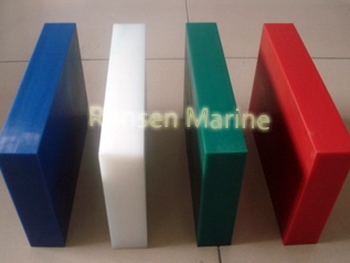
UHMW-PE facing fender pad
If you’ve ever inspected a large rubber fender up close — the kind mounted on a container terminal or LNG jetty — you may have noticed the smooth, usually white or black plastic panel bolted to the front of it. That panel is a UHMW-PE facing fender pad.
It’s a small component, but it plays a critical role: without it, the fender works less efficiently, the vessel’s hull paint gets scuffed, and the whole system wears out faster.
But what exactly is a UHMW-PE facing pad, how does it work, and why do port engineers insist on it for serious berthing installations?
This guide gives you everything buyers, marine engineers, and contractors need: the material science, the specifications that matter, how it compares to steel and other facing options, installation steps, costs, and a five-question checklist for choosing a manufacturer.
What Is a UHMW-PE Facing Fender Pad?
A UHMW-PE facing fender pad (also called a UHMW-PE fender facing, UHMWPE facing pad, or polyethylene fender pad) is a wear panel made from Ultra-High-Molecular-Weight Polyethylene — a dense, tough, self-lubricating engineering plastic.
It is bolted or bonded to the front face of a rubber fender (typically a cone, cell, or arch fender), forming the actual contact surface between the fender and the vessel’s hull.
Its job is twofold:
- Reduce friction — as a vessel slides along the berth during docking, the pad’s ultra-low friction surface lets the hull move smoothly instead of dragging and scraping
- Protect both surfaces — the pad absorbs abrasion that would otherwise tear into the rubber fender and scuff the vessel’s hull paint
Why “UHMW-PE”?
The acronym stands for Ultra-High-Molecular-Weight Polyethylene. The “ultra-high” part is the key: the polymer chains are enormously long — typically 3 to 6 million molecular weight, compared to around 100,000 for ordinary HDPE.
Those long chains are what give the material its unusual combination of properties:
- Extremely low coefficient of friction — among the lowest of any solid material, close to that of ice
- Exceptional wear and abrasion resistance — it outlasts steel in sliding-contact applications
- High impact strength — it absorbs blows without cracking, even at low temperatures
- Self-lubricating and non-stick — nothing sticks to it, and it needs no grease or maintenance
- Chemical and corrosion resistant — unaffected by seawater, most chemicals, and marine growth
In short: a UHMW-PE facing pad is the low-friction, high-durability shield that makes a rubber fender system perform the way it was designed to.
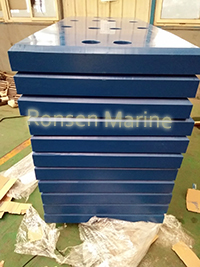
UHMW-PE facing fender pads
How Does a UHMW-PE Facing Pad Work?
The working principle has two parts:
1. Friction reduction
When a vessel docks, it rarely hits the berth perfectly square. As the ship settles against the fender line, its hull slides vertically and horizontally along the dock face.
- Without a facing pad: rubber-on-steel or rubber-on-paint contact creates high friction. The fender can’t compress properly, reaction forces spike, and the hull paint gets damaged.
- With a UHMW-PE pad: the hull slides across a surface with a friction coefficient as low as 0.1–0.2. The fender compresses evenly, reaction forces stay within design limits, and the hull glides cleanly.
2. Load distribution and protection
The pad spreads the contact load across a wider area of the fender face, preventing point loading that would otherwise deform or crack the rubber. It also protects the fender from abrasion and UV exposure.
Key takeaway: A rubber fender and a UHMW-PE facing pad are a system, not separate components. Specifying a high-performance fender without a proper facing pad is like fitting a luxury tire without tread — you’ve spent the money but aren’t getting the performance.
UHMW-PE Facing Pad Specifications (What Actually Matters When You Buy)
When specifying facing pads, these are the parameters that carry the most weight:
| Parameter | Typical Range / Notes |
| Material Grade | UHMW-PE 500 -1000 (molecular weight 3-6 million) |
| Thickness | 15-50 mm (30mm most common for marine use) |
| Friction Coefficient | 0.1-0.2 (dry, against steel) |
| Abrasion Resistance | 5-10x better than carbon steel |
| Temperature Range | -200 degree +80 dregree |
Common Facing Pad Variations
- Standard UHMW-PE pad — flat panel, bolted to the fender face
- Grooved or ribbed pad — surface grooves channel water and reduce suction effect
- Stainless steel backed pad — a steel plate laminated to the PE for extra rigidity
- Pre-drilled pad with countersunk holes — for flush, snag-free mounting
- Custom-shaped pad — curved or contoured to match cone or cell fender geometry
UHMW-PE vs Steel Facing vs No Facing: An Honest Comparison
This is the comparison every port buyer makes. Here’s the straight answer.
UHMW-PE vs steel facing:
- UHMW-PE offers far lower friction — the vessel slides instead of dragging
- Steel is stronger in pure compression but rusts, needs painting, and tears hull paint
- UHMW-PE is lighter, maintenance-free, and corrosion-proof — a clear long-term winner for most berths
UHMW-PE vs no facing at all:
- No facing means higher reaction forces, uneven compression, and accelerated rubber wear
- Many port authorities now mandate facing pads on all new fender installations
- The small extra cost is negligible compared to hull repair and fender replacement bills
UHMW-PE vs HDPE / LDPE pads:
- HDPE and LDPE are cheaper but far less durable — they wear quickly and deform under load
- UHMW-PE’s ultra-high molecular weight is what gives it the abrasion resistance and impact strength
- For a permanent berth, UHMW-PE is the only sensible choice
Rule of thumb: If your berth handles large vessels that slide during docking, a UHMW-PE facing pad isn’t optional — it’s essential. For tiny craft at near-zero berthing speed, you can sometimes skip it, but you’ll sacrifice protection.
UHMW-PE Facing Pad Installation: 6 Steps That Prevent Premature Failure
Most facing pad failures trace back to installation, not material. Follow this sequence:
- Clean and flatten the fender face — the mounting surface must be smooth and free of debris. Any gap causes the pad to crack under load.
- Use the correct fasteners — stainless steel bolts and washers are standard. Never use plain carbon steel, which rusts and stains the pad.
- Countersink bolt heads — protruding heads catch on hulls and tear paint. Heads must sit flush or below the surface.
- Torque to specification — under-tightening lets the pad vibrate loose; over-tightening cracks the PE. Follow the manufacturer’s chart.
- Allow for thermal expansion — UHMW-PE expands significantly with temperature. Leave appropriate gaps between adjacent pads.
- Inspect annually — look for cracks, wear-through to the fender, loose bolts, and uneven surfaces. Replace before the fender face is exposed.
Pro tip: Always install pads in a continuous, evenly spaced field across the fender face. Gaps create hard spots that concentrate load and damage both fender and hull.
How Much Does a UHMW-PE Facing Pad Cost?
Pricing varies with thickness, grade, size, and order volume. As a rough 2026 guide:
- Standard 20–30 mm pads: from around tens of dollars per square meter
- Thick / grooved / steel-backed pads: mid-to-high range
- Custom-shaped large panels: quoted per project
The biggest cost driver is material grade and machining. Buying direct from a manufacturer typically saves 20–40% versus going through a trading company — but always verify certifications (ISO 9001, material test reports, friction and abrasion test data) before committing.
How to Choose a UHMW-PE Facing Pad Manufacturer
Not all pads are built the same. Ask these five questions:
- Do they certify the actual molecular weight of the PE they use — and provide test reports?
- Can they supply friction coefficient and abrasion resistance data from a third-party lab?
- Do they offer custom sizes and shapes to match your fender geometry?
- Can they show reference projects at ports or terminals similar to yours?
- What’s the warranty — and do they have a track record of honoring it?
A reputable manufacturer will answer all five without hesitation. If they can’t prove the molecular weight of their material, walk away — you’re probably being sold ordinary HDPE at UHMW-PE prices.
Frequently Asked Questions
What is a UHMW-PE facing fender pad used for?
UHMW-PE facing pads are mounted on the front of rubber fenders at ports, terminals, and docks. They reduce friction during vessel sliding contact, protect the fender from abrasion, and prevent damage to the vessel’s hull paint.
How long do UHMW-PE facing pads last?
Typically 10–20 years in normal harbor conditions, often outlasting the rubber fender behind them. Service life drops with constant heavy abrasion or exposure to high-velocity sand and gravel.
Can UHMW-PE pads be repaired?
Cracked or worn-through pads cannot be repaired — replacement is the only safe option. Minor surface scratches are harmless and do not affect performance.
What’s the difference between UHMW-PE and HDPE fender pads?
UHMW-PE has a much higher molecular weight, giving it 5–10× better abrasion resistance and far superior impact strength. HDPE pads are cheaper but wear quickly and deform under load.
Are facing pads always necessary?
For large vessels and high-energy berths, yes — many port authorities now mandate them. For very small craft at near-zero berthing speeds, they may be optional, but omitting them reduces protection and accelerates fender wear.
Final Thoughts
A UHMW-PE facing pad is a small, unglamorous component that makes the entire fender system work as designed. Specify it correctly, install it properly, and it will protect your fender and your vessel’s hull for decades.
The classic buyer’s mistake isn’t choosing the wrong pad — it’s treating it as an afterthought, then paying for it in hull damage, torn rubber, and emergency replacements.
The fender and the facing pad are a system. Specify them together, and to the same standard.
