

What Is a Cone Rubber Fender? The Complete Guide for Port Engineers and Procurement Teams (2026 Edition)
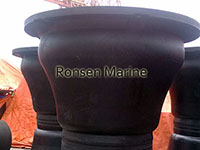
Cone Rubber Fenders
If you’ve ever stood beside a large container terminal, an LNG jetty, or a naval dock, you’ve seen them: those massive, black, cone-shaped rubber blocks mounted along the quay wall. Those are cone rubber fenders — the heavyweight champions of marine impact protection.
They’re the go-to choice for the world’s largest ports for a reason. But what exactly is a cone rubber fender, how does it work, and — just as importantly — when should you choose it over a cell or arch fender?
This guide gives you everything buyers, port engineers, and marine contractors need: the working principle, the specifications that actually matter, a head-to-head comparison with cell and arch fenders, installation steps, costs, and a five-question checklist for choosing a manufacturer.
What Is a Cone Rubber Fender?
A cone rubber fender is a marine fender made from molded rubber (typically natural rubber NR, SBR, or EPDM blends), shaped like a truncated cone or frustum, mounted with its wide base against the dock and its narrower top facing the vessel.
It is a fixed installation, bolted to the quay face, often behind a steel front panel. When a large vessel makes contact, the cone compresses under the load, absorbing the kinetic energy of the impact and releasing it slowly as the rubber rebounds.
The result: the vessel’s hull and the berth structure are both protected — even under the enormous, repeated impacts of large-ship operations.
Why “Cone”?
The name comes from the shape. Seen from the side, the fender tapers like a cone. That geometry is the source of its two standout advantages:
- Exceptional energy absorption per unit volume — the tapered design lets the rubber compress deeply and evenly, making cone fenders the highest-capacity fixed fender type
- Very low reaction force — the vessel experiences a gentler pushback than with most other fender types, which protects both hull and structure
- Stable under heavy, repeated loads — the wide base distributes reaction force into the dock structure efficiently
In short: a cone fender is the heavy-duty, high-performance choice for large-vessel, high-energy berths where failure is not an option.
How Does a Cone Rubber Fender Work?
The principle is straightforward but powerful:
- A large vessel approaches the berth and contacts the fender’s face (usually via a front panel).
- The rubber cone compresses axially, typically to 50–60% of its original height.
- The rubber’s molecular structure deforms, absorbing 70–80% of the impact energy as heat, which then dissipates.
- The fender slowly rebounds to its original shape, ready for the next impact.
A well-made cone fender will survive hundreds of thousands of compression cycles over a service life of 15–25 years in normal harbor conditions.
Key takeaway: A fender’s job is not to “stop” a ship — it’s to manage energy. Cone fenders are simply the best fixed-fender design at the high-energy end of the spectrum. Matching the fender to the energy demand is everything.
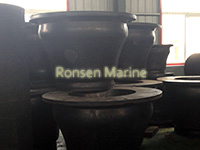
Cone Fenders
Cone Rubber Fender Specifications (What Actually Matters When You Buy)
When specifying cone fenders, five parameters carry the most weight:
| Parameter | Typical Range/Notes |
| Energy Absorption | 100-400 kJ(model-dependent) |
| Reaction Force | 50-800 kN |
| Compression Ratio | 50-60% of original height |
| Rubber Hardness | 60-70 Shore A |
| Temperature Range | -40 degree +70 degree (special grades available) |
Standard cone fender sizes range from units for medium vessels up to 1,500 mm diameter and beyond for ultra-large container terminals, LNG carriers, and naval docks.
Common Cone Fender Variations
- Standard cone fender — the classic truncated-cone design
- Super cone fender — reinforced construction with higher energy capacity and lower reaction force in the same footprint
- Cone fender with UHMW-PE face pad — reduces friction and protects hull paint during sliding contact
- Cone fender with steel front panel — distributes load across multiple fenders for very large contact areas
Cone Fender vs Cell Fender vs Arch Fender: An Honest Comparison
This is the comparison every port buyer makes. Here’s the straight answer.
Cone fender vs cell fender:
- Cone fenders offer the highest energy absorption per unit volume of any fixed fender type
- Cell fenders are a strong all-rounder with slightly higher reaction force at the same energy level
- For the largest vessels and highest-energy berths, cone fenders are generally the preferred choice
Cone fender vs arch fender:
- This isn’t really a contest. Arch fenders are light-duty and economical, suited to marinas and small craft
- Cone fenders are built for large vessels and heavy impacts — an entirely different league
- If you’re handling container ships, tankers, or bulk carriers, arch fenders are not an option
Cone fender vs pneumatic fender:
- Pneumatic (Yokohama-type) fenders float and are used for ship-to-ship (STS) and temporary operations
- Cone fenders are fixed installations for permanent berths and cannot be relocated
Rule of thumb: If your berth handles vessels above ~20,000 DWT or experiences high berthing velocities, cone (or super cone) fenders are usually the right call. For anything lighter, a cell fender may be the more cost-effective choice.
Cone Rubber Fender Installation: 6 Steps That Prevent Premature Failure
Most fender failures trace back to installation, not manufacturing. Follow this sequence:
- Calculate the energy demand first — never size a fender by eyeballing it. Use vessel displacement, berthing velocity, and eccentricity.
- Prepare a flat, reinforced concrete mounting surface — the dock must handle the substantial reaction load without cracking.
- Use the correct anchor bolts — chemical anchors or through-bolts into reinforced concrete. Never downgrade bolt grade to save money.
- Fit the front panel and UHMW-PE face pad — these distribute load evenly and protect hull paint.
- Torque to specification — under-tightening causes movement and abrasion; over-tightening cracks the rubber.
- Inspect annually — look for cracks, abrasion, bolt corrosion, and uneven compression marks. Replace at the first sign of structural cracking.
Pro tip: Install fenders in continuous, evenly spaced runs. Gaps between units create “hard spots” on the dock face that defeat the entire protection system.
How Much Does a Cone Rubber Fender Cost?
Pricing varies sharply with size, rubber grade, reinforcement, and order volume. As a rough 2026 guide:
- Small cone fenders: from around a thousand dollars per unit
- Medium cone fenders: mid-to-high range
- Large / super cone fenders: several thousand dollars per unit, typically quoted per project
The biggest cost driver is raw rubber price and MOQ. Buying direct from a manufacturer typically saves 20–40% versus going through a trading company — but always verify certifications (ISO 9001, PIANC compliance, third-party test reports) before committing.
How to Choose a Cone Rubber Fender Manufacturer
Not all fenders are built the same. Ask these five questions:
- Do they supply a performance curve (energy vs. reaction force) for every model?
- What rubber compound do they use — and can they prove its age and weather resistance?
- Do they reference PIANC / BS 6349 design standards?
- Can they show reference projects of similar scale to yours?
- What’s the warranty — and do they have a track record of honoring it?
A reputable manufacturer will answer all five without hesitation. If they dodge question 1 or 2, walk away.
Frequently Asked Questions
What is a cone rubber fender used for?
Cone rubber fenders protect quays, jetties, container terminals, LNG berths, naval docks, and large vessel hulls from impact damage during berthing. They are the standard choice for high-energy, large-vessel berths.
How long do cone rubber fenders last?
Typically 15–25 years under normal harbor conditions. Service life drops in areas with heavy oil exposure, intense UV, or constant abrasion from sand and gravel.
Can cone fenders be repaired?
Minor surface cuts can be patched with rubber repair compound. Once the main body is cracked or reinforcement is exposed, replacement is the only safe option.
What’s the difference between a cone fender and a super cone fender?
A super cone fender has a reinforced structure that delivers higher energy absorption and lower reaction force in a similar footprint — ideal for the largest vessels and highest-energy berths.
Are cone fenders suitable for all vessels?
No. For marinas, small craft, and light-duty jetties, cone fenders are over-specified and over-priced. Arch or cell fenders are the more economical choice at the low-to-medium end.
Final Thoughts
A cone rubber fender is the unglamorous piece of infrastructure that makes modern mega-ports possible. Specify it correctly, install it properly, and it will protect your asset quietly for decades.
The classic buyer’s mistake isn’t choosing the wrong fender — it’s under-specifying to save a few percent upfront, then paying for it in hull damage, cracked concrete, and emergency replacements.
Match the fender to the energy demand, not to the price tag.
