

What Is a Marine Rubber Airbag? (Definition, How It Works & Complete Buying Guide)
What Is a Marine Rubber Airbag?
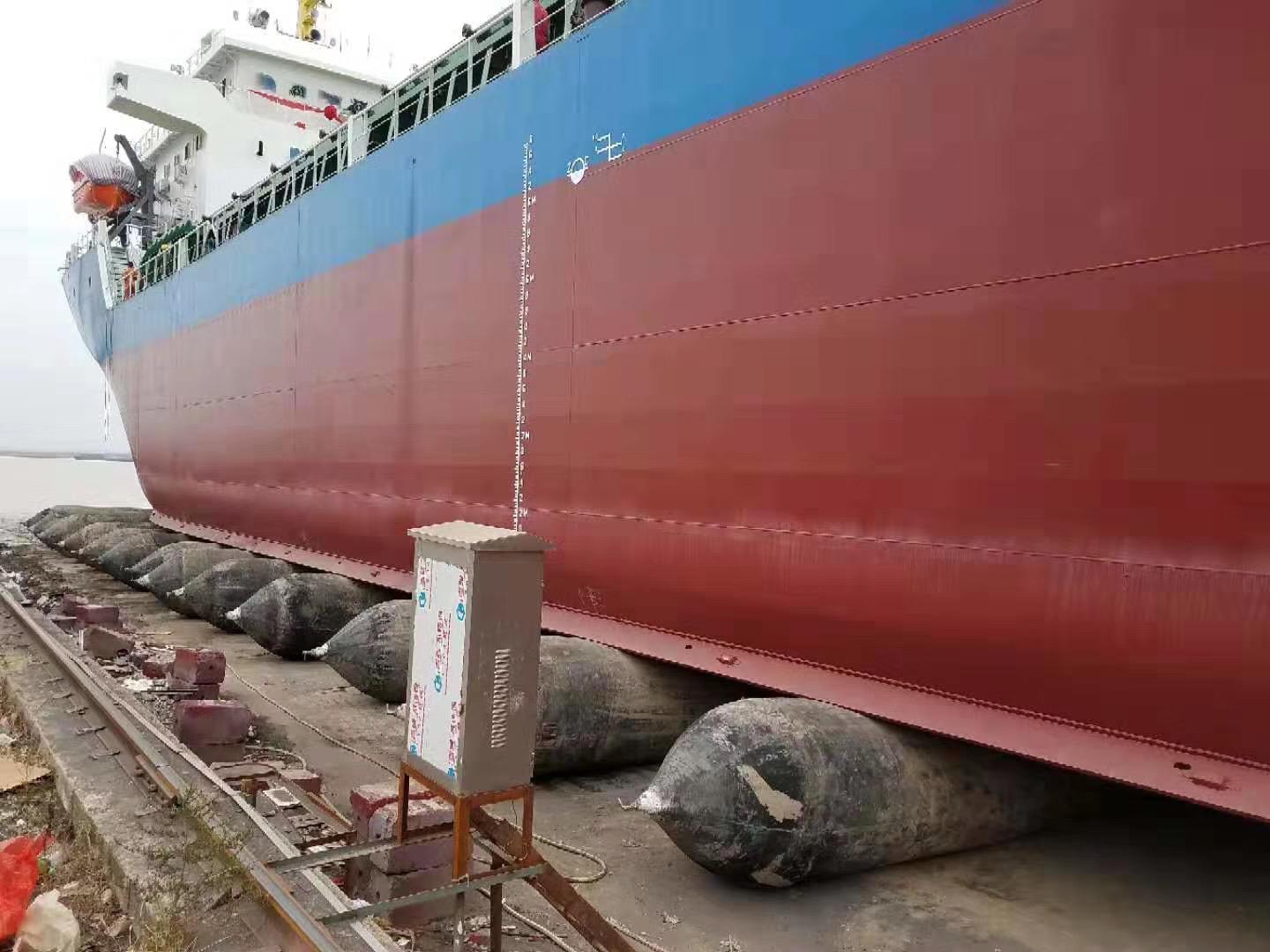
Rubber Marine Airbag
A marine rubber airbag — also called a ship launching airbag, marine airbag, pneumatic roller bag, or inflatable marine roller — is a heavy-duty, cylindrical, cord-reinforced rubber tube inflated with compressed air. Shipyards place deflated airbags under a vessel’s hull, inflate them to working pressure, and use them as flexible rollers to launch, land, lift, or move ships and heavy marine structures without permanent slipways or dry docks.
In simple terms: it is an industrial-strength inflatable roller that lifts a vessel off its keel blocks and rolls it safely into the water.
Important distinction: a marine rubber airbag is not a pneumatic fender. Both are air-filled rubber, but an airbag is built for rolling contact and static load-bearing under the keel; a fender is built to absorb berthing impact energy.
How Does a Marine Rubber Airbag Work?
The working principle is a quasi-static balance between hull weight and internal air pressure. The cord plies carry the hoop stress and set the pressure ceiling — not the thickness of the outer rubber.
Step-by-Step Launching Process
- Position deflated airbags under the hull, transverse (end-launch) or longitudinal (side-launch), spaced so unsupported hull span stays within plate and keel stress limits.
- Inflate to working pressure (typically 0.08–0.12 MPa for mid-size bags). As pressure rises, the hull lifts evenly off the keel blocks.
- Remove keel blocks. The hull now rests entirely on the airbags’ top arc — load is distributed continuously, with no hard chocks.
- Release the holding winch. Gravity (on a 1:70 to 1:20 slope) or tug/winch pulls the ship forward; the bags rotate under the keel like conveyor rollers.
- Water entry and buoyancy transfer. As the stern enters water, hydrostatic lift progressively sheds load from the rear bags.
- Recover, deflate, rinse, and store. With proper care, quality airbags last 8–15 years and hundreds of cycles.
Because the load rests on compressed air, impact and point-load damage are reduced, making airbags safer for FRP, aluminum, and wooden hulls than hard cradles or steel ways.
Marine Rubber Airbag Structure
A standard marine airbag has a three-layer composite structure, with tapered/conical ends and metal end fittings.
| Layer | Material |
| Inner rubber | NR/SBR/IIR airtight blend |
| Cord reinforcement | Nylon/polyester tire cord, RFL-bonded |
| Outer rubber | Abrasion-/UV-/salt-resistant NR |
End fittings: steel flange + ball valve + pressure gauge + safety relief valve. The cord angle and ply count decide the maximum working pressure — not the outer rubber thickness.
Key Specifications Buyers Should Verify
Diameter alone is never enough. Always confirm the full specification set before purchase.
| Parameter | Common Range |
| Diameter | 0.8-3.0 m (most common 1.0-2.5m) |
| Effective length | 6-25 m |
| Cord plies | 4-12 layers |
| Working pressure | 0.05-0.20 MPa |
| Burst safety factor | >4:1 vs working pressure |
| Standards | ISO 14409:2011, ISO 17682:2013 |
Cord ply count matters more than diameter. A 2.0 m Ø bag at 4 plies may cap at 0.07 MPa, while higher ply counts unlock heavier load ratings. As a reference, a 1.5 m × 12 m, 6-ply airbag at rated pressure carries roughly 100–150 tonnes along its contact length.
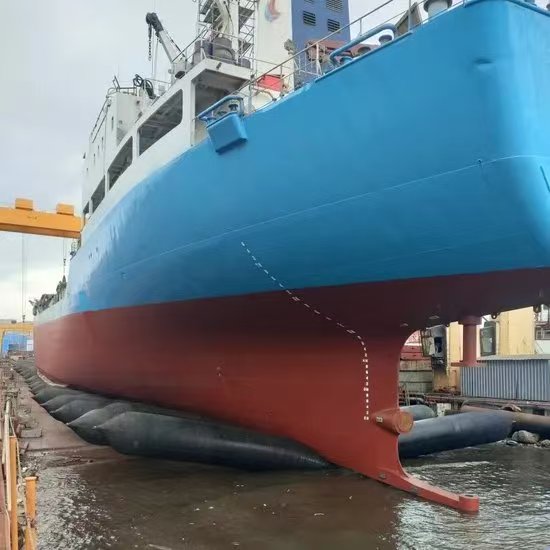
Marine Rubber Airbags
Standards and Certifications
The two international standards every buyer should know:
- ISO 14409:2011 — defines the product: materials, dimensions, classification, and testing (airtightness, compression, bearing capacity, burst, compression-recovery).
- ISO 17682:2013 — defines the methodology: airbag selection and arrangement, launching procedures, safety safeguards, and contingency planning. China’s GB/T 41888-2022 is the identical adoption (IDT) of this standard.
ISO 14409 classifies marine airbags into Ordinary (QP) and High-capacity (QG) categories. When importing, request:
- Mill test certificate for rubber compound
- Hydrostatic burst test report (video evidence preferred)
- Third-party inspection by CCS, BV, ABS, DNV, LR, or equivalent
- Traceability code on each airbag body
How to Calculate the Required Number of Airbags
The ISO-based engineering formula is:
N = K₁ × (Q × g) / (C_b × R × L_d)
Where:
- N = number of airbags required
- K₁ = safety coefficient (generally ≥1.2)
- Q = vessel weight (tonnes)
- g = gravitational acceleration (9.8 m/s²)
- C_b, R, L_d = capacity, bearing, and effective-length factors per ISO method
Simplified Practical Method
- Determine total hull weight (lightship + outfitting margin + any water trapped in hull).
- Estimate contact width ≈ diameter × 0.6 (empirical deformation factor).
- Single airbag capacity ≈ working pressure × contact width × effective length × safety derating (0.7–0.8).
- Required count = total vessel weight ÷ single airbag capacity.
Example: 500-ton barge, 1.5 m diameter, 12 m effective length, 0.10 MPa working pressure → approx. 60 airbags distributed along keel and bilge.
Pro tips:
- Always add 15–20% buffer above the calculated count for slope irregularities, uneven inflation, and tidal timing.
- Keep 2–4 spare bags on site and total capacity at least 20–30% above hull weight.
- Have a marine engineer sign off on the final layout; unsupported spans between bags must not overstress the hull.
How to Choose the Right Marine Rubber Airbag
Match the specification to the actual load — not the catalogue photo. Check:
- Vessel displacement and weight per unit length
- Diameter and effective length (diameter must exceed keel-block height; add ~0.5 m minimum)
- Cord ply rating — 4–5 layers for light duty/small craft; 6–8 for standard commercial launching; 10–12 for heavy vessels and high safety margins
- Rated working pressure and safety factor
- Rubber quality — new natural rubber, not recycled/reclaimed (reclaimed rubber ages fast and loses elasticity)
- ISO 14409 compliance plus classification-society approvals
- Burst-test report and pressure-hold record
- Supplier engineering support — load calculation, spacing plan, and on-site launch procedure
Applications of Marine Rubber Airbags
Beyond ship launching, the same equipment covers a wide range of marine and heavy-lift work:
- New vessel launching (cargo ships, tugs, barges, tankers, workboats)
- Vessel haul-out, landing, and dry-ground maintenance
- Hull inspection and painting
- Marine salvage and refloating of stranded or sunken vessels
- Heavy cargo transportation — caissons, box culverts, bridge girders, oil-rig modules, prefabricated concrete
- Industrial equipment moving — transformers, generators, tanks where cranes are impractical
- Buoyancy and floating support for pontoons, pipelines, and subsea structures
Ship launching remains the largest use segment, while marine salvage and heavy lifting airbags are the other primary market segments.
Marine Airbag vs Traditional Slipway / Dry Dock
| Factor | Marine Airbag | Concrete Slipway / Dry Dock |
| Upfront cost | Low-medium | High/very high |
| Setup time | Hours to days | Weeks to months |
| Reusable | yes, 8-15 years | Built-in structure |
| Site flexibility | High | Low |
| Hull stress | Lower, distributed | Medium-high at contact points |
| Best for | Most vessels sizes and remote yards | High-volume fixed yards, major repairs |
For shipyards launching under 5,000 tonnes, airbags typically deliver 60–80% cost savings over building a slipway. Independent technical studies put the figure around 40% for dry-docking applications.
Honest limitation: airbags are not always optimal. Very large vessels, ultra-high launch frequency, or unsafe/exceptionally steep slopes may still favor floating docks or engineered slipways. The correct choice depends on vessel size, site conditions, and operational frequency.
Pre-Launch Inspection Checklist
A safe launch is roughly 80% calculation and 20% inflation. Before moving anything, confirm:
- [ ] Vessel lightship weight, DWT, LOA, beam, and center of gravity
- [ ] Hull structural strength at keel and frame lines
- [ ] Slipway gradient (common 1:10 to 1:20)
- [ ] Ground/surface condition — clean, level, no sharp debris
- [ ] Required water depth at entry (usually ≥1.5× stern draft)
- [ ] Tide table and current/wind limits (avoid Beaufort 4–5 if possible)
- [ ] Winch capacity, ground anchors, wire ropes, emergency brake
- [ ] Airbag diameter, effective length, ply count, rated line load, certified pressure
- [ ] Visual inspection — no cuts >50 mm, no cord exposure
- [ ] Pressure hold test — inflate to 1.1× WP, hold 30 min, pressure drop <5%
- [ ] Relief valve calibrated; gauges certified within 12 months
- [ ] Recovery boat and crew on standby; emergency stop briefed to all personnel
Key Safety Rules
- Never exceed the manufacturer’s rated working pressure.
- Clear all sharp objects, weld beads, rocks, and nails from the track.
- Keep winches, anchors, wires, and emergency brakes ready at all times.
- Keep launch speed at approx. 0.5–1 m/s (6–13 m/min); use winch brakes to control descent.
- Do not forcibly remove jammed blocks — this can cause sudden weight shifts and pressure spikes.
- Maintain minimum clearance: ≥1.5 m initial placement under vessel, ≥0.8 m post-compression height.
Maintenance and Storage
Extend service life with a disciplined routine:
- Inspect for cracks, cuts, cord exposure, and valve function before every use.
- Rinse with fresh water after seawater exposure; dry thoroughly before folding.
- Apply talc/protective powder to prevent the rubber from sticking and aging.
- Store in a cool, dry place away from direct sunlight, chemicals, and sharp objects.
- Repair minor damage promptly with a proper repair kit; replace airbags with significant wear or holes.
- Annual pressure test: inflate to maximum pressure, hold 24 hours; if pressure drops more than 5%, locate and repair the leak.
With correct pressure management, cleaning, talc treatment, and dry storage, quality airbags deliver 8–15 years of service. The rubber ages out before the cord fails if stored out of direct sun.
Conclusion
A marine rubber airbag is a proven, ISO-standardized, reusable pneumatic rolling cylinder that turns a capital-heavy, fixed-infrastructure launching operation into a portable, repeatable, lower-cost marine engineering process. The keys to success are simple: buy to the full specification, engineer the layout, respect the working pressure, and inspect before every use.
Frequently Asked Questions
What is a marine rubber airbag used for?
Launching and landing vessels, lifting and moving heavy marine structures, refloating stranded ships, and providing temporary buoyancy for pipelines, caissons, and subsea structures.
How much weight can a marine rubber airbag support?
A single 1.5 m × 12 m, 6-ply bag at rated pressure carries roughly 100–150 tonnes along its contact length. A standard 1.5 m × 18 m bag carries about 160 tonnes, while a 2.0 m × 24 m, 10-ply configuration can exceed 330 tonnes. Total capacity comes from multiplying single-bag capacity by the number of airbags in the arrangement.
How is a marine rubber airbag different from a marine fender?
A marine airbag supports rolling or static load under the keel; a pneumatic fender absorbs lateral berthing impact. They look similar, but the cord angle, pressure rating, and end fittings are engineered for entirely different load cases — never substitute one for the other.
What size marine rubber airbag do I need?
Match diameter to keel-block height (add at least 0.5 m clearance), effective length to vessel beam, and ply count to hull weight per unit length. Provide your supplier with displacement, LOA, beam, draft, and slipway gradient; the layout must be calculated, not guessed.
What pressure should a marine rubber airbag be inflated to?
Working pressure typically ranges from 0.05 to 0.20 MPa depending on diameter and cord plies. Never exceed the pressure stamped on the airbag body, and always fit a calibrated relief valve.
How long does a marine rubber airbag last?
8–15 years with proper care, and 80–200 inflation cycles per bag. Inspect after every 10 launches.
Can marine rubber airbags be used in saltwater?
Yes. The outer rubber compound is formulated for salt, UV, and abrasion resistance. Rinse with fresh water after each use and dry before storage.
Are marine rubber airbags certified?
Reputable manufacturers build to ISO 14409 (product) and ISO 17682 (methodology), with burst-test reports and classification-society approvals from CCS, BV, ABS, DNV, or LR.
Can airbags be repaired?
Minor cuts and punctures can be repaired in the field with a proper cold-vulcanizing kit. Any damage that exposes cord reinforcement requires workshop repair or replacement.
What is the largest ship launched on airbags?
Record cases have exceeded 100,000 DWT, though most commercial operations handle vessels under 5,000 tonnes. The limiting constraint is usually water depth and slipway geometry, not airbag capacity.
