

What Is a Steel Buoy?
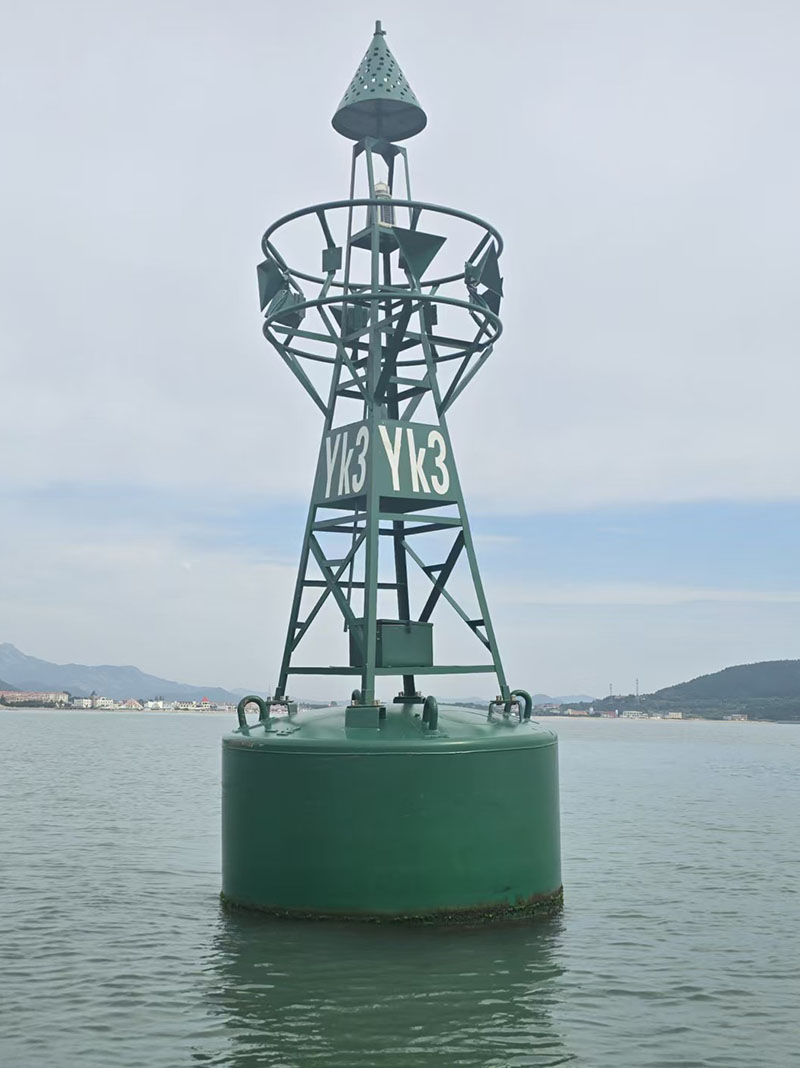
Steel buoys
A steel buoy is a floating marine structure whose hull is fabricated primarily from welded steel plate. It is moored to the seabed by chain or cable and rides with the water surface, marking a channel, hazard, boundary, or mooring location for vessels. The shape can be spherical, cylindrical, conical, can, or spar, and the visible color and topmark follow the IALA buoyage system so that a mariner can read its meaning at a glance.
Unlike a lightweight polyethylene float, a steel buoy gets its reliability from mass and weldable structure. It can carry a heavy central pipe, a mooring bollard or pad eye rated to the full design load, and a lantern, radar reflector, solar panel, or sensor package. That is why steel is the default choice for exposed coastal waters, commercial harbors, offshore terminals, and any site where a buoy must survive impact and stay upright.
Key Takeaways
- A steel buoy is a welded-steel floating marker anchored to the seabed, used for navigation, marking, mooring, and monitoring.
- Its hull is typically 4 to 10 mm marine-grade steel plate, sealed and protected by epoxy anticorrosion coating plus a high-visibility topcoat.
- Steel wins on structural strength, stability in currents, radar reflectivity, and repairability; it loses on weight, handling cost, and coating maintenance.
- Steel buoys commonly serve as channel markers, isolated-danger marks, special marks, mooring buoys, and instrument platforms.
- Service life with proper maintenance is typically 15 to 25 years, against 7 to 12 years for a standard polyethylene buoy.
How a Steel Buoy Works
A buoy is not an anchored boat. It is a deliberately lightweight float whose job is to hold position on the surface while a submerged sinker holds it down. The balance between buoyancy, reserve buoyancy, draft, and mooring load is the whole engineering problem.
- The main parts are:
- Float, or hull: the sealed welded steel body that provides buoyancy.
- Tail pipe or central axle: a through-bolted steel pipe or rod that carries the vertical mooring load.
- Top fitting: a ring, bollard, or pad eye for the pennant or vessel mooring line.
- Bottom connection: a swivel shackle or chain connector that stops the riser chain from twisting.
- Superstructure: lantern stand, radar reflector bracket, topmark, daymark, and identification numbers.
- Sinker: a concrete block, mushroom anchor, screw anchor, or drilled rock anchor on the seabed.
Reserve buoyancy is the amount of buoyancy left after the buoy is fully equipped and loaded. It is the margin that keeps the buoy afloat if spray ice forms, marine growth adds weight, or a compartment is breached. A well-designed steel buoy carries substantial reserve buoyancy and, on larger navigation buoys, is divided into sealed chambers so that one flooded compartment does not sink the unit.
Common Types of Steel Buoy
| Type | What it marks | Typical form |
| Lateral buoy | The edge of a safe navigable channel | Can (green) or nun (red), with a matching topmark |
| Cardinal buoy | Safe water in a compass direction around a hazard | Yellow and black, with a distinctive cone topmark |
| Isolated danger buoy | A danger with safe water all around it | Black with one or more red horizontal bands |
| Safe water buoy | Mid-channel or landfall, safe water all around | Red and white vertical stripes, single sphere topmark |
| Special mark | An area or feature not related to navigation safety | Yellow, often marking cables, aquaculture, or worksites |
| Mooring buoy | A fixed pickup point for a vessel | Large spherical, cylindrical, or disc hull with a heavy top ring |
| Monitoring buoy | An instrument platform for data collection | Steel hull with sensor mast, solar panels, and telemetry |
What Steel Buoys Are Made Of
Marine steel buoys are usually fabricated from 4 to 8 mm thick marine-grade steel plate, welded into shape and coated inside and out. For demanding offshore projects the plate can run to 10 mm or more. Internal compartments are sealed, and many units are filled with closed-cell polyurethane foam so that the buoy retains buoyancy even if the shell is punctured.
- The coating system matters as much as the steel:
- Surface preparation, normally abrasive blasting to a clean, sharp profile.
- Zinc-rich primer applied directly to the prepared steel.
- One or more epoxy intermediate coats for film thickness and barrier protection.
- A marine-grade topcoat in the required IALA color, typically international orange, yellow, red, green, black, or white.
Fittings above the waterline are commonly hot-dip galvanized steel or stainless steel, because that is where corrosion and mechanical wear concentrate. An inspection port on the upper hemisphere lets a maintenance crew check for water ingress and touch up coating without lifting the buoy.
Steel Buoy Sizes and Working Loads
Steel buoys are project-built rather than bought from a fixed catalog. The figures below are representative ranges from commercial suppliers, not a substitute for a certified specification.
| Hull diameter | Approximate weight | Reserve buoyancy | Typical sinker |
| 1.0 m | 410 kg | 270 kg | 0.5 tonne |
| 1.5 m | 1,430 kg | 900 kg | 1.0 tonne |
| 2.0 m | 2,600 kg | 1,700 kg | 2.0 tonnes |
| 2.4 m | 4,600 kg | 4,200 kg | 3.0 tonnes |
| 3.0 m | 7,000 kg | 7,500 kg | 8.0 tonnes |
A steel mooring buoy rated for a 5-tonne working load can serve vessels up to about 30 m in length, while a comparably priced polyethylene buoy is generally limited to a much lower working load. The difference is the reason steel stays in the specification for commercial moorings.
Where Steel Buoys Are Used
- Navigation and safe-water marking
- Channel edges, port approaches, harbor entrances, and isolated shoals are marked with steel buoys where impact resistance and long service life matter more than low weight.
- Commercial mooring
- Steel mooring buoys provide a permanent pickup point for ships, workboats, and offshore tenders. The hull carries the load hardware while the sinker and chain keep it on station.
- Offshore and industrial sites
- Pipe crossings, cable routes, dredging works, offshore terminals, and construction exclusion zones use special-mark steel buoys because the fittings and signage can be welded or bolted to suit the project.
- Aquaculture and fisheries
- Steel buoys support net pens, feeding systems, and boundary lines. Their mass helps keep the system stable under wind and current.
- Environmental monitoring
- A steel hull makes a steady platform for sensors that record water temperature, salinity, current, tide, and weather. Solar power and telemetry are straightforward to mount on a welded mast.
Steel Buoy vs Plastic Buoy
There is no universal winner. The choice is a trade-off between structural duty and whole-life cost.
| Factor | Steel buoy | Plastic buoy |
| Impact resistance | High, can be repaired by welding | Good in the hull, but damage can puncture flotation |
| Weight | Heavy, needs a larger service vessel | Light, easy to deploy and relocate |
| Coating | Requires blasting and repainting on a schedule | Color is in the material, no painting required |
| Radar return | Strong radar reflector, roughly 8 dB above plastic | Low inherent return, needs a fitted reflector |
| Service life | 15 to 25 years with maintenance | 7 to 12 years for standard units |
| Best use | Exposed sea, heavy mooring, long-term marking | Calm water, short-term works, budget-sensitive jobs |
Plastic wins when handling and first cost dominate, and when the buoy can be serviced from a small workboat. Steel wins when the buoy must take a hit, stay put in a strong current, or support a heavy mooring load. A practical compromise is the hybrid buoy: a steel central structure with a polyethylene float, which reduces weight while keeping the strength where the loads are applied.
Steel Buoy Maintenance
- A steel buoy is inspected on a cycle, not when it looks wrong:
- Waterline and boot-top inspection for early corrosion and coating breakdown.
- Hull inspection for dents, abrasion, weld cracking, and signs of water ingress.
- Fitting inspection of shackles, swivels, bollards, pad eyes, and lifting lugs for wear and free movement.
- Chain inspection for stretch, wear, and adequate scope through the full tidal range.
- Topside inspection of lantern, solar panel, radar reflector, topmark, and identification markings.
- Marine-growth removal, because fouling adds drag and weight and can hide corrosion.
Maintenance is normally done ashore after lifting the buoy. Abrasive blasting, priming, and topcoating restore the protection system. The heavier weight of steel means more lifting capacity and more service-vessel time, which is the main reason its lifecycle cost needs to be calculated honestly against the alternatives.
How to Choose the Right Steel Buoy
- Get these items into the specification before asking for a quote:
- Buoy type, color, topmark, and any local authority or IALA requirement.
- Required buoyancy, displacement, reserve buoyancy, and freeboard.
- Hull diameter, height, draft, plate thickness, and structural scheme.
- Working mooring load and the size, grade, and surface treatment of chain and shackles.
- Fittings: lantern, solar panel, radar reflector, daymark, and access ladder or platform.
- Coating specification and the design service life in the actual operating environment.
- Drawings, inspection documents, certificates, and any required load tests.
A steel buoy is only one part of the system. The hull, riser chain, sinker, shackles, and swivels must be sized together against water depth, tidal range, seabed type, wind, current, and the largest vessel expected. A buoy that is correctly built but under-anchored will still drag or submerge.
Steel Buoy FAQs
Is a steel buoy the same as a mooring buoy?
No. A mooring buoy is one job a steel buoy can do. A steel buoy may instead be a navigation aid, a special mark, or a monitoring platform. The hull material does not define the function.
How long does a steel buoy last?
With a sound coating system and a regular inspection and repainting program, 15 to 25 years is a reasonable expectation in normal coastal service. The limiting factor is usually coating breakdown at the waterline, not loss of plate strength.
Can a steel buoy sink if it is holed?
It can, unless the hull is foam-filled or divided into sealed, redundant compartments. For navigation duty, compartmentation is the important safety feature: a breach in one chamber should not remove all buoyancy.
Why choose steel instead of plastic?
Choose steel when the job involves exposed sea, heavy mooring loads, impact risk, or a need for radar visibility and welded fittings. Choose plastic when low weight, easy handling, and minimal maintenance are more valuable than brute structural strength.
Are steel buoys bad for the environment?
Steel itself is straightforward to recycle, and a steel buoy can be repaired and kept in service for decades. The maintenance burden comes from coating work and the service-vessel trips needed to lift and repaint it. The fair comparison is whole-life environmental cost, not the material alone.
Final Word
So, what is a steel buoy? It is a welded, coated, anchored steel float that turns a point on the seabed into a visible, reliable reference on the water surface. Its strength is not that it is maintenance-free, steel never is, but that it can take the load, take the hit, and be repaired in the field. For exposed waters, heavy moorings, and long-term marking, that combination is hard to beat.

