

What Is a Solid Foam Fender? The Complete Guide to Foam-Filled Marine Fenders
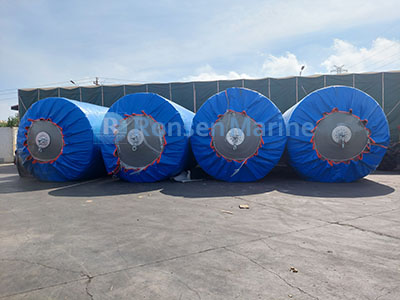
Solid foam fenders
What is a solid foam fender?
A solid foam fender—also called a foam-filled fender or solid foam-filled marine fender—is a floating marine protection device that uses a closed-cell EVA or polyethylene foam core to absorb berthing impact energy. Unlike pneumatic fenders, it contains no compressed air, so it cannot deflate, burst, or sink if the outer skin is damaged.
Solid foam fenders are widely used for ship-to-ship transfer, ship-to-dock berthing, cruise terminals, offshore platforms, yachts, ferries, and high-tidal-range ports where reliability and low maintenance matter more than inflatable convenience.
What Is a Solid Foam Fender Used For?
A solid foam fender protects:
- Ship hulls
- Quay walls and wharves
- Dolphins and piles
- Offshore platforms and FPSO boat landings
- Cruise ships and yachts
- Ro-Ro ferries and barges
- Floating bridges, locks, and salvage operations
When a vessel approaches a berth, the fender compresses and converts kinetic energy into controlled deformation. After the vessel moves away, the closed-cell foam rebounds and is ready for the next impact.
How Is a Solid Foam Fender Built?
Most foam-filled fenders have a three-layer structure:
1. Closed-Cell Foam Core
Made from EVA (ethylene-vinyl acetate) or cross-linked polyethylene foam.
Each cell is sealed independently, so water cannot migrate into the core. Even if the skin is cut, the fender stays buoyant and keeps working.
2. Reinforcement Layer
A nylon cord, filament, or tire-cord layer sits between the foam and the skin.
It prevents the outer coating from peeling under repeated shear and impact.
3. Polyurethane / Polyurea Elastomer Skin
A sprayed, seamless outer shell protects the fender from:
- Saltwater
- UV radiation
- Oil and fuel
- Abrasion
- Chemicals
- Impact and scraping
High-quality skins are often non-marking, which is important for white hulls, cruise ships, and naval vessels.
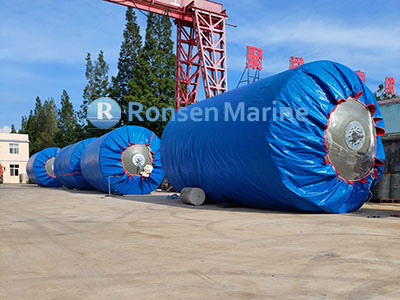
Solid Foam Fender
How Does a Solid Foam Fender Work?
A berthing ship has kinetic energy:
E = ½mv²
The solid foam fender absorbs this energy through foam compression, not air compression.
When compressed to about 60% deflection, the fender:
- Absorbs high impact energy
- Produces a progressive reaction force
- Reduces peak load on the hull and berth structure
- Rebounds elastically after impact
Because there is no gas law involved, performance does not change much with temperature, altitude, or small leaks. The fender simply compresses and recovers.
Solid Foam Fender vs Pneumatic Fender
| Feature | Solid Foam Fender | Pneumatic Fender |
| Energy medium | Closed-cell foam | Compressed air |
| Deflation risk | None | Yes if punctured |
| Sinking risk | Very low/unsinkable | Possible if ruptured |
| Maintenance | Minimal | Pressure checks required |
| Reaction force | Moderate to high | Low |
| Best use | Fixed berths, offshore, unattended sites | STS transfer, temporary berths |
| Upfront cost | Higher | Lower |
| Lifecycle cost | Often lower over 10 years | Higher if punctures are frequent |
Foam fenders are not “better” in every case. Pneumatic fenders are excellent for portable STS operations and low reaction force. Foam fenders win where puncture resistance, buoyancy, and zero-inflation maintenance are critical.
Key Advantages of Solid Foam Fenders
1. Unsinkable by Design
The buoyant medium is the foam itself. Cut the skin, and the closed cells stay dry.
2. No Inflation, No Valves
No air pressure checks, no relief valves, no sudden deflation.
3. High Energy Absorption
Foam-filled fenders can deliver high energy absorption with manageable reaction force, depending on foam density and diameter.
4. Tide-Independent Floating
Because they float, they work well in ports with large tidal ranges.
5. Low Maintenance
Ideal for remote jetties, offshore platforms, and military bases.
6. Long Service Life
Quality foam fenders commonly last 10–15 years with proper use.
7. Customizable
Diameters from 500 mm to 4500 mm and lengths up to 9000 mm are common. Colors, slings, chains, tire nets, and donut shapes can all be customized.
Common Types of Solid Foam Fenders
- Netless foam fender – smooth polyurea skin, used for yachts, cruise ships, STS
- Netted foam fender – chain/tire-net protection for heavy berths
- Donut foam fender – used on piles, dolphins, and turning structures
- Portable shipboard foam fender – small units hung by rope for quick response
- Rubber-coated foam fender – extra-tough version for construction and rock-dumping work
Typical Size and Performance Range
Example reference values at 60% compression:
| Size D x L | Approx. Reaction Force | Appro. Energy Absorption |
| 1000 x 1500 mm | ~205 kN | ~49 kJ |
| 1500 x 3000 mm | ~624 kN | ~216 kJ |
| 2000 x 3500 mm | ~990 kN | ~456 kJ |
| 2500 x 5000 mm | ~1750 kN | ~985 kJ |
| 3000 x 6000 mm | ~2460 kN | ~1695 kJ |
Exact numbers depend on foam density, skin system, reinforcement, and manufacturer test method.
How to Choose the Right Solid Foam Fender
Do not size by boat length alone. Use:
- Vessel displacement
- Approach velocity
- Allowable hull pressure
- Design berthing energy
- Reaction force limit of wharf/dolphin
- Tidal range and current
- Frequency of impacts
- Debris, ice, or abrasive conditions
For professional projects, follow PIANC guidelines and request the manufacturer’s energy–reaction curve at 60% deflection.
FAQ: People Also Ask
Is a solid foam fender the same as a foam-filled fender?
Yes. “Solid foam fender,” “foam-filled fender,” and “EVA foam fender” describe the same family of air-free floating fenders.
Can a solid foam fender sink?
No. The closed-cell foam core remains buoyant even if the skin is damaged.
Do foam fenders need air?
No. They absorb energy by compressing solid foam, not compressed gas.
Are foam fenders better than pneumatic fenders?
They are better for low-maintenance, puncture-prone, offshore, and tidal environments. Pneumatic fenders are better when very low reaction force and easy transport/storage are priorities.
How long does a solid foam fender last?
Typically 10–15 years, depending on skin quality, impact frequency, and UV/oil exposure.
Final Takeaway
A solid foam fender is a closed-cell foam-filled marine fender designed for maximum reliability, buoyancy, and low maintenance. It will not deflate, it keeps working after skin damage, and it performs consistently in tidal, offshore, and high-traffic berthing conditions.
If your priority is “install it and trust it,” a solid foam-filled fender is often the smartest long-term choice.
Need a quoted specification?
Send us vessel tonnage, berth type, tidal range, and target energy absorption—we’ll recommend D × L, foam density, skin type, and sling/chain configuration.
