

How Do Floating Pneumatic Rubber Fenders Work? A Complete Working Principle Guide

Floating Pneumatic Rubber Fenders
Floating pneumatic rubber fenders work by using compressed air inside a reinforced rubber body to absorb berthing energy. When a ship presses against the fender, the air column compresses, the synthetic-cord/rubber shell deforms, and the vessel’s kinetic energy is converted into air pressure and elastic strain. The fender then pushes back with a relatively low reaction force, protecting both the hull and the berth.
In one sentence: they are air-spring shock absorbers that float on the water.
What Is a Floating Pneumatic Rubber Fender?
A floating pneumatic rubber fender is a cylindrical, air-filled marine fender with hemispherical ends. It is made from:
- outer rubber layer
- synthetic tyre-cord reinforcement layer
- inner airtight rubber liner
- steel end flanges / valves
Because it is filled with compressed air, it is naturally buoyant and floats at the waterline. That is why it is called a floating pneumatic fender.
It is also commonly called a Yokohama fender or pneumatic fender, and most commercial units are built to ISO 17357-1:2014.
How Do Floating Pneumatic Rubber Fenders Work? Step by Step
1. Vessel approaches with kinetic energy
A ship may move slowly, but its mass is enormous.
Berthing energy is roughly:
E = ½ × effective mass × velocity²
Even at 0.1–0.2 m/s, a large tanker carries huge energy.
2. Fender floats at the contact point
Because the fender is buoyant, it sits at the hull/quay interface. It rises and falls with tide, swell, and vessel draft—no fixed brackets needed.
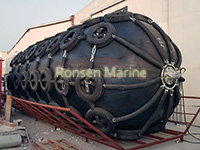
Floating Pneumatic Fenders
3. Hull compresses the fender
When the ship touches the fender:
- the rubber body deforms
- the internal air column shortens
- internal pressure rises
- the cord-reinforced rubber distributes stress
4. Energy is absorbed, not transferred
The fender absorbs energy through:
- air compression — the main mechanism
- rubber/cord elastic deformation — secondary mechanism
Under ISO 17357 testing, performance is measured up to 60% deflection of the fender diameter.
5. Reaction force stays low
A solid fender resists with material stiffness. A pneumatic fender resists with compressible air.
That gives the key advantage:
High energy absorption + low reaction force
Low reaction force means less damage to:
- ship hulls
- thin-shell LNG tanks
- quay walls
- dolphins
- fender supports
6. Fender rebounds
When the vessel moves away:
- compressed air re-expands
- rubber returns toward original shape
- fender is ready for the next contact
Good pneumatic fenders recover repeatedly without large permanent deformation.
Why “Floating” Matters
Fixed fenders are bolted to a quay. Floating pneumatic fenders are not.
They are used because they:
✅ float at the waterline
✅ follow tide and swell
✅ work for ship-to-ship transfers
✅ protect both vessels, not just the dock
✅ deploy quickly for temporary or emergency berthing
✅ need no complex adjustable brackets
That makes them ideal for:
- STS oil/LNG/product tanker transfers
- FPSO and offshore platform boat landings
- deepwater terminals
- tidal jetties
- naval alongside replenishment
- emergency berthing
Floating Pneumatic Fender Construction
Most ISO 17357 pneumatic fenders have these layers:
| Layer | Function |
| Outer rubber | Resists abrasion, UV, seawater, ozone |
| Synthetic tyre-cord layer | Hold internal pressure, prevents burst |
| Inner rubber layer | Seals compressed air |
| Bead ring/end ring | Anchors cord layers at ends |
| Steel flange+valve | Inflation, pressure check, safety release |
The cord layer is the “skeleton.” Without it, the rubber would balloon and fail.
P50 vs P80: How Air Pressure Changes Performance
ISO 17357 defines two common initial internal pressures:
| Grade | Initial pressure | Energy absorption | Reaction force | Typical use |
| P50 | 50 kPa | Baseline | Lower | LNG, yachts, naval, sensitive hulls |
| P80 | 80 kPa | Higher | Higher | VLCC STS, high-energy berthing |
Rule:
- Higher pressure → more energy absorption
- Higher pressure → higher reaction force
- You must match pressure grade to hull allowable pressure and berth structure limits
Net Type vs Sling Type
Type I — Net Type
Chain and/or tyre net around the fender body.
Best for:
- heavy STS
- tankers
- rough terminals
- high-abrasion environments
Type II — Sling Type
No hard tyre net. Lifted by slings or integrated eyes.
Best for:
- yachts
- cruise ships
- naval vessels
- applications where marking/scratching must be minimized
Pneumatic vs Foam-Filled Floating Fenders
| Feature | Pneumatic rubber fender | Foam-filled fender |
| Energy medium | Compressed air | Closed-cell foam |
| Reaction force | Very low | Moderate |
| Adjustable by pressure | Yes | No |
| Deflation risk | Yes if damaged | None |
| Maintenance | Pressure checks, valve checks | Lower |
| Best use | STS, tidal, low-reaction berthing | Unmanned, debris-heavy, fail-safe sites |
What Determines Fender Performance?
Engineers look at:
- fender diameter and length
- initial internal pressure (50 or 80 kPa)
- deflection, usually 60% for GEA
- Guaranteed Energy Absorption, GEA
- Reaction Force, R
- hull pressure
- berthing velocity
- vessel displacement
- number of fenders in the line
- tyre/net/sling protection
GEA = energy the fender can absorb without permanent deformation or failure.
Reaction force = force pushed back onto the ship or structure.
Common Mistakes in Specifying Pneumatic Fenders
❌ Choosing fender size only by vessel length
❌ Using P80 when hull pressure limits require P50
❌ Ignoring tide range
❌ Not checking safety valve requirement
❌ Letting pressure drop due to lack of monthly checks
❌ Using sling type in heavy tanker STS service
❌ Mixing ISO 17357-1 high-pressure with low-pressure products
Maintenance: How to Keep Them Working
For floating pneumatic rubber fenders:
- Inflate with clean dry air or nitrogen
- Check pressure monthly
- Inspect outer rubber for cuts and abrasion
- Check chain/tyre net or slings
- Test safety relief valve before deployment
- Keep records by serial number
- Never overinflate beyond rated pressure
Safety valves are commonly required for larger fenders, e.g. diameter ≥ 2500 mm under ISO 17357.
FAQ
How does a pneumatic rubber fender absorb energy?
It compresses trapped air inside a reinforced rubber body. The ship’s kinetic energy becomes air pressure and elastic deformation instead of hull damage.
Why are pneumatic fenders better than solid fenders?
They give much lower reaction force for the same energy absorption, which protects sensitive hulls and berth structures.
Do pneumatic fenders float by themselves?
Yes. Compressed air makes them buoyant, so they float at the waterline and follow tide and vessel movement.
What is the difference between P50 and P80 pneumatic fenders?
P50 starts at 50 kPa and gives lower reaction force. P80 starts at 80 kPa and absorbs more energy but pushes back harder.
Are pneumatic fenders the same as Yokohama fenders?
“Yokohama fender” is a common trade-name style term. Technically, it refers to floating pneumatic rubber fenders, often built to ISO 17357.
How much can a pneumatic fender compress?
Performance is usually rated to 60% deflection of the fender diameter under ISO 17357 compression testing.
Key Takeaway
Floating pneumatic rubber fenders work like giant marine air springs. Compressed air inside a cord-reinforced rubber shell absorbs ship berthing energy, keeps reaction force low, floats with the tide, and protects vessels plus structures during ship-to-ship and ship-to-dock operations.
If you need low hull pressure, tidal flexibility, and high energy absorption, pneumatic fenders are usually the right choice.

