

How to Select Pneumatic Rubber Fenders: The Complete Marine Buyer’s Guide
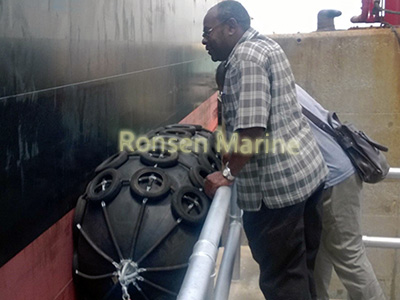
Pneumatic Rubber Fender
Choosing the wrong pneumatic rubber fender can lead to hull damage, berth structural failure, premature wear, and costly downtime. The right fender absorbs berthing energy safely, keeps reaction force within hull and quay limits, and performs reliably in tides, currents, and ship-to-ship operations.
This guide explains how to select pneumatic rubber fenders using vessel data, ISO 17357-1 standards, energy absorption, reaction force, initial pressure, fender type, and installation conditions.
What Is a Pneumatic Rubber Fender?
A pneumatic rubber fender—also called a Yokohama-type fender—is a floating, air-filled marine fender that uses compressed air to absorb impact energy during:
- Ship-to-quay berthing
- Ship-to-ship (STS) transfer
- Offshore terminal operations
- LNG, tanker, bulk carrier, container ship, and naval vessel berthing
Unlike solid rubber fenders, pneumatic fenders provide high energy absorption with low reaction force, which protects both the vessel hull and the berthing structure.
Why Pneumatic Fenders Are Specified by ISO 17357-1
When selecting pneumatic rubber fenders, do not specify only “diameter x length.” You must specify:
ISO 17357-1:2014 + nominal size + initial pressure + fender type + accessories
ISO 17357-1 defines:
- Guaranteed Energy Absorption (GEA)
- Reaction force at rated deflection
- Hull surface pressure
- Initial internal pressure: 50 kPa (P50) or 80 kPa (P80)
- Type I: chain-tire-net fender
- Type II: sling-type fender
- Marking, testing, safety valves, and tolerances
Step 1: Calculate Berthing Energy, Not Just Vessel Tonnes
The most common mistake is selecting fender size only from DWT.
Use the PIANC berthing energy formula:
E = 0.5 × Me × V² × Ce × Cm × Cs × Cc
Where:
- Me = effective vessel mass
- V = approach velocity
- Ce = eccentricity coefficient
- Cm = added mass coefficient
- Cs = softness coefficient
- Cc = configuration/berth coefficient
Then select a fender where:
GEA at 60% deflection ≥ Design Berthing Energy × safety factor
Typical safety factor: 1.1–1.25.
If you skip this step, a fender may look “big enough” but fail under real approach speed.
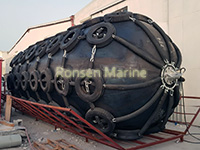
Pneumatic Rubber Fenders
Step 2: Understand GEA, Reaction Force, and Hull Pressure
For the same diameter and length:
| Parameter | What it matters |
| GEA | Guaranteed energy absorption |
| Reaction force (R) | Push-back on hull/quay |
| Hull pressure | Contact pressure on shell plating |
Example:
- 3300 × 6500 mm P50: ≈ 1814 kJ / 3015 kN
- 3300 × 6500 mm P80: ≈ 2532 kJ / 3961 kN
Same size, very different performance.
Step 3: Choose P50 (50 kPa) or P80 (80 kPa)
P50 — 50 kPa initial pressure
Best when hull or structure is sensitive.
Use for:
- Yachts
- Naval vessels
- Aluminum hulls
- LNG carriers
- Cruise ships
- Sensitive coatings
Advantages:
- Lower reaction force
- Lower hull pressure
- Safer for fragile structures
P80 — 80 kPa initial pressure
Best when berthing energy is high.
Use for:
- VLCCs
- Large tankers
- High approach velocity
- STS transfer
- Limited number of fenders
Advantages:
- Higher energy absorption
- More compact fleet possible
- Better for heavy commercial berthing
⚠️ Never inflate a P50-rated fender to 80 kPa. Cord angle, end ring, and safety factors differ.
Step 4: Select Fender Type—Net Type vs Sling Type
Type I — Chain-Tire-Net (CTN)
External protection made of chains + tires or rubber sleeves.
Best for:
- Permanent berths
- High-frequency ports
- STS oil/LNG transfer
- Rough weather
- Abrasive quay surfaces
Pros:
- Excellent abrasion resistance
- Long service life
- Withstands repeated heavy contact
Cons:
- Heavy
- Can mark sensitive hulls
- Slower to deploy
Type II — Sling Type
No chain-tire net. Lifting eyes/slings instead.
Best for:
- Yachts
- Naval ships
- Cruise vessels
- Temporary berthing
- Quick deployment
Pros:
- Lightweight
- Non-marking options
- Easy handling
Cons:
- Less abrasion protection
- Needs careful operation near sharp edges
Special option: Hydro-Pneumatic Fender
Part air, part water ballast.
Used for:
- Submarines
- Low-freeboard vessels
- Sub-surface hull contact
Step 5: Match Diameter and Length to Vessel Class
Rule of thumb:
- Diameter mainly affects reaction force and contact geometry
- Length mainly affects energy absorption
- Larger diameter = higher reaction force
- Longer fender = more energy absorption
Quick reference
| Vessel/operation | Typical size (D x L) |
| Small boat/workboat | 500 X 1000 to 1000 x 2000 mm |
| Fishing/patrol/tug | 1000 x 1500 to 1500 x 3000 mm |
| Feeder/ro-ro/coaster | 1500 x 3000 to 2000 x 3500mm |
| Panamax/bulk/container | 2500 x 4000 to 2500 x 5500 mm |
| Aframax/Suezmax | 3000 x 5000 to 3300 x 6500 mm |
| VLCC/LNG/STS | 3300 x 6500, 3300 x 10600, 4500 x 9000 mm |
Do not oversize diameter blindly—an excessively large fender increases the gap between ship and quay, making gangway and cargo transfer harder.
Step 6: Check Site Conditions
Select fenders based on the berth environment:
- Tidal range → pneumatic fenders float, so they suit large tides
- Wave height and current
- Berthing angle
- Quay roughness
- Hull coating sensitivity
- STS freeboard differential
- Frequency of vessel calls
- Risk of sharp edges, ice, oil, UV exposure
For angled berthing, add fenders or size up one class.
Step 7: Verify Supplier Quality Before Buying
Ask for:
- ISO 17357-1:2014 compliance
- Factory performance test report
- GEA and reaction force at 60% deflection
- Outer/inner rubber material test
- Cord reinforcement specification
- Initial pressure grade: 50 or 80 kPa
- Safety relief valve for Ø ≥ 2500 mm
- Proper body marking: standard, size, pressure, serial no., maker, year
- Classification approvals: ABS, DNV, BV, LR, CCS
- Spare valves, shackles, swivels, chains, slings
A cheap fender without test data is rarely the cheapest over 10 years.
Pneumatic vs Foam-Filled vs Solid Fender
| Type | Energy absorption | Reaction force | Maintenance |
| Pneumatic rubber | High | Low | Periodic pressure check |
| Foam-filled | High | Medium-high | Low |
| Solid rubber | Medium | High | Low |
Choose pneumatic when you need soft cushioning + floating + repairable + cost-effective.
Common Selection Mistakes
❌ Sizing only by DWT
❌ Ignoring reaction force
❌ Using P50 fender at P80 pressure
❌ Putting chain-net fenders on yacht/LNG hulls
❌ Forgetting safety valve on large fenders
❌ Buying on price instead of GEA + certification
❌ Ignoring freeboard differential in STS
Pneumatic Rubber Fender Selection Checklist
✅ Vessel displacement and approach velocity known
✅ Design berthing energy calculated
✅ GEA ≥ design energy × safety factor
✅ Reaction force within quay/hull limit
✅ Hull pressure acceptable
✅ P50 or P80 selected correctly
✅ Net / sling / hydro-pneumatic chosen
✅ Safety valve included if Ø ≥ 2500 mm
✅ ISO 17357-1 marking correct
✅ Test report + classification docs available
FAQ: How to Select Pneumatic Rubber Fenders
What size pneumatic fender do I need?
It depends on vessel displacement, approach speed, berth stiffness, and allowable hull pressure—not just DWT. Start from design berthing energy, then match ISO 17357 GEA.
Is 50 kPa or 80 kPa better?
50 kPa is softer and safer for sensitive hulls. 80 kPa absorbs more energy for large vessels and high-impact berthing.
Net type or sling type?
Net type for harsh, high-frequency commercial berthing. Sling type for yachts, naval, cruise, and quick-deploy operations.
Do pneumatic fenders work in large tides?
Yes. They are self-floating and follow water level changes.
What standard should pneumatic fenders meet?
Preferably ISO 17357-1:2014, with documented GEA, reaction force, hull pressure, and classification society verification.
Final Recommendation
To select pneumatic rubber fenders correctly:
- Calculate berthing energy
- Match GEA with safety margin
- Control reaction force and hull pressure
- Choose P50 or P80
- Choose net/sling/hydro-pneumatic by application
- Verify ISO 17357-1 compliance and test reports
If you send us vessel DWT, beam, approach speed, quay type, and hull material, we can return a sized fender schedule in 24 hours.
Need a pneumatic fender selection sheet? Share your vessel specs and berthing condition—get an ISO 17357-compliant recommendation.
