

How to Select the Right Foam Fenders: Marine Buyer’s Guide (PIANC WG211)
How to select the right foam fenders?
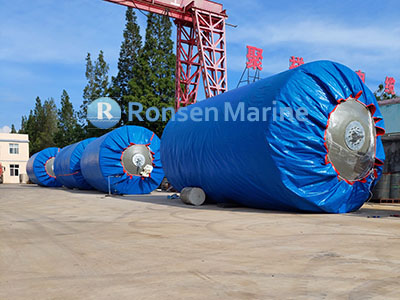
Foam Fenders
Start from berthing energy, hull-pressure limit, and site conditions—not diameter. Choose foam-filled fenders when maintenance access is limited, puncture/debris risk is high, tidal swing is large, or hull pressure limits are tight. Then match the fender type (netless / rope-net / chain-net), foam grade (STD / HC / EHC), diameter × length, skin system (PU/polyurea), and mounting arrangement to the design vessel.
Most buyers lose money because they ask:
“What size foam fender do I need?”
The better question is:
“What berthing energy, reaction force, and hull pressure must this fender control?”
Featured Snippet Answer
To select the right foam fenders, calculate effective berthing energy from vessel displacement and approach velocity, set the allowable hull pressure (PIANC WG211 often uses <200 kN/m²), then choose fender diameter, length, foam grade, and outer protection. Netless PU fenders suit cruise/yacht/STS; rope-net suits medium ports; chain-net suits bulk, container, and abrasive berths.
1. Foam Fender vs Pneumatic Fender: Choose the System First
Before sizing, confirm whether foam is even the right family.
| Factor | Foam-Filled Fender |
| Energy medium | Closed-cell EVA/PE foam |
| Punctured | Still floats, still works |
| Maintenance | No inflation/pressure checks |
| Tidal/free-floating | Excellent |
| Hull pressure | Grade-dependent |
| Capex | Higher |
Choose foam fenders when:
- maintenance access is poor
- debris, ice, or sharp hulls exist
- tidal range is large
- STS/offshore/unattended berths
- hull pressure limits are strict (LNG, naval, cruise)
2. The 6 Inputs That Actually Size a Foam Fender
PIANC WG211 says fender selection deserves the same attention as any marine structure.
① Vessel displacement / DWT
Bigger displacement = more kinetic energy.
Berthing energy basics:
E = ½ × M × V² × Cm × Ce × Cs × Cc
- M = vessel displacement
- V = approach/closure velocity
- Cm = added mass
- Ce = eccentricity
- Cs = softness
- Cc = berth configuration
② Approach velocity
A 10,000 DWT tanker at 0.2 m/s can generate ~140–180 kJ.
Small changes in velocity massively change energy (V²).
③ Allowable hull pressure
PIANC WG211 commonly references <200 kN/m² for many vessel types.
LNG/LPG/cruise/yacht hulls are stricter.
Larger fender diameter → larger contact area → lower hull pressure for the same reaction force.
④ Reaction force limit of the structure
The quay, dolphin, pile, or fender panel has a max load.
If reaction force (RF) is too high, the berth fails even if energy is absorbed.
⑤ Tidal range and freeboard
Foam fenders are great for free-floating units because they track water level.
If tidal swing > 4 m, foam often beats pneumatic for suspended/floating layouts.
⑥ Exposure and operating mode
- Sheltered port: simpler spec
- Exposed jetty: polyurea skin, stainless hardware
- STS: filament reinforcement mandatory
- High-cycle ferry: surface consistency matters
- Scrap/cement/bulk: chain-net sacrificial layer
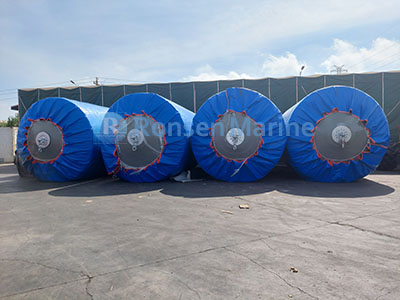
Foam Fender
3. Choose the Foam Fender Type by Outer Protection
This is where most buyers confuse themselves.
A. Netless / Skin-Only Foam Fender
- PU or polyurea skin only
- Smooth, non-marking options
- Lowest weight, easiest inspection
- Best for: cruise terminals, yachts, naval, STS, floating pontoons
Avoid in heavy-abrasion industrial berths.
B. Rope-Net Foam Fender
- Synthetic rope net instead of steel chain
- Softer than chain-net
- Medium abrasion resistance
- Best for: medium ports, passenger terminals, marinas
C. Chain-Net / Tyre-Net Foam Fender
- Steel chain + tyres as sacrificial layer
- Highest abrasion/puncture resistance
- Heavier, can mark soft hulls
- Best for: bulk terminals, coal/ore, container quays, tug berths, workboat docks
4. Choose the Foam Grade by Energy Demand
Foam-filled fenders are often graded by core density and energy absorption at 60% deflection:
| Grade | Meaning | Use |
| STD | Standard | Normal commercial berthing |
| HC | High capacity | Bulk carriers, larger tankers |
| EHC | Extra high capacity | VLCC, LNG, FSRU |
| SHC | Super high capacity | Extreme berthing energy |
HC grades commonly give 1.3×–1.5× STD energy absorption.
5. Choose Diameter and Length from the Performance Curve
Do not pick diameter from a photo.
Check the maker’s curve at 60% deflection:
- Energy Absorption (EA) in kJ / kN·m
- Reaction Force (RF) in kN
- Contact pressure / hull pressure
- Number of fenders and spacing
Example logic:
If design energy = 500 kJ and hull limit = 180 kN/m², one small fender may bottom out. You may need larger diameter, longer length, HC grade, or more units.
A 1000 × 1500 mm foam fender may be ~49 kJ at ~205 kN reaction at 60% deflection—useful as a sanity check, not a substitute for project calc.
6. Choose the Skin and Reinforcement
Foam core alone is not the product.
Proper stack:
- Closed-cell EVA/PE foam core — buoyancy + energy absorption
- Nylon/Kevlar filament layer — stops skin peel under shear
- PU or polyurea elastomer skin — UV, salt, oil, abrasion
- Optional net system — chain / rope / tyre
Spec tips:
- PU skin: 75–95 Shore A
- Polyurea: better for offshore UV/saltwater
- Non-marking skin: cruise/yacht
- Filament winding: STS and offshore
- Internal chain: hanging load, not energy absorption
7. Choose Mounting Arrangement
| Mounting | Best for |
| Vertically suspended from guay | Permanent berths |
| Free-floating between vessels | STS transfer |
| Pile-mounted donut | Turning dolphins, bridges, locks |
| Hull-mounted foam collar | Tugs, pilot boats, CTVs |
| Chain sling /swivel eye | General floating use |
Wrong mounting ruins even a perfect fender.
8. Application Shortcut
Permanent quay
STD/HC + netless or chain-net + PU skin
Container / bulk terminal
HC + chain-net + reinforced skin
LNG / FSRU
HC/EHC + polyurea + strict hull pressure check
Cruise / yacht
Netless + non-marking PU + low RF
Ferry / Ro-Ro
High-cycle netless or rope-net, consistent surface
Offshore / FPSO
Polyurea skin + filament reinforcement + stainless hardware
Tug / pilot / CTV
Hull-mounted foam collar or small portable foam fender
9. Specification Checklist Before You Request a Quote
Send this to the supplier instead of “quote foam fenders”:
- Design vessel: DWT / displacement
- Max approach velocity (m/s)
- Allowable hull pressure (kN/m²)
- Required EA (kJ) and RF (kN) at 60% deflection
- Diameter × length
- Foam grade: STD / HC / EHC / SHC
- Skin: PU / polyurea / non-marking
- Protection: netless / rope-net / chain-net
- Mounting: swivel eye / chain sling / pile / hull collar
- Tidal range and exposure
- Class society: DNV / ABS / BV / LR / CCS
- Standards: PIANC WG211, ASTM F2192, ASTM D2240
10. Common Mistakes
❌ Buying by diameter only
❌ Using netless fenders in scrap/bulk ports
❌ Ignoring reaction force on the quay
❌ Forgetting hull pressure for LNG/cruise
❌ Treating foam grade and pneumatic size as interchangeable
❌ No filament reinforcement for STS/offshore
❌ No class certificates on project tenders
FAQ
How do I know if I need foam fenders or pneumatic fenders?
If puncture risk, tidal swing, unattended operation, or long service life matter more than low capex → foam. If capex is tight and crews can maintain air pressure → pneumatic.
What is the most important number in foam fender selection?
Effective berthing energy. But you must also respect reaction force and hull pressure.
Which foam fender type is best for cruise terminals?
Netless PU/polyurea fender with non-marking skin and low reaction force.
Which foam fender type is best for bulk terminals?
Chain-net foam fender, HC grade, reinforced PU skin.
Do foam fenders need PIANC calculation?
For commercial ports and projects, yes. PIANC WG211 gives the berthing-energy, correction-factor, and hull-pressure methodology.
Conclusion
To select the right foam fenders, do not start with size.
Start with berthing energy → hull pressure → site condition → fender type → foam grade → skin system → mounting.
- Cruise/yacht/STS → netless foam
- Medium port → rope-net
- Bulk/container/heavy industrial → chain-net
- LNG/offshore → HC/EHC + polyurea + filament reinforcement
- Always verify EA, RF, and hull pressure at 60% deflection
If you can fill the specification checklist above, any serious manufacturer can engineer the right unit instead of guessing.
