

How to Use Ship Launching Airbags: A Step-by-Step Guide
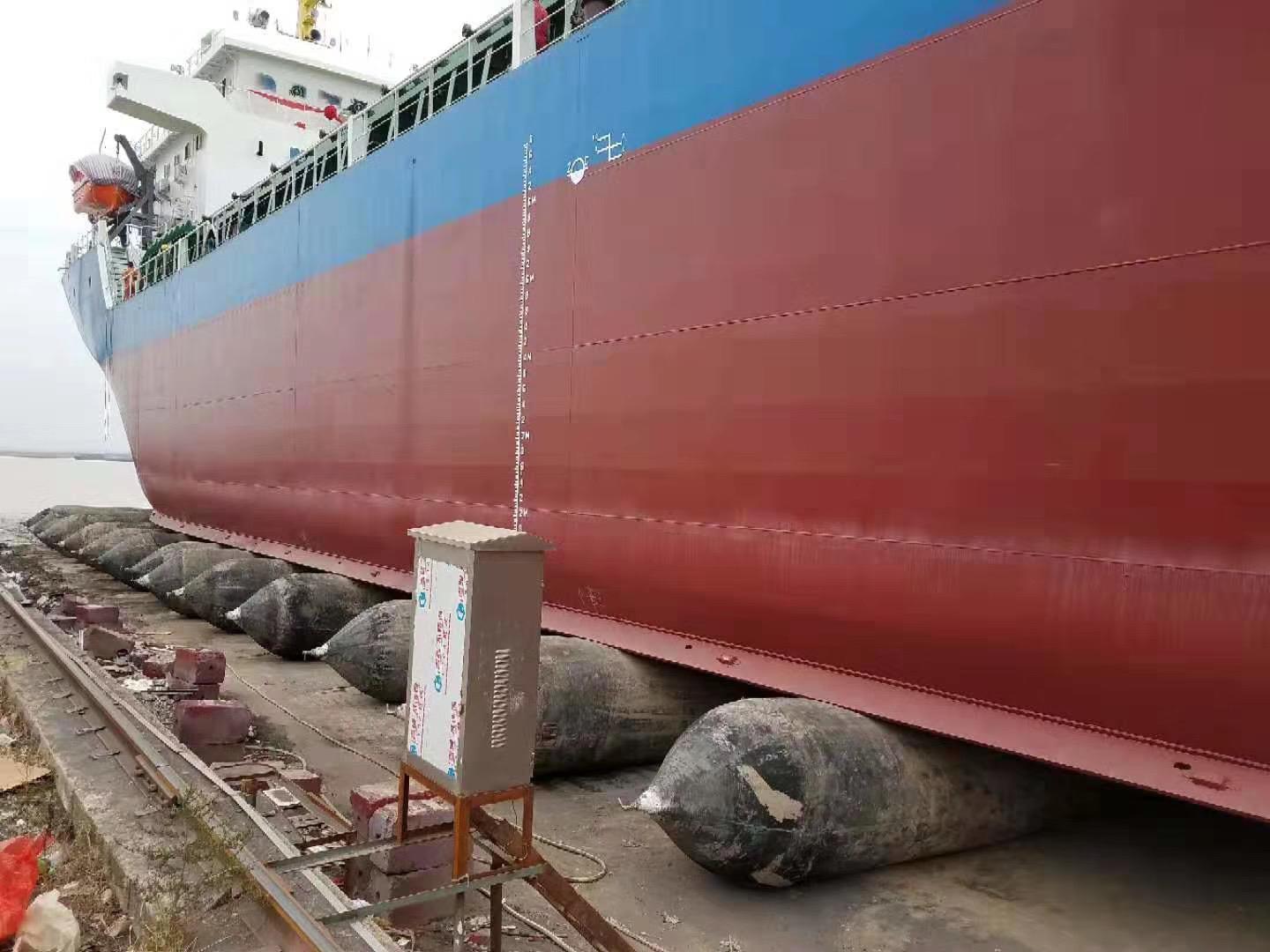
ship launching airbags under vessel hull on slipway
Direct answer (featured snippet target):
To use ship launching airbags, place deflated ISO 14409 marine rubber airbags transversely under the hull, inflate them to 0.05–0.20 MPa working pressure with calibrated compressors, remove keel blocks, then release holding winches to let the vessel roll down a 1:70–1:10 slope into water at 0.5–1 m/s. Always add a 30% load safety margin, never exceed rated pressure, and recover/deflate airbags after float-off.
Ship launching airbags—also called marine rubber airbags or pneumatic rollers—have replaced fixed concrete slipways in thousands of shipyards because they cut civil cost by 60–80% for vessels under 5,000 tons and reuse 80–200 cycles per bag.
What Are Ship Launching Airbags?
A ship launching airbag is a cylindrical, cord-reinforced rubber tube with tapered ends. It has three functional layers:
- Inner rubber layer – airtight, seawater-resistant
- Tire-cord reinforcement – nylon/polyester plies (4–12 layers) carrying hoop stress
- Outer rubber layer – abrasion-, UV-, and salt-resistant
Typical specs:
| Parameter | Common range |
| Diameter | 0.8-2.5 m (up to 3.0 m) |
| Effective length | 6-25 m |
| Working pressure | 0.05-0.20 MPa |
| Burst safety factor | >4.1 vs working pressure |
| Standard | ISO 14409:2011, ISO 17682:2013 |
A 1.5 m × 12 m, 6-ply bag supports roughly 100–150 t per linear meter at safe pressure.
When to Use Airbag Launching Instead of a Slipway
Use marine airbags when:
- Vessel is 20 t to ~10,000 t
- Yard has no permanent slipway or dry dock
- Launch site is a graded beach, compacted soil, or temporary ramp
- You want portable equipment that moves to repair sites
Avoid or engineer carefully if: wind > Beaufort 6, cross-slope error >50–80 mm, or water depth <1.5× draft.
Pre-Launch Preparation
1. Engineering Calculation
Calculate total vessel weight, LCG, and load per linear meter. Choose airbag diameter, ply count, and quantity with ≥30% capacity margin over static hull weight.
2. Site and Slipway Prep
- Slope 1:70 to 1:10 (1:10–1:20 most common)
- Remove nails, weld beads, stones, sharp debris
- Cross-slope error <80 mm (small craft) or <50 mm (large craft)
- Water depth ≥1.5× max draft at entry point
- Lay steel plates if surface is rough concrete/gravel
3. Airbag Inspection
- No cuts >50 mm, no cord exposure
- Inflate to 1.1× working pressure, hold 30 min, drop <5%
- Calibrated gauge + relief valve on compressor
- Certified within 12 months
4. Rigging
Set holding winches, ground anchors, wire ropes, pulleys, and recovery boat. Brief all crew on emergency stop.
Step-by-Step: How to Launch a Ship with Airbags
Step 1 – Position Deflated Airbags
Lay bags transverse to launch direction under the keel at calculated spacing (denser under midship). Center on hull centerline, no twisting.
Step 2 – Inflate and Lift Hull
Connect compressor. Inflate slowly to target working pressure (e.g. 0.08–0.12 MPa for mid-size bags). As bags expand, hull lifts off keel blocks. Remove all wooden/steel blocks only after hull is fully borne by airbags.
⚠️ Never exceed manufacturer rated working pressure. Burst occurs from overpressure, not from hull weight alone.
Step 3 – Level and Fine-Tune
Adjust individual bag pressure so hull is level within a few cm. Uneven pressure causes tilt, premature wear, or plate stress.
Step 4 – Controlled Rolling
Keep holding winch brake engaged. Ease brake so vessel rolls forward at 0.5–1 m/s (6–13 m/min). Use guide ropes for yaw. Airbags rotate under keel like conveyor rollers—rolling friction is far lower than sliding ways.
Step 5 – Water Entry
As stern enters water, buoyancy progressively sheds load from rear bags. In narrow channels keep winch tension; in open water release final hold-back wire at engineered moment.
Step 6 – Deflate, Recover, Store
Drop pressure below 0.03 MPa before disconnecting hoses. Recover bags by boat, rinse with fresh water, dry, powder, and store cool/dark. Inspect hull for leaks.
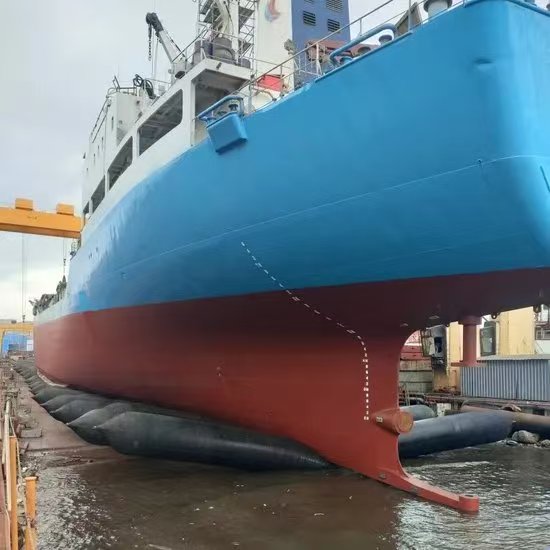
marine airbags
Safety Rules That Prevent 90% of Failures
- No personnel inside launch zone
- Helmets, life jackets, anti-slip boots mandatory
- Wind > Beaufort 6 = stop
- Relief valve on every compressor
- Pressure gauge visible to controller at all times
- Emergency-stop drill before inflation
Common Mistakes
- Under-specifying plies → burst under dynamic load
- Too-wide bag spacing → hull plate overstress
- Sharp slipway → punctures outer rubber
- No pressure-hold test → silent leak during launch
- Overinflation for “faster lift” → cord failure
FAQ
How many times can ship launching airbags be reused?
80–200 cycles with proper rinse/dry/storage; inspect after every 10 launches.
Can airbags launch a 10,000-ton ship?
Yes, with enough bags, correct ply count, and engineered spacing—not with one or two bags.
What pressure do marine rubber airbags use?
Typically 0.05–0.20 MPa depending on diameter and ply; always below rated working pressure.
Are launching airbags the same as pneumatic fenders?
No. Fenders absorb impact energy; launching airbags carry quasi-static hull weight and roll. Different cord angle, standard, and end fitting.
