

What Are Floating Pneumatic Rubber Fenders?

Floatng Pneumatic Rubber Fenders
Floating pneumatic rubber fenders are air-filled, reinforced-rubber cylindrical buffers that rest on the water surface and absorb berthing impact energy between ship-to-ship (STS) or ship-to-dock (STD) contacts. Also called Yokohama fenders, they follow ISO 17357-1:2014, run at 50 kPa (P50) or 80 kPa (P80) initial pressure, and come in net type, sling type, and hydro-pneumatic configurations.
Why “Floating” Matters
Unlike fixed cell/cone fenders, the compressed-air core gives them self-buoyancy—they rise and fall with tide, track vessel roll/pitch, and need no adjustable brackets. That is why the phrase floating pneumatic rubber fender is not decorative: it is the structural differentiator from solid and foam-filled fenders.
How a Floating Pneumatic Rubber Fender Works (Air-Spring Principle)
- Vessel contacts the fender at the waterline.
- Reinforced rubber body deforms; internal air pressure rises uniformly.
- Kinetic energy converts to air compression + elastic cord-layer strain (up to ~70% absorbed).
- Reaction force stays low and stable → hull pressure within class-society limits.
- At 60% deflection (ISO 17357 test point) GEA/R are read from the curve.
- Load removed → air re-expands, fender recovers shape.
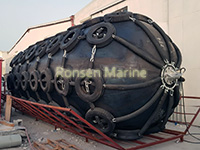
Floating Yokohama Pneumatic Rubber Fenders
Internal Structure: 4 Layers (ISO 17357-1)
- Outer rubber: abrasion, UV, seawater, ozone resistance
- Synthetic tire-cord layer: angled nylon/polyester, burst-proof skeleton
- Inner rubber: air-tight sealing membrane
- End flanges + safety relief valve: inflation, pressure control, auto over-pressure release (mandatory ≥ Ø2500 mm)
Types of Floating Pneumatic Rubbers Fenders
Type I – Net Type (Chain-Tire-Net / Wire / Fibre)
ISO 17357 Type I. Chain + used tires (or rubber sleeves) wrap the body. Best for heavy STS, tankers, LNG, permanent berths. Highest abrasion life.
Type II – Sling Type
No hard net; thick outer rubber + integral slings/lifting eyes. Lighter, non-marking options for yachts/naval/cruise. Quick deploy, lower abrasion resistance.
Hydro-Pneumatic (Subclass)
Part air, part water ballast (~60–70% water) for submerged low-freeboard contact—submarines, special low-hull-pressure ops.
P50 vs P80: Same Size, Different Performance
| Initial pressure | Reaction force | Energy absorption | Typical use |
| 50 kPa (P50) | Lower | Lower | LNG, aluminium hulls, yacht, navy |
| 80 kPa (P80) | Higher | ~35-40%, more than P50 | VLCC STS, high approach speed, limited fender count |
Never inflate a P50 body to 80 kPa—cord angle and end-ring safety factor differ.
ISO 17357-1:2014 Standard Sizes (Reference)
Range Ø500×L1000 mm to Ø4500×L12000 mm. Example GEA at 60% deflection:
- 2500×5500 mm P50: 943 kJ / 2019 kN
- 3300×6500 mm P50: 1814 kJ / 3015 kN
- 3300×6500 mm P80: 2532 kJ / 3961 kN
(GEA = Guaranteed Energy Absorption, R = Reaction Force; tolerance ±10%)
How to Select the Right Fender
- Compute berthing energy E = ½ Mₑ V² Cₑ C_m C_s C_c (PIANC method)
- Set allowable hull pressure + berth reaction limit
- Match GEA at 60% deflection ≥ computed E
- Pick P50/P80 by hull sensitivity
- Pick net/sling by abrasion + marking risk
- Verify ISO 17357-1 cert, relief valve, marking (ISO part, size, pressure, serial)
Installation & Maintenance Basics
- Inflate with dry air/nitrogen to rated pressure
- Test safety relief valve before deployment
- Monthly pressure check (sun heats +10–15%)
- Inspect cuts >1 cm, exposed cord, net corrosion
- Store deflated, shaded, away from ozone sources
- Service life 10–15 yrs with correct care
FAQ (People Also Ask – AEO block)
Are floating pneumatic rubber fenders the same as Yokohama fenders?
Yes. “Yokohama” is the legacy brand name (Yokohama Rubber Co., 1950s); technically both are floating pneumatic rubber fenders. Spec buyers on ISO 17357, not the brand.
Do floating pneumatic fenders work in high tide ranges?
Yes—self-floating is the whole point; they track tide without mechanical adjustment.
Net type or sling type for LNG STS?
LNG/clean hulls → sling type or non-marking grey net; high-frequency crude STS → chain-tire net.
