

What Is UHMW-PE Facing Fender Pad?
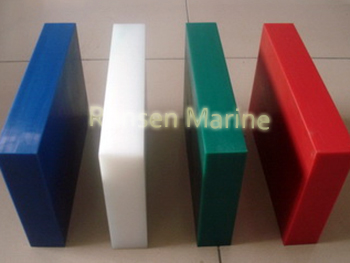
UHMW-PE facing fender pad
A UHMW-PE facing fender pad (Ultra-High Molecular Weight Polyethylene facing fender pad) is a thick, machined plastic sheet fixed to the front face of steel fender panels, rubber fenders, lock walls, bridge buttresses, and jetty structures. It acts as the low-friction, wear-resistant contact layer between a vessel hull and the berthing structure.
Unlike timber, rubber, or steel facings, a UHMW-PE fender facing fender pad does not rot, rust, splinter, or stick. Its molecular weight typically ranges from 3 to 9 million g/mol, giving it a unique mix of self-lubrication, impact absorption, and saltwater immunity.
In plain terms: when a ship rubs against a quay, the UHMW-PE pad lets the hull slide instead of scrape—protecting both the boat and the dock.
Why “Facing Fender Pad” and Not Just “Plastic Sheet”?
- Facing = it is the exposed surface that takes the hit.
- Pad = it is a discrete, bolt-on module (not the whole fender).
- UHMW-PE = the polymer grade, not standard HDPE or PP.
Common synonyms Google indexes together:
UHMWPE fender face pad, UHMW PE fender liner, marine fender facing board, UHMW-PE rub strip, dock bumper facing, wharf fender panel pad.
Key Properties of UHMW-PE Facing Fender Pads
| Property | Typical Value | Why it matters for Fendering |
| Molecular weight | 3-9 million g/mol | Chain length = toughness + wear life |
| Density | 0.93-0.96g/cm3 | 1/7 weight of steel, easy to lift |
| Dynamic friction coeff. | 0.08-0.22 | Hull glides, shear force drops |
| Tensile strength | >22-24 MPa | Resists hot pull-out and tearing |
| Notched impact (Charpy) | >100-150kJ/m2 | Survives 30k-ton berthing hits |
| Water absorption | <0.01% | No swelling in seawater |
| Temp range | -200°C to +80 °C | Arctic ports to tropical sun |
| UV/salt/chemical | Stable | 15+ yr service life reported |
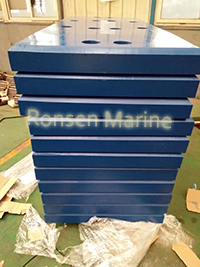
UHMW-PE fender pad
Where Are UHMW-PE Facing Fender Pads Used?
- Wharf & jetty fender panels – bolted to Super Cell, Cone, V, D, and Arch fenders.
- Lock gates & canal walls – mitre protection, rub strips, entrance guards.
- Bridge buttress protection – absorbs tug and barge impact.
- Offshore platforms & dolphins – survive wave fatigue and UV.
- Shipyard dry docks – protect hull from steel frames.
- Workboat beltings & slipways – low-friction launch surfaces.
UHMW-PE Facing Fender Pad vs Rubber / Steel / Timber
| Facing Type | Friction | Wear Life | Rot/Rust? | Hull Damage | Maintenance |
| UHMW-PE pad | Very low | 15-30 yrs | No | Low | Bolt replace only |
| Rubber face | Medium | 5-8 yrs | No (but ages) | Medium | Full fender swap |
| Steel plate | High | 10-15 yrs | Rusts | High | Paint + weld |
| Timber | High | 2-4 yrs | Rotts | Splinters | Frequent change |
Source data consolidated from marine fender suppliers.
Installation Basics
- Substrate: clean, flat steel panel (SS316 bolts from rear).
- Hole pattern: countersunk or recessed slots, CNC-drilled to match panel.
- Thermal gap: leave side clearance—UHMW-PE expands ~0.02% per °C.
- Thickness: 20–100 mm typical; 6–150 mm customizable.
- Colors: black standard; blue/yellow/red for visibility.
FAQ (add FAQPage schema for rich results)
Q: What does UHMW-PE stand for?
A: Ultra-High Molecular Weight Polyethylene, a polyethylene with chain weight above 1.5 million g/mol, usually 3–9 million in marine pads.
Q: Is UHMW-PE facing fender pad better than HDPE?
A: Yes for fendering. UHMW-PE has far higher impact strength, abrasion resistance, and low friction than HDPE.
Q: Can UHMW-PE pads be used in cold climates?
A: Yes. They stay tough down to -60 °C to -200 °C depending on grade, with no brittle cracking.
Q: How long does a UHMW-PE fender facing last?
A: Field data shows 15+ years in seawater; rubber fenders alone last 5–8 years, so pads extend system life 2–3×.
Q: Are UHMW-PE facing fender pads recyclable?
A: Yes, 100% recyclable, non-toxic, IMO-compliant, no heavy metal leach.
Buyer’s Mini-Checklist (capture transactional intent)
When sourcing a UHMW-PE facing fender pad, ask for:
- Virgin marine-grade resin (not recycled filler)
- Molecular weight cert (3M+)
- Friction coeff. test (ASTM D1894)
- UV stabiliser confirmation
- CNC hole template drawing
- ISO 9001 / REACH / RoHS or SGS/DNV report
