

Pneumatic vs Foam Fenders: Which Marine Fender Actually Fits Your Berth (2026 Guide)
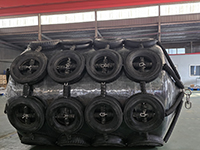
Foam Fenders
Choosing between pneumatic and foam-filled fenders is not a spec-sheet footnote—it decides how much downtime, puncture repair, and hull-pressure risk your port, yard, or offshore project absorbs over the next 10 years. Both are “marine fenders,” but they behave nothing alike under cyclic wave load, STS impact, or permanent pile mooring.
This guide breaks down the real-world difference, when each type fails, and how we at Ronsen Marine specify them for clients running ports, OSV fleets, and yacht pontoons.
What Is a Pneumatic Fender?
A pneumatic fender is an inflatable, compressed-air marine fender built from reinforced rubber-nylon plies (Yokohama-type). Impact energy is absorbed by air compression, giving a low reaction force / high energy absorption curve that is friendly to lightweight hulls.
Core traits
- Air-filled, needs inflation pressure checks (typically 50–80 kPa)
- Linear load-deflection, excellent under cyclic (wave) conditions—air doesn’t creep
- Lightweight, easy to relocate, popular for STS (ship-to-ship) and temporary berths
- Puncture = loss of performance; needs spare units and patrol inspection
Ronsen’s pneumatic rubber fender line follows ISO 17357-1S/2S geometry for STS and quay use.
What Is a Foam-Filled Fender?
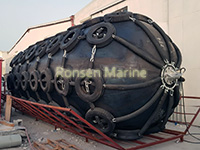
Pneumatic Fenders
A foam fender has a closed-cell EVA/PE foam core wrapped in polyurea/PU skin with nylon reinforcement—no air, no inflation. Energy is absorbed by foam compression.
Core traits
- Unsinkable, zero puncture risk, zero pressure maintenance
- Higher abrasion/UV/oil resistance via polyurea skin—good for high-traffic docks
- Heavier, higher upfront cost, but near-zero lifecycle service
- Foam slowly recovers after compression; under permanent cyclic load it can creep, so it’s better as floating/offshore than fixed permanent pile fender
Ronsen builds netless sling type, cushion netted (chain+tire), donut pile fenders, and suitcase pendant foam buoys for offshore mooring.
Pneumatic vs Foam Fenders: Side-by-Side
| Dimension | Pneumatic Fender | Foam-Filled Fender |
| Energy absorption | High, air-linear | High, foam-nonlinear |
| Reaction force on hull | Low | Low-moderate |
| Maintenance | Inflation + leak patrol | Near zero |
| Puncture risk | Yes | None |
| Cyclic wave performance | Excellent (deflate/move) | Risk of creep if permanently loaded |
| Portability | Lower | Medium (heavy) |
| Upfront cost | Mid (repairs/spares) | Higher |
| 10-yr ownership cost | STS, temp berth, big ships | Low |
| Best for | Offshore, piles, yachts, dirty docks |
When to Pick Pneumatic
- Ship-to-ship transfer where fenders move between vessels daily
- Large tankers/bulk carriers needing low hull pressure at high energy
- Temporary project berths (dam construction, salvage) where you deflate and redeploy
- Budget-sensitive first buy with crew available for weekly pressure checks
When to Pick Foam-Filled
- Offshore platforms, windfarm SOVs, OSV side fendering—no one wants a midnight puncture
- Pile/donut applications with tidal rise-fall and turning dolphins
- Yacht marinas and barge fleets where “maintenance-free” beats “cheap”
- High-abrasion environments (tire nets, construction barges, rock dumping)
Rule of thumb: pneumatic wins on cyclic permanence + portability; foam wins on abuse tolerance + zero maintenance.
Common Spec Mistakes Buyers Make
- Sizing by diameter only—ignore energy/reaction curve vs hull panel strength.
- Using foam fenders as fixed permanent fenders under constant swell (creep risk).
- Running pneumatic fenders with no spare—one puncture halts berthing.
- Ignoring skin chemistry: polyurea > old PU for oil + UV zones.
FAQ
Are foam fenders better than pneumatic?
Not universally. Foam is better for maintenance-free offshore/pile use; pneumatic is better for cyclic STS and portable deployment.
Do foam fenders sink if damaged?
No. Closed-cell EVA/PE core stays buoyant even if skin is cut—unlike pneumatic, which deflates.
Can pneumatic fenders be used permanently?
Yes, but only with scheduled pressure checks and spare inventory; air fatigue is not the issue—rubber-nylon body wear and punctures are.
Which is cheaper long term?
Foam usually wins TCO over 8–10 yrs because no puncture repair, no spares rotation, no labor patrol.
Does Ronsen make both types?
Yes—pneumatic rubber fenders (ISO Yokohama type) and foam-filled fenders (netless, netted, donut, shipboard portable). See Ronsen foam fenders and pneumatic range.
