

How Do Marine Airbags Work?
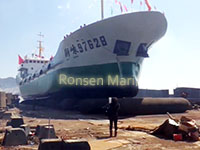
Marine Airbags
A marine airbag works by inflating a cord-reinforced rubber cylinder with compressed air to lift a vessel off its keel blocks, then acting as a giant roller that carries the ship’s weight on its curved surface while the hull glides down a slipway into the water. The ship’s static weight is balanced by internal air pressure (typically 0.05–0.20 MPa working pressure); the synthetic tire-cord layers stop the rubber from bursting; and the cylindrical shape turns linear motion into smooth rolling contact.
Also called ship launching airbags or rubber roller bags, they are governed by ISO 14409:2011 (construction/testing) and ISO 17682:2013 (launch methodology)—and they are not pneumatic fenders, even though both are air-filled rubber.
What Is a Marine (Ship Launching) Airbag?

Ship Launching Airbags
A marine airbag is a heavy-duty, inflatable, cylindrical device with tapered/conical ends, placed perpendicular or longitudinal under a hull to support and roll vessels. Typical specs:
- Diameter: 0.8–3.0 m (most common 1.0–2.5 m)
- Effective length: 6–25 m
- Cord plies: 4–12 layers
- Working pressure: 0.05–0.20 MPa (varies with Ø and ply count)
- Burst safety factor: ≥ 4:1 vs working pressure (leading makers ≥ 5:1)
- Standards: ISO 14409:2011, ISO 17682:2013; class endorsements CCS/ABS/BV/DNV/LR
The 3-Layer Composite Structure
Same family as a pneumatic fender, but optimized for rolling contact and static load, not impact EA.
LayerMaterialFunctionInner rubberNR/SBR/IIR airtight blendSeals compressed air, resists fatigueCord reinforcementCrisscrossed nylon/polyester tire cord (2- or 3-strand), RFL-bondedCarries hoop stress from internal pressure, prevents burstOuter rubberAbrasion-/UV-/salt-resistant NR compoundProtects cords on rough slipways, low-friction rolling surface
End fittings: steel flange + ball valve + pressure gauge + safety relief valve. The cord angle and ply count decide the max working pressure, not the outer rubber thickness.
The Working Principle, Step by Step
- Place deflated bags – laid longitudinally (end-launch) or transverse (side-launch) under the hull between keel blocks, spaced so unsupported hull span stays within plate/keel stress limits.
- Inflate to working pressure – compressor fills bags to 0.08–0.12 MPa (mid-size). Internal pressure × contact footprint lifts the hull off the blocks.
Lift height ≈ pressure-based squash; e.g. a 1.5 m Ø bag at 0.10 MPa supports ~12 t/m line load.
- Remove keel blocks – hull now rests entirely on the airbags’ top arc. Load is distributed continuously, no hard chocks.
- Release holding winch – gravity (on 1:70 to 1:20 slope) or tug/winch pulls the ship. The bags rotate under the keel like conveyor rollers, so the hull rolls instead of slides. Rolling friction is far lower than greased wooden ways.
- Stern picks up buoyancy – as the aft enters water, hydrostatic lift takes over part of the weight; forward bags shed load progressively.
- Deflate and recover – bags roll out, get deflated, rinsed, powdered, and stored for the next cycle (6–15 yr service life).
The physics in one line
Static equilibrium: vessel weight per unit length ≤ internal pressure × contact width × safety factor, with cord plies setting the pressure ceiling. No kinetic-energy integral like a fender—this is a quasi-static load path, not an impact curve.
Why Cord Ply Count Matters More Than Diameter
A 2.0 m Ø bag at 4 plies might cap at 0.07 MPa; the same Ø at 8 plies runs 0.13–0.15 MPa. Doubling plies roughly doubles allowable pressure (hence line load), which is how yards launch 5,000 t+ hulls without giant diameters.
Selection math (simplified):
- Total launch weight − buoyancy gain = weight on bags
- Bags needed = total weight on bags ÷ (working pressure × contact width × safety margin)
- Then check hull span between bags against plate/keel bending limits—this, not bag capacity, is usually the real constraint.
Marine Airbag vs Pneumatic Fender (The Confusion Google Sees)
AspectMarine launching airbagPneumatic rubber fenderStandardISO 14409 / ISO 17682ISO 17357-1Primary jobLift + roll vessel (static/dead load)Absorb berthing kinetic energyLoad typeQuasi-static hull weightDynamic impact, 60% deflection EAShapeCylinder + conical ends, valve at endCylinder + hemispherical ends, swivel eyesPressure0.05–0.20 MPa working50 kPa (P50) / 80 kPa (P80) initialFailure modeBurst under sustained overloadPuncture/deflation under impactUse caseSlipway launch, haul-out, heavy moveQuay/STS cushioning
Using one for the other is unsafe—different reinforcement geometry, different end fittings, different cert.
Where Marine Airbags Are Used
- New-build launching (fishing boat → 100,000 DWT bulk carrier cases on record)
- Ship haul-out / dry-docking at bare beaches
- Heavy hull section moving in yard
- Salvage lifting (salvage-grade variants, higher buoyancy/weight ratio)
- Bridge girder / caisson relocation (civil spin-off)
Safety Non-Negotiables
- Pressure-hold test per ISO 14409: ≤5% drop in 1 h at rated pressure
- Relief valve mandatory on larger bags
- Slipway cleared of sharp objects; ground bearing checked
- Cycle log kept; retire on cord fatigue or outer rubber through-wear
Never exceed 4:1 working/burst margin in calc
FAQ
How does a marine airbag support a ship’s weight?
Compressed air inside the bag pushes outward; the cord-reinforced rubber converts that pressure into a vertical reaction force on the hull contact patch. Pressure × contact area = supported load.
Is a marine airbag the same as a pneumatic fender?
No. Airbags lift and roll dead weight under ISO 14409; pneumatic fenders absorb impact energy under ISO 17357. Different shape, cord angle, end fittings, and safety philosophy.
What pressure do ship launching airbags use?
Typically 0.05–0.20 MPa working, depending on diameter and ply count (e.g. 1.5 m Ø / 6-ply ≈ 0.13 MPa; 1.0 m Ø / 4-ply ≈ 0.13 MPa). Burst pressure is ≥4× working.
Can airbags sink a ship if they burst?
A burst under a hull drops local support and can cause hull grounding or keel overstress—not sinking from the bag itself. That is why multi-bag layouts and 4:1 margins are used: one bag failing does not collapse the launch.
How many airbags do I need?
Divide (vessel launch weight − buoyancy gain) by per-bag line load at your working pressure, then space bags so the unsupported hull span stays within class-approved bending limits. Suppliers turn LOA/beam/weight/slope into a calc sheet.
Do airbags work on flat ground?
They need a slope (as low as 1:70 in favorable cases, typically 1:30–1:20) or external winch/tug pull. Truly flat ground with no pull = no launch motion.
