

How Do Foam Fenders Work?
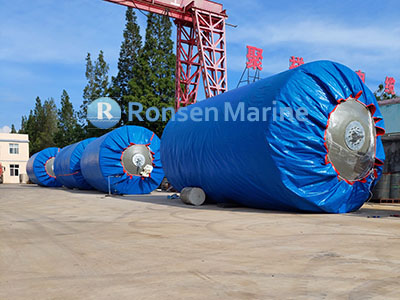
Foam Fenders
A foam fender works by converting a ship’s kinetic berthing energy into reversible compression of a closed-cell foam core wrapped in a tough elastomer skin. There is no compressed air inside—so the fender cannot deflate, keeps floating after skin damage, and needs no pressure maintenance.
When a vessel presses against it, the closed-cell EVA or polyethylene foam compresses (typically rated to 60% deflection), the reaction force rises progressively, and the hull slows down. Once the vessel moves away, the foam rebounds elastically and is ready for the next impact.
That is the whole mechanism in one paragraph.
The 3-Layer Structure of a Foam-Filled Fender
Every foam fender (also called foam-filled fender or floating foam fender) uses the same functional stack:
1. Closed-Cell Foam Core
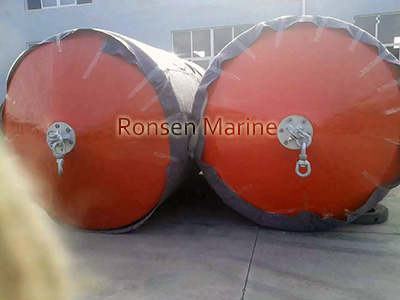
Foam Fender
Made of cross-linked PE or EVA foam, thermally laminated into one solid body. Each cell is sealed independently.
- Absorbs energy by cell compression + polymer shear
- Water cannot enter even if the skin is cut
- Density (~58–70 kg/m³) sets the energy/reaction balance
2. Filament Reinforcement Layer
A helical nylon or Kevlar cord layer sits between foam and skin to stop the coating from peeling under repeated shear—critical for STS and offshore use.
3. Polyurethane / Polyurea Elastomer Skin
Sprayed seamless outer shell (Shore A 75–95, tear >52 N/mm, −40 °C to +60 °C).
- Resists UV, saltwater, oil, abrasion
- Optional non-marking grade for cruise/yacht hulls
Internal swivel eyes or a center tension chain take the hanging load; the foam itself only takes compression.
The Energy Absorption Mechanism (Physics)
A berthing ship arrives with kinetic energy:
E = \frac{1}{2}mv^2
The fender dissipates that energy in four steps:
- Hull contacts fender → local pressure rises
- Closed-cell foam cells compress and shear
- Micro gas pockets in cells add pneumatic-like cushioning without air chambers
- Vessel decelerates; energy is stored elastically, then released as the foam rebounds to ≥90% of original diameter within 24 h
Unlike a pneumatic fender, performance does not drift with temperature or altitude, because there is no gas law involved—only foam modulus and geometry.
Foam Fender vs Pneumatic Fender
FactorFoam-Filled FenderPneumatic (Yokohama) FenderEnergy mediumClosed-cell foam compressionCompressed air (50/80 kPa)Punctured skinStill floats, still worksDeflates, loses functionMaintenanceNone (no inflation)Periodic pressure checksReaction forceModerate–high (grade-dependent)Very lowTemp sensitivityLowNoticeableBest usePermanent berths, offshore, STS, unattended sitesTemporary STS, variable hull curvesInitial costHigherLower
Source synthesis:
Why “Unsinkable” Is Literally True
In a pneumatic fender, one valve or skin failure = total pressure loss.
In a foam fender, the buoyant medium is the solid foam itself. Cut the skin, and each closed cell stays dry and buoyant. The unit keeps cushioning until you patch or re-skin it.
That is why naval bases, LNG terminals, FPSO boat landings, and remote jetties specify foam-filled units.
Where Foam Fenders Are Used
- Quay and jetty berthing (vertical hung, chain sling)
- Ship-to-ship transfer (LNG, crude, product tankers)
- Offshore platforms, SPM buoys, FPSO boat landings
- Ro-Ro ferries, cruise terminals (non-marking skin)
- Floating drydock faces and lock entrances
Sizing Note (So It Actually Works)
Selection is not by vessel length. You need:
- Displacement and approach velocity
- Allowable hull pressure (PIANC WG-211: usually <200 kN/m²)
- Design energy per PIANC/ASTM F2192
- EA and RF at 60% deflection from the maker’s curve
Example: a 1000 × 1500 mm foam fender is commonly ~49 kJ absorption at ~205 kN reaction at 60% deflection—then you check that RF against your hull and dolphin limit.
FAQ
How does a foam fender absorb energy without air?
It compresses a closed-cell foam core; the polymer matrix and sealed cells store elastic energy, so no internal air pressure is needed.
Do foam fenders bounce a ship back?
They rebound elastically (≥90% diameter recovery in 24 h), but with less liveliness than pneumatic fenders—better for fixed structures, less ideal for high-angle STS roll.
What happens if a foam fender is punctured?
Nothing catastrophic: the skin can be patched, the core stays buoyant, and the fender keeps working until repaired.
Are foam fenders better than pneumatic fenders?
For unattended, debris-heavy, or offshore sites—yes. For temporary STS with strict low reaction force—pneumatic is often better.
How long do foam fenders last?
Quality PU/polyurea-skin units run 10–20 years; cores can be re-skinned to extend life.
